“The Single Most Important Function of Marriage”

It might not be what you think. From Stephanie Coontz’ book Marriage, a History: How Love Conquered Marriage (p. 31): 

“Probably the single most important function of marriage through most of history, although it is almost completely eclipsed today, was its role in establishing cooperative relationships between families and communities.” 

A few pages later, she adds that marriage has historically fulfilled a variety of functions in different societies, so much so that it’s hard to pin down exactly what marriage is. These functions also occur in different combinations, which could alternatively be performed by other institutions. The exception, according to Coontz, is not reproduction or even love, but the extended ties created through in-laws. Here is the whole quote:

Continue reading

Erotic Laundry Lists

As I continue to read up on the evolution of human mating, a theme that keeps recurring is how complex people are in what they want from their erotic pursuits. Many books, journal articles, and even popular magazines compile lists about the physical features we consider attractive, the traits we look for in a mate, etc. In those lists, we can find patterns, but none can ever be perfect because we are complex, individually and culturally variable, and always in flux, trying to balance an array of wants and needs that shift over time along with our circumstances. No single variable will ever be sufficient to explain what people want. Sometimes it’s Arthur Miller; sometimes it’s Joe DiMaggio.

Marilyn Monroe

Here is a sample of the complexity, in list form:

Continue reading

Evelyn’s Story

Recently, we attended a going-away party for some friends who are moving to Europe. One of the guests arrived a bit late, along with her husband and daughter. She also brought her 83-year old mother, Evelyn [1], who was the chronological outlier among the crowd of 30 to 50 year-olds and their kids. As the children played and the younger adults socialized I made eye contact with Evelyn, who was standing alone. She smiled back in that kindly, typical grandmotherly way, so I introduced myself. We made small talk and she mentioned how she had recently sold the house that she had lived in for more than thirty years, and how much she loved her new apartment and her granddaughter, and other things grandmothers like to talk about.

From her slight accent, it was obvious that she was born elsewhere. Eventually she revealed that she grew up on a farm in eastern Canada, in one of the maritime provinces, and that’s where our conversation took off.

Continue reading

Mythic War

From Chris Hedges:

“Lawrence LeShan in The Psychology of War differentiates between “mythic reality” and “sensory reality” in wartime. In sensory reality we see events for what they are. Most of those who are thrust into combat soon find it impossible to maintain the mythic perception of war. They would not survive if they did. Wars that lose their mythic stature for the public, such as Korea or Vietnam, are doomed to failure, for war is exposed for what it is– organized murder.

But in mythic war we imbue events with meanings they do not have. We see defeats as signposts on the road to ultimate victory. We demonize the enemy so that our opponent is no longer human. We view ourselves, our people, as the embodiment of absolute goodness. Our enemies invert our view of the world to justify their own cruelty. In most mythic wars this is the case. Each side reduces the other to objects – eventually in the form of corpses.

for the lie in war is almost always the lie of omission. The blunders and senseless slaughter by our generals, the execution of prisoners and innocents, and the horror of wounds are rarely disclosed, at least during a mythic war, to the public. Only when the myth is punctured, as it eventually was in Vietnam, does the press begin to report in a sensory rather than a mythic manner. But even then it is it reacting to a public that has changed its perception of war.” 


― Chris Hedges (2002) War Is a Force That Gives Us Meaning (p. 21-22)

.

Check Your Ego

Neil de Grasse Tyson on the cosmic perspective:

“I assert that if you are depressed after being exposed to the cosmic perspective, you started your day with an unjustifiably large ego.”

Existence itself is awe-inspiring enough.

.

Part 12. Humans Are Blank-ogamous. Jankowiak’s Tripartite Conundrum

This is part 12 of a series on the evolution of human mating behavior. Please see the introduction here.

This video is a lecture by the cultural anthropologist William Jankowiak speaking at my alma mater, Binghamton University, on what he calls the “tripartite conundrum” between romantic love, companion love, and sexual desire. I think he has several insights, but realize that the lecture is lengthy.  If you can’t listen to it in its entirety, here is the heart of the matter:

Continue reading

Part 11. Humans Are Blank-ogamous. Sexaptation: The Many Functions of Sex

This is part 11 of a series on the evolution of human mating behavior. Please see the introduction here. P.s. Does anybody actually read of all this?

____________________________________________________________________

“When the gods gave people sex, say the !Kung, they gave us a wonderful thing. Sex is often referred to as food: just as people cannot survive without eating… hunger for sex can cause people to die.” (Shostak 2000: 237) 

“sex can be many things to many people, including but not limited to a blend of personalities, social rules, desire, intimacy and performance, moral order and national image that speak to processes of sexual embodiment, varieties of sexual practice and the dynamics of culture.” (Donnan and Magowan, 2010: 175)

E unum, pluribus. (Out of one, many).

 

Penis Festival

Genital-themed ashtrays from the Komaki Penis Festival in Japan. For humans, sex is more complex than just getting genitals together. (globalpost.com).

Last month, representatives in Montana debated whether to repeal an old law that made homosexual sex illegal in that state (the law was in fact overturned). Apart from the fact that private, consensual sexual behavior is still considered a matter to be legislated, there were other interesting developments from the discussion. A representative named Dave Hagstrom raised a deep question when he asked: “What is the purpose of sex?” I appreciate Hagstrom’s line of inquiry, as we could probably use more reflection on human sexuality. Unfortunately his own answer did not live up to the profundity of the question: 

“To me, sex is primarily purposed to produce people. That’s why we’re all here. Sex that doesn’t produce people is deviate. That doesn’t mean it’s a problem, it just means it’s not doing its primary purpose.”

Continue reading

Heck Yeah, Humans!

Here’s a  reprieve from the bombardment of bad news and encroaching cynicism. Thank you, Russians and your dash-cams.

.

Related: Optimism and Human Nature

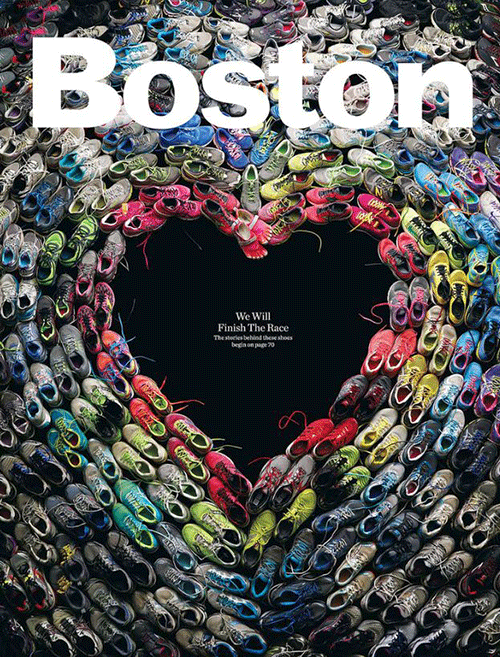
Forgiveness in Boston

Boston-Magazine Shoes http://www.bostonmagazine.com/news/blog/2013/04/25/behind-our-may-boston-marathon-cover/

Cover of ‘Boston Magazine,’ by Mitch Feinberg

Less than a week after the Boston Marathon bombings, which left 3 people dead and over 280 injured, Cardinal Sean O’Malley emphasized the importance of forgiveness during Mass at the Cathedral of the Holy Cross. According to the Boston Globe, Cardinal O’Malley gave the congregation  two reasons to consider forgiveness. The first was  to avoid the “eye for an eye, tooth for a tooth mentality.” In that way, forgiveness offered a potential means to avoid further hostilities between groups. In fact, local tensions seemed to be simmeringO’Malley was likely cognizant of this, hoping to help defuse things before they progressed any further.  

Continue reading

Patriots’ Day

No more hurting people. (Martin Richard).

No more hurting people. (Martin Richard).

I’m at a loss as to how to properly address yesterday’s tragedy here in Boston, on Patriots’ Day. Following the attacks at the marathon and a nearby scare for our neighbors at the JFK Library, our university was closed yesterday afternoon and for most of the day today as a precaution. I’ve been wondering how, as teachers, we’ll get back to normal so soon after the event. Do we ignore it, and go on as if nothing happened, or address it head on? I don’t know, and will probably make some gut decision during tomorrow’s morning commute.

Continue reading