The Lie and the Myth

I’ve liked this for a long time. That is all.

“For the great enemy of the truth is very often not the lie—deliberate, contrived, and dishonest—but the myth—persistent, persuasive, and unrealistic. Too often, we hold fast to the clichés of our forebears. We subject all facts to a prefabricated set of interpretations. We enjoy the comfort of opinion without the discomfort of thought.”

.

.

Part 10: Humans are (Blank)-ogamous: Wondrously Complex Paleo-Sex

This is the tenth(!) part on the evolution of human mating behavior, comparing evidence for promiscuity and pair-bonding in our species. Please see the Introduction here.

_______________________________________________________________


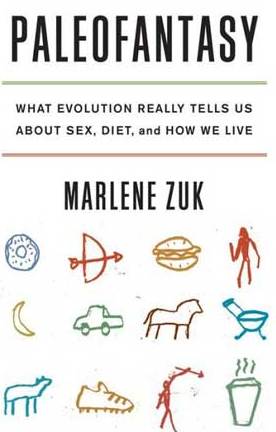
In her new book “Paleofantasy,” Marlene Zuk (2013) takes on the notion that our diet, exercise, and mating Zuk Paleofantasypatterns are out of synch with our evolutionary biology. Some have argued that we have modified our environments too quickly for our own good, leading to the position that we would be better off if we could return to the days of old, before the modern world messed things up. There is probably some truth to this argument (an example I use in classes is that in only a few seconds, inserting $1.00 into a vending machine could return you over 400 empty calories bereft of other nutrients, a scenario our ancestors never encountered). But Zuk counters that the idea that we are stuck with hunter-gatherer bodies and minds in a modern world is overly simplistic.

Zuk notes that attempts to find health and happiness by returning to our idyllic, ancestral past (i.e., paleofantasies) face a few challenges. Among these are:

1. The methodological difficulties in determining exactly how our ancestors lived.
2. The variation among human groups across time and geography.
3. The idea that we were ever fully (perfectly?) adapted to our environment.
4. The fact that evolution does not stop; we are not ‘stuck’ evolutionarily in time.


 In sum, she writes:

Continue reading

A Child’s Wisdom

Today, my son  told me he had figured out how to never make a mistake again. His solution: just never try or do anything anymore. He said it with a smile, but I think he half wishes this was an option. Unfortunately, he seems to have inherited a personality quirk (defect?) from me, which is that we are both incredibly good at self-flagellation when we make mistakes.

To cite a minor example, sometimes I’ll dwell for a couple of days on a student’s question that I couldn’t answer in class. Or if I forget somebody’s name who I am definitely supposed to know, I will swear at myself under my breath far too many times, more than most people would. And those are just minor examples. It can be a problem, one that I wish I hadn’t passed along. Dammit (see?).

To reassure my son, he is actually on the same wavelength as Alain de Botton, one of the better known modern  philosophers out there. And he’s not even 10 yet. Good for him.

de Botton

Continue reading

The Goodall Fallout

Goodall with Flint as an infant

Goodall with Flint as an infant

I use the above photo in many of my classes. It paints an iconic scene of a young Jane Goodall in 1964 reaching out to the infant Flint. From there, I often elaborate on the number of years Goodall invested in her work and life into studying and advocating for chimpanzees, and for nature more generally.  

By now, most people have heard that Goodall’s new (co-authored) book “Seeds of Hope” contains not only several lifted passages, but fabricated interviews and poor research. Here is one particularly harsh but even-handed review, which notes that the criticism of Goodall has been muted because of who she is and her long track record as a gentle ambassador of primatology. 

Continue reading

KIPP Students Rock!

…as does their teacher, Ms. Bertrand. 

I just got a nice package in the mail today, full of seventy or so “thank you” notes for my visit to the three 8th grade classes at KIPP Lynn last week. I appreciate it, guys.

What really makes me smile are the notes that mention how students had their curiosity piqued or that they explored some idea further on their own.  That alone is worth the visit. Learning isn’t limited to school. It never stops, and the world is yours to explore.

Continue reading

On Marriage Equality

I wrote this about a year ago: Human Nature, Humility, and Homosexuality, and thought it was worth putting it up again today, given the Supreme Court cases on Marriage Equality being heard today and tomorrow.    

Earlier this month, Lech Walesa, former President of Poland and a Nobel Peace Prize winner, said that: “They (homosexuals) have to know that they are a minority and adjust to smaller things, and not rise to the greatest heights. A minority should not impose itself on the majority.” Walesa is not American and his ideas are not relevant to the Supreme Court hearings. But his words elicit two thoughts: first, a Nobel Peace Prize does not confer immunity against illogical bigotry (who knew?). Second,  it exposes the fallacy in the argument that human rights are dependent on numbers, and that those in the minority should ‘stay in their place.’ 

I have an old, dog-eared and annotated book of quotations from M.K. Gandhi that my wife gave me about 17 years ago. I still look through it from time to time. Among the quotes, one seems appropriate here: 

“I do not believe in the doctrine of the greatest good of the greatest number. It means in its nakedness that in order to achieve the supposed good of 51 per cent the interest of 49 per cent may be, or rather, should be sacrificed. It is a heartless doctrine and has done harm to humanity. The only real, dignified, human doctrine is the greatest good of all.”
.
.

More Public Outreach

For the third consecutive year, I went back to the Knowledge is Power Program (KIPP) school in Lynn, Massachusetts to share a little biological anthropology with some 8th graders again. They have a beautiful new building, and I’m even more impressed by their students. The first class starts at 7:25am, and they were really bright young minds who asked lots of questions.  I was a little burnt out by the third class, but the students really kept me on my toes. The three hours actually flew by.

Their teacher, Ms. Bertrand, even had the class present me with an Honor Roll t-shirt. Do I have any ganas? Yup.

Related: Public Outreach 3: Sharing Anthropology with 8th Graders.

Tradeoffs, Happiness, & the Biology of Our Cacophonous Selves

You can’t have everything. Where would you put it?” – Steven Wright  (comedian)

 It seemed like a good idea at the time.” – S.A. (neuroscientist, friend)

 .

 .

Lately, I keep seeing a recurrent theme in a number of widely different sources. It’s a concept taught in Economics 101, that of tradeoff and opportunity costs – money or time invested in one object or activity cannot be spent on another. A related concept, foundational to biology, is life history theory (LHT). In his book “Patterns of Human Growth,” the biological anthropologist Barry Bogin defined LHT as:

the study of the strategy an organism uses to allocate its energy toward growth, maintenance, reproduction, raising offspring to independence, and avoiding death. For a mammal, it is the strategy of when to be born, when to be weaned, how many and what types of pre-reproductive stages to pass through, when to reproduce, and when to die.” (1999: 154)

life

you could be a winner at the game of life

Continue reading

Survival, Reproduction, and Play

This is a stirring video of a young gorilla in an Atlanta zoo, having a blast in a pile of leaves. After all, evolution is about survival and reproduction. And play.

Chris Lynn and Daniel Lende left me some comments on post a while back (Nature, Not Always Red in Tooth and Claw) that made me think about something similar — the ‘living’ part of life. So much of biology focuses (rightly) on survival, adaptation, and passing along genes to offspring.  

But for long-living species like ourselves, there is a LOT of time to spend responding to life’s challenges, before, during, and after making it to the age of reproduction. All those moments surely count for something, and they’re probably better spent when they are pleasurable, when we can find meaning and happiness, and when our relationships with those around us are cooperative rather than antagonistic.

It seems that evolution has gotten us to the point where we can, as Daniel put it, “grow and prosper” in whatever ways are significant or pleasurable to us, so that we can enjoy the living part of life.

.

Meta Mike Little

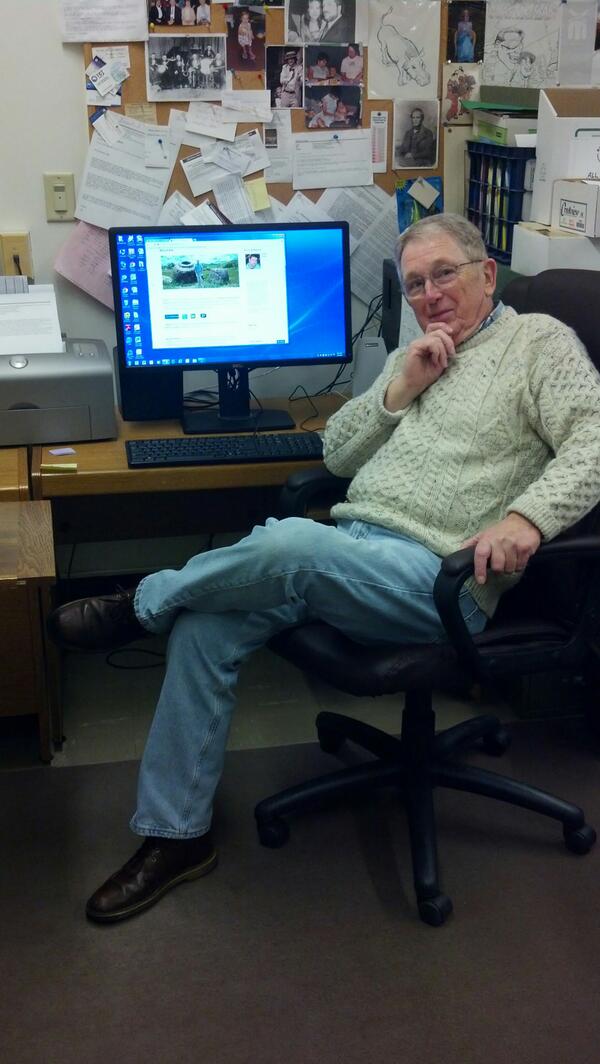
Someone at Binghamton sent me this photo today. It’s my advisor from graduate school, Mike Little, reading this blog. This made me smile.

Mike, if you’re reading this, thanks for everything. I hope seeing this isn’t too meta.

Mike and me.

.