Thorin: “Farewell, good thief. I wish to part in friendship, and would take back my words at the Gate.”
Bilbo: “There are many words I would take back also.”
Thorin: “And does it take this to make us see each other?…. I was wrong. You did understand war. It was I who did not, until now.”
Bilbo: “Farewell, King under the Mountain!”
Thorin: “Child of the kindly West, I have come to know, if more of us valued your ways: food and cheer above hoarded gold, it would be a merrier world. But sad or merry, I must leave it now. Farewell!”
“(This is) a lecture on the mingling and merging and therefore on the oneness and unity of all the races of mankind...Let no Irishman throw a stone at the foreigner; he may hit his own clansman. Let no foreigner revile the Irish; he may be vilifying his own stock.”
– James Connolly, 1908
.
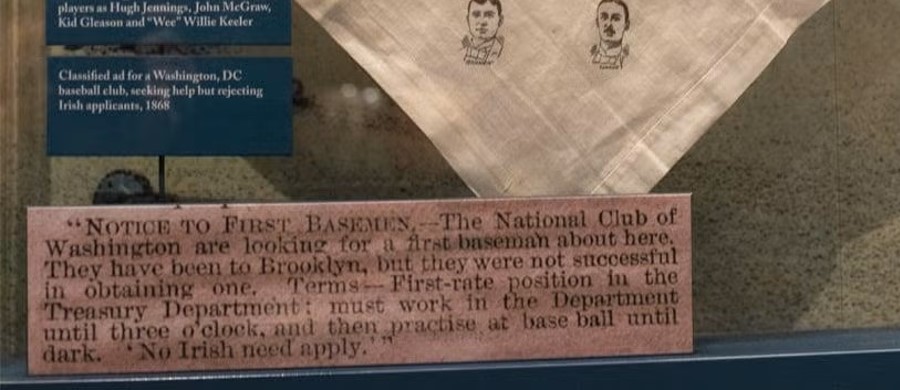
Years ago, on a trip to the Baseball Hall of Fame in idyllic Cooperstown New York, my father called me over to see something he found in the next exhibit. He pointed me to an 1860s job advertisement for a baseball club in Washington D.C. searching for top players, while also promising them a government job, a “first-rate position” in the Treasury Department (so much for meritocracy). The ad concluded with the disclaimer: “No Irish need apply.”
It wasn’t for lack of ability. The historian Jerrold Casway (2006: page X) referred to the late 19th century as “the Emerald Age of Baseball,” with Irish Americans becoming “baseball’s dominant ethnic group” and eventually making up as much as 40% of major league rosters. Casway noted that the game provided “a shortcut to the American Dream” for the sons of Irish immigrants, mere decades after the Great Famine. These would include early stars and Hall of Famers (often with colorful nicknames) such as Ed Delahanty, “Pud” Galvin, “Orator Jim” O’Rourke, and Mike “King” Kelly.[1]
But this isn’t an essay about 19th century baseball, as tempting as that topic might be to me (only me?), as an aficionado of the beautiful game that has marked the time.[2] Nor is it about discrimination against Irish immigrants being unique (it categorically was not). Rather, it’s about striking nativist parallels seen in the United States today, particularly against so-called “Third World” immigrants. And I suppose for that reason it’s also about empathy, and decency. In many ways the species of nativism seen today is even more pernicious than yesteryear in ideology and its effect on actual human lives, and deaths in the streets and in custody. And, I think lamentably, such nativistic thought is often exhibited by people whose ancestors faced similar discrimination, of which many seem to have forgotten.[3]
Summary: (1) Previous research shows that an immigration raid in Iowa in 2008 was associated with lower birth weight. (2) This was true of infants born to both foreign-born and US-born Latina women, suggesting this association centered around fear of being racially profiled, not merely immigration status. (3) Low birth weight is correlated with a range of health issues, including chronic diseases in middle age. (4) The scale of immigration raids today is much larger than 2008, affecting a wider segment of the population, increasing collateral damage among citizens. (5) One survey found that roughly 1 in 4 U.S. adults worry about deportation, with higher rates among immigrants and US born, second-generation citizens. This constitutes tens of millions of Americans, including an unspecified number of women of reproductive age. (6) In addition to human rights abuses, harsh deportation policies will likely lead to prenatal stress, impaired early development, and extensive long-term costs to public health.
“And you can see, you can hear, you could feel the fear, the intimidation. You could feel the terror.”
– Los Angeles resident Elizabeth Castillo, referring to local ICE raids (source)
.
In 2017, Nicole Novak and colleagues looked at the effects of a major government raid against suspected undocumented, primarily Hispanic, migrant workers in Postville Iowa (Novak et al 2017). In May of 2008, nine hundred ICE agents, along with a Black Hawk helicopter, raided a meat-processing plant in Postville, resulting in the arrests of nearly 400 workers. After a five-month prison sentence, 297 people were eventually deported. However, even those who were not deported (or even arrested) were affected.
If you ever get close to a human And human behavior Be ready, be ready to get confused … They’re terribly, terribly, terribly moody … And there is no map And a compass wouldn’t help at all (Bjork, Human Behaviour , 1993)
.
This semester I tried something new in my undergraduate class on anthropology and war. Briefly, the class has two parts: in the first half of the semester we explore cooperation, conflict, and war from an anthropological perspective. In the second half, we look at various ways that wars affect health and become embodied, or get “under the skin.”
When writing the syllabus back in early January, I thought about delving deeper into what’s going on in people’s minds when they feel violence is warranted, a topic I’ve written about before:
determining when violence (lethal and non-lethal) is morally justifiable can be a gray zone, with people positioning themselves on a continuum between completely nonviolent “doves” to hyper-aggressive “hawks.” While many people hold nonviolence as an ideal; living up to that ideal perfectly has proven difficult to almost impossible. The question is where people draw their line.
.
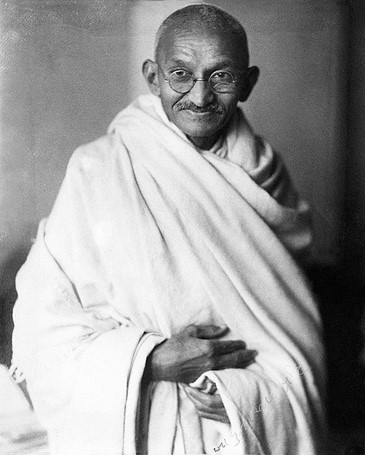
For the class exercise, I gave students a survey. On a scale of 0 to 100, I asked them to rate how justifiable it would be to use violence under 28 different scenarios. For a bit more background, I picked some scenarios that were hypothetical (ex. Gandhi’s famous example of using violence to “dispatch” a man in the act of committing mass murder with a sword), while others were based on real-world events. I did not tell students which scenarios were hypothetical or not ahead of time, but did so after compiling results, which they then discussed in groups. A few scenarios involved variations on a theme to find where people drew their lines. Some scenarios were about the behavior of other people, while others were about how students themselves might respond. And some involved lethal violence, others sub-lethal, and still others pertained to threats of violence (therefore, the numeric results aren’t all directly comparable).
Last week, Elon Musk wrote that “USAID is/was a radical-left political psy op,” as a partial explanation for his desire to close the organization. I am not an expert on the entire history of USAID (United States Agency for International Development), but I do know a little something about one particular episode in its past that contradicts Musk’s claim.
Long ago, I wrote my dissertation about some of the long-term health impacts of the civil wars in Laos from the 1950s-70s. That required interviewing and assessing Laotian refugees. It also meant delving into different subjects, including the biology of what was then called the “fetal origins hypothesis,” today commonly known as the DOHaD idea. It also meant plunging into the history of the wars and how the civilian population fared. I found the history fascinating, involving a revolving door of royalists, communists, and “neutralists,” featuring Laotians themselves, but against a backdrop of French colonialism, Japanese occupation, and later intervention by Vietnam, Thailand, and of course the United States.
“When there is a storm, and you stand in front of a tree, if you look at its branches, you swear it will fall. But if you watch the trunk, you will see its stability.”
Demagogue /n./ ˈdem’ə gäg’ : a leader who makes use of popular prejudices and false claims and promises in order to gain power.
“Blessed are the ‘shithole countries,’ for they gave us the American Dream.” – Paul Hewson
.
In the past month, much of the political discourse in the U.S. revolved around fearmongering by Donald Trump and his vice-presidential candidate J.D. Vance against immigrants, specifically Haitian immigrants in Ohio. After Trump repeated baseless rumors about Haitians stealing (and eating) people’s cats and dogs in Springfield, that town was subjected to at least 33 bomb threats, including schools, government buildings, and local colleges, according to Ohio Governor Mike DeWine (a Republican, if that matters to you).
While the bomb threats turned out to be empty, they were nonetheless highly disruptive, with hospitals put on lockdown, City Hall and schools evacuated, and universities forced to hold classes remotely. DeWine revealed that there was evidence that some of the threats originated overseas, likely in an attempt to create a bit of chaos in the U.S. Yet, other threats were local and not so empty. Haitians in Springfield have had property vandalized and reported feeling anxious and afraid for their lives. Haitian-American media outlets have also been threatened. And even a white business owner in Springfield (a Republican who voted twice for Trump) has had his life and those of his family threatened after he defended his Haitian employees. The fallout for ordinary people has been very real, stemming largely from Trump’s and Vance’s incitement.
Together with my brilliant colleagues Delaney Glass (UToronto) and Meredith Reiches (UMass Boston), we recently published our article “Coming of age in war: Early life adversity, age at menarche, and mental health” in the journal Psychoneuroendocrinology.
This was a special issue on forced migration and physiology, guest edited by Lee Gettler (Notre Dame) and Jelena Jankovic-Rankovic (University of South Carolina), and I think we probably compiled one of the most comprehensive reviews to date about armed conflict and menarche (first menstruation).
There are a couple of hypotheses about how child and adolescent bodies respond to early stressors: one is that bodies should mature quicker in times of uncertainty to increase one’s chances of reaching reproductive maturity. (The literature suggests that this does seem to happen under certain circumstances and types of stressors). The other is that maturation would be delayed, possibly due to energetic constraints.
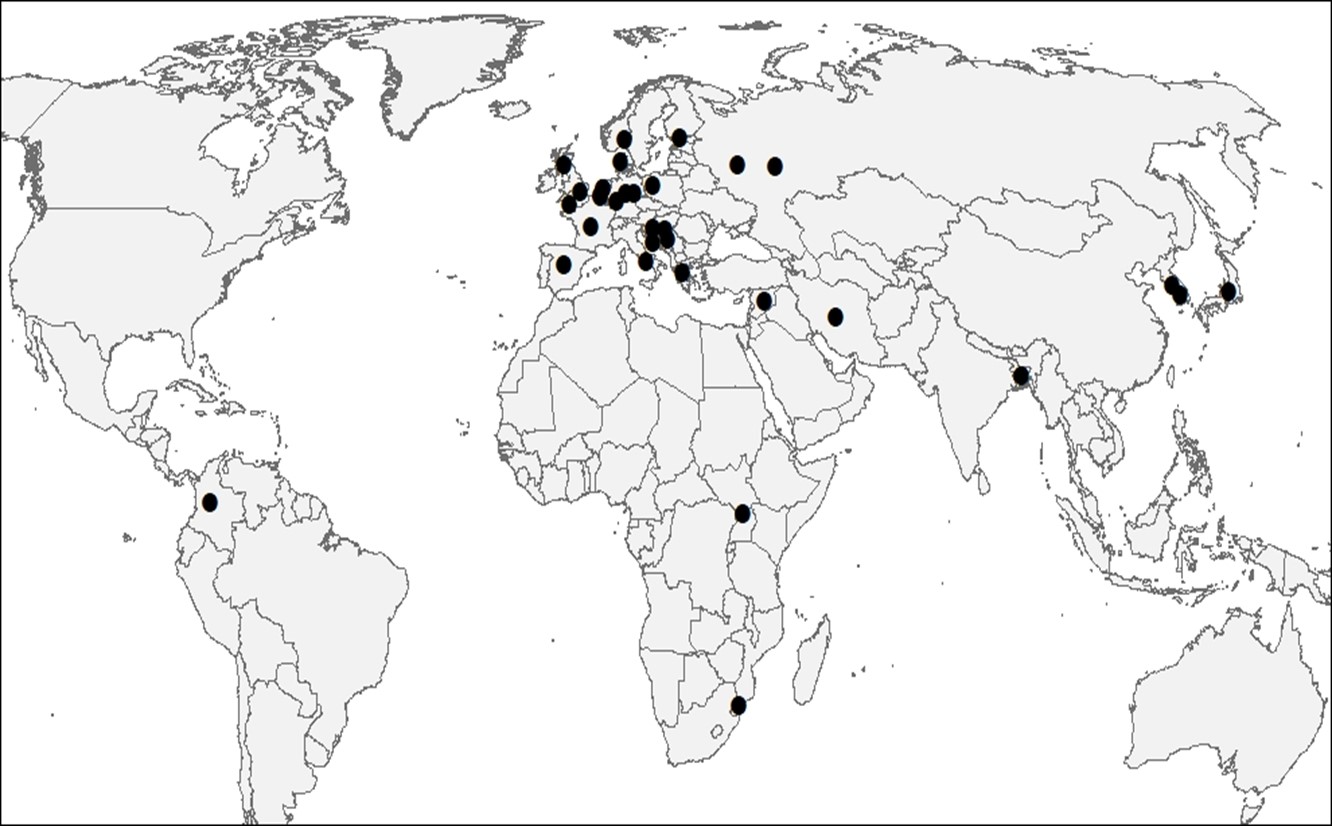
We identified 36 samples from 29 studies in the literature that looked at armed conflict and menarche, with a range of methods and populations from around the globe. Here’s some of what we found…
Locations of samples on conflict and menarche we identified from the literature.
In graduate school, my advisor Mike Little recommended I take a class outside of the Anthropology Department, since our class offerings were slim that semester. He suggested I go over to Biology and sign up for David Murrish’s class “The Biology of Extreme Environments,” which explored how different species adapted to their worlds. Dr. Murrish kindly accepted me. On the first day of class, before getting into any subject matter, he asked the students for examples of extreme environments.
People suggested some of the ones you’re probably thinking of—deserts because of their heat, polar regions, the deep oceans, etc. I recall one student suggested outer space. I raised my hand and asked, “What about war?” Dr. Murrish smiled and said with a chuckle, “You anthropologists… always looking at the social side of things!”
Of course, biological anthropologists recognize that there is a natural world to which species adapt, which existed long before humans ever evolved roughly 300,000 years ago (Hublin et al 2017). Not everything about human biology can be attributed solely to “the social side of things.” In Mike Little’s classes we learned about his research with Quechua people in highland Peru and Turkana pastoralists in northwestern Kenya, and they how they adapted biologically to stressors in their respective environments: hypoxia, cold, aridity, seasonal rainfall (Leslie and Little, 1999; Little et al., 2013). But Dr. Murrish’s question that day made me think about other types of extreme environments that we create for ourselves, and war certainly applies.
I didn’t get to explore war much further that semester, but the idea percolated. A couple of years later for my dissertation, I eventually explored how the Second Indochina War impacted the growth and body composition of Hmong refugees living in the US and French Guiana (Clarkin 2008). From there I thought about war as an environment in a general sense, including the various stressors they can create and the ways these things leave a mark on human biology and get “under the skin,” particularly among the very young who are still growing.
After seeing a flurry of recent examples (early August 2024), I decided to start a running tally of people calling for, or alluding to, a coming civil war in the U.S.
I first wrote about this topic five years ago with the essay “Red States versus Blue States: Who Would Win a Civil War in the U.S?”Unfortunately, it is the most read thing on this site, by far. That isn’t because the essay is brilliant (really, I think I can do better). Instead, I think it’s because some Americans are anxious or even eager about the prospect of widespread political violence. The essay happens to show up in Internet search results, which brings people here.
The upshot of the essay was that we should reframe the question away from who would “win” a war. By deriving lessons from wars around the world, the one thing that we can be absolutely certain of is that a second civil war here would be devastating for everyone. Whatever resentments people feel – and we all have them – it is an understatement to say that war and political violence are not only unethical, but stupid and impractical, and something best avoided.
For that reason, it is highly irresponsible for politicians, authority figures, and celebrities to encourage the idea or throw it around recklessly. I think we need to confront the fact that people keep vocalizing this fantasy because there is an established pattern that dangerous speechand incitement like this can lead to actual violence. I’ll keep adding to the list as new examples arise. There will likely be more to follow. I may even go back in time to dig up older examples, though I know that will be an exhausting task.
.
●June 15, 2024 Steve Bannon asked a conservative crowd “Are we at war?,” adding “Are you prepared to leave it all on the battlefield in 2024? It’s very simple: victory or death!”
●July 3, 2024 Referring to plans to overhaul the federal government, The Heritage Foundation President Kevin Roberts said “we are in the process of the second American Revolution, which will remain bloodless if the left allows it to be.”
The co-founder of the Global Project Against Hate and Extremism, Heidi Beirich, said Roberts’ comments were “a bit terrifying but also elucidating.”
●July 22, 2024 At a political rally in Middletown Ohio, state Senator George Lang said civil war would be necessary if Donald Trump loses the election in November:
“I believe wholeheartedly Donald Trump and Butler County’s J.D. Vance are the last chance to save our country politically. I’m afraid if we lose this one, it’s going to take a civil war to save the country, and it will be saved. It’s the greatest experiment in the history of mankind.”
●August 5, 2024 (Honorable mention, UK version) Self-proclaimed expert on everything, Elon Musk wrote on X/Twitter that “civil war is inevitable” in the UK, following widespread rightwing riots. Prime Minister Keir Starmerreplied that there was “no justification” Musk’s comments.
●August 6, 2024 Actor Jon Voight stopped chewing on his pencil long enough to post a video on X/Twitter titled “Civil War”
“This is the war of our lifetime now. We the people are in trouble if this nation picks Kamala Harris. We must stop this crime that is happening. It’s a war crime that Obama’s directing and Kamala Harris will be the cackling hyena that just listens and repeats.”