Since yesterday was Valentine’s Day….
https://kevishere.com/category/love/


We’ve gotten a lot of snow over the past week in our area, so after I got home from work this afternoon, I shoveled snow for my older neighbor down the street. As soon as I started, I heard someone yelling, trying to get my attention. It was yet another neighbor, an older woman I’d never met before, and she was unable to get her car up the steep, icy incline in her driveway.
She asked for my help, and detecting an accent, I asked where she was born. “Budapest,” she smiled. “If I had four-wheel drive, I could make it, but all I have is this shitty Kia. This driveway is terrible. When I bought this house, it was in September; if I had known how terrible it would be in the winter, I wouldn’t buy it. And I can’t leave the car here. It will slide back into the street. I also have a bad hip so it is hard for me to walk on the snow.” I chuckled at her forwardness and colorful language, especially for an older woman I just met.
I did my best to clear the driveway, chipping at the ice with a garden spade, and scattering some salt, but it didn’t work. She would attempt the climb, and then slide back down again. After several tries, she asked me to drive her car. I backed up into another neighbor’s driveway across the street to build as much momentum as possible, and it worked.
“There have been four sorts of ages in the world’s history. There have been ages when everybody thought they knew everything, ages when nobody thought they knew anything, ages when clever people thought they knew much and stupid people thought they knew little, and ages when stupid people thought they knew much and clever people thought they knew little. The first sort of age is one of stability, the second of slow decay, the third of progress, and the fourth of disaster.” – Bertrand Russell, Mortals and Others (1931: 106)
“Spare me the true believer.” – my father
.
I recently found the below essay, “A Message to the 21st Century,” written by Isaiah Berlin. Apparently, he wrote it in 1994 after he was given an honorary doctorate degree by the University of Toronto. The heart of the essay is a warning against fanaticism, a reminder of the need to be aware of our own limitations, and the wisdom of the unavoidable need for compromise. We all have values that we hold more dearly than others, but they inevitably clash. Berlin advocated, wisely, that we seek balance among our values (freedom and equality, for example), rather than championing one exclusively above all others.
As Bertrand Russell cautioned, disaster is most likely to occur when we are overconfident in our convictions, particularly when those convictions have little merit. It seems to me that the solution is to retain some humility, no matter how much we think we know (rather than being limited to the people Russell would categorize as ‘stupid.’)
I’ve pasted parts of Berlin’s essay below, boldfacing some of the parts that resonated with me. I recommend reading it in its entirety.
“There are men who will kill and maim with a tranquil conscience under the influence of the words and writings of some of those who are certain that they know perfection can be reached.
A friend asked if I’d consider writing something on human nature for the evolution-themed website This View of Life, which was just published today. I really struggled with it and kept putting it down and picking it back up again because it seemed like well-worn territory and I wasn’t sure if I was saying anything new. Anyway, I came up with an essay I first titled “Conflict, Cooperation, and Complex Apes” (the complex apes being us, of course). This was changed to “Genocidal Altruists,” a much catchier title I have to admit. In a nutshell…
“The challenge is not to figure out whether our species is inherently violent or altruistic, but why both extreme capacities are found within a single species, and what circumstances and social structures facilitate or impede those behaviors.”

Homer’s inner angel and devil. Which one we listen to probably depends on many factors.
“You know, animals have sex. It’s biology, it’s natural instinct. We are the only ones who have an erotic life, which means that it’s sexuality transformed by the human imagination.” — Esther Perel
“One of the reasons some cultural elitists – political pundits, novelists, intellectuals – tend to be so unsettled by the Internet is that it has revealed how oceanically broad are the interests of the public in general. Before the Internet, with no way of observing the obsessions of the masses, it was a lot easier to pretend that these obsessions simply didn’t exist; that the nation was “united” around caring about the same small number of movies, weekly magazines, novels, political issues, or personalities. This was probably always a self-flattering illusion for the folks who ran things. The Internet destroyed it. When you gaze …upon the Pacific of strangeness online, you confront the astonishing diversity of human passion.” — Clive Thompson (2013) Smarter Than You Think: How Technology is Changing Our Minds for the Better
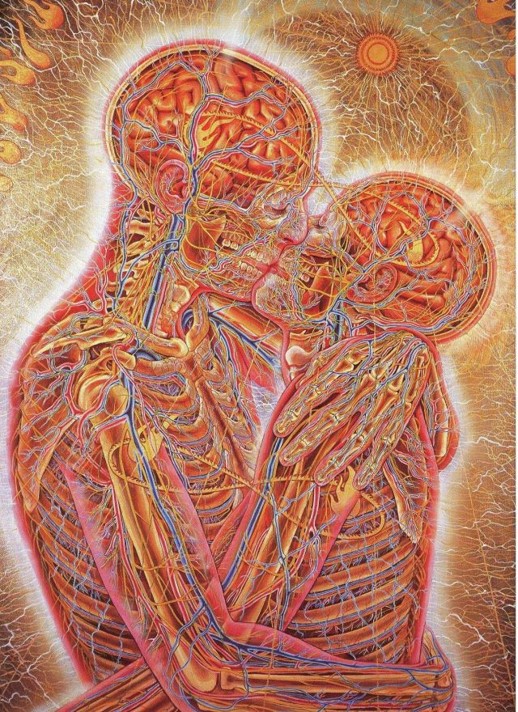
Kissing, by Alex Grey. (alexgrey.com)
~~~~~~~
Please bear with me as I try to connect two not very obviously connected ideas: romantic love and our species’ behavioral flexibility. I don’t have it all worked out. Perhaps I’m going down the wrong path altogether.
I started thinking about these things after several friends on social media shared this Mandy Len Catron essay: “To Fall in Love With Anyone, Do This”. Catron describes a time that she and a male acquaintance intentionally tried to induce feelings of romantic love. To do this, they followed two steps, borrowed from a study done by the psychologist Arthur Aron. First, they asked each other a series of 36 increasingly intimate questions. Next, they stared into each other’s eyes for four uninterrupted minutes.
My first reaction when I went through the questions was that I can see how they could elicit feelings of intimacy under the right circumstances and with the right person. To work through all 36 of them would take some time, as they are not typical of everyday conversation. Time itself is could be a factor in bonding. To answer each question would require some thought, as they do not have prepared, canned responses. Some examples from Aron’s list:
Nothing is permanent. That doesn’t mean beauty does not exist.

Tibetan sand painting (mandala). Source: wikicommons.
.
A few years ago, I attended a conference on war and health in Seattle, and one of the keynote speakers was Chris Hedges, a former journalist who had covered several conflicts around the world. After he finished his presentation, the floor was opened for questions. I’ve since forgotten much of his speech and nearly all of the Q&A session, except for the final question. Someone in the audience asked him how his life had been affected by what he had seen, and how he readjusted to a life of relative comfort in the US.
At that point, he sighed and said that one of his young children had asked him something similar when he was preparing her lunch. I’m paraphrasing, but it was something like “how can you be happy here making me a peanut butter and jelly sandwich when you’ve seen so many big, important things like war around the world?” And he replied that “it’s because I’ve seen so many wars that I know how important the little things are, like making sandwiches” (again, I’m paraphrasing).
The New York Times reported yesterday that in 2014 more than 76,000 people were killed in the ongoing war in Syria. This was actually the highest figure since the conflict began (with 73,447 deaths in 2013; 49,294 in 2012; and 7,841 in 2011), so things have not gotten better.
The statistics came from the British-based organization The Syrian Observatory for Human Rights, and the newspaper admitted that the figures could not be independently verified. That is probably to be expected. Estimating casualties during a time of war is a nearly impossible task, for obvious reasons. Even demographic surveys conducted after a war give a wide range of casualty estimates, as was the case with Iraq. Still, any attempt to quantify casualties is admirable, and a reminder of the damage done by war.
One pattern stood out to me, which was the proportion of deaths attributed to civilians. If their estimates are correct (as much as possible), then civilians comprised 23% of deaths. The rest were divided among various factions of combatants.

Reasons to be hopeful.
I just found out that this site made a list of frequently read science-y blogs. It’s one of the smaller dots on the radar, but it’s flattering just to be mentioned.
Apparently, Paige Brown Jarreau conducted a survey of 600 science bloggers, asking them to name three science blogs, other than their own, that they read on a regular basis. So, thanks to those people who mentioned this site.
The other interesting feature was that Jarreau mapped the blogs into nodes, where sites that were commonly mentioned by the same reader were tied together. It looks like this site has connections to a couple of other excellent bioanthro blogs: Katie Hinde’s Mammals Suck…Milk! and Kate Clancy’s Context and Variation, as well as Ed Yong’s Not Exactly Rocket Science (Ed Yong is connected to more people than Kevin Bacon).
On a related note, this blog is approaching its fifth anniversary, and I’ve been thinking of making some changes. However, I’m torn. I originally named it for personal reasons, in memory of my brother Kevin. But I think that can be confusing to people, since it has no direct correlation with anthropology or other things I write about here. So I’m not sure which way to go. Any advice?

A family of science blogs. The yellow arrow points to this tiny site. (Source)

