The biologist Robert Sapolsky had a recentessayin The Wall Street Journal on the Christmas Truce of WWI, where he discusses how cooperation might develop under difficult circumstances. I wrote a blogpost on the same topic here a few years ago (in fact, it is still the most viewed thing on this site), and I think we cover much of the same ground. Sapolsky’s essay is better, which I’m fine with; it’s Robert Sapolsky after all.
At the end of the essay, he presents a thought experiment about trying to fast-forward mentally through the passage of time and seeing the present through the eyes of our older, wiser selves.
These were the ten most read posts of 2014, with #1 being the most read. As I look for patterns, I think they fall into three categories: War, cooperation & conflict; Evolution & plasticity; and Sex, love & relationships. You know, easy uncontroversial topics. 🙂
As always, nothing on this site would be read if not for you all. Thanks to everyone who visits here, particularly for the regular readers (you know who you are), and for your comments and sharing these posts. Happy New Year!
An in-class academic exercise suggests that we are always somewhat dependent on the kindness of others, regardless of our own disposition as cooperators or defectors.
Although we often think of war as a contest between competing militaries, data suggest that since the Second World War, 67% to 90% of casualties occur among non-combatants. I wrote this to help contextualize some of the conflicts occurring in the summer of 2014.
“Both sides are motivated by fear, by anger, and by wrong perception. But wrong perceptions cannot be removed by guns and bombs. They should be removed by deep listening, compassionate listening, and loving space.
…. We should be able to say this: “Dear friends, dear people, I know that you suffer. I have not understood enough of your difficulties and suffering. It is not our intention to make you suffer more. It is the opposite. We don’t want you to suffer. But we don’t know what to do and we might do the wrong thing if you don’t help us to understand. So please tell us about your difficulties. I’m eager to learn, to understand.”
A few weeks ago, my infant daughter found a stash of old letters I’d written to my wife (longhand!) when we first started dating in college many years ago. With a big grin on her face, she pulled several of them out and scattered them all over the floor. As I began to clean up the mess, I pulled one out at random and started to read it. [Long story short: early romantic love is gross.]
The handwriting was instantly recognizable, but it had been so long since I wrote the letter that it almost seemed like I was reading someone else’s words. That would probably be true about anything I wrote that long ago, but given the tone of the letter, I assumed that it would all come back to me instantly. Some of it did, but with the passage of time, much has been forgotten. A quote from Joan Didion seems appropriate here: “I have already lost touch with a couple of people I used to be.” (But there is always room to become re-acquainted).
“Blood just looks the same/ when you open the veins.” – Karl Wallinger
From where I sit right now, it feels like a lot of social divisions are widening, many of which are intertwined: rich-poor, Black-White, Republican-Democrat, police-civilians, etc. I just want to step back a little bit to help me remember to maintain perspective. Below is a copy-and-paste from something I wrote before about my daughter(I don’t have much time to reinvent the wheel). The general sentiment is about trying to see commonality first.
[begin paste]
I’ve liked this passage from Matt Ridley’s book “The Agile Gene” for a while:
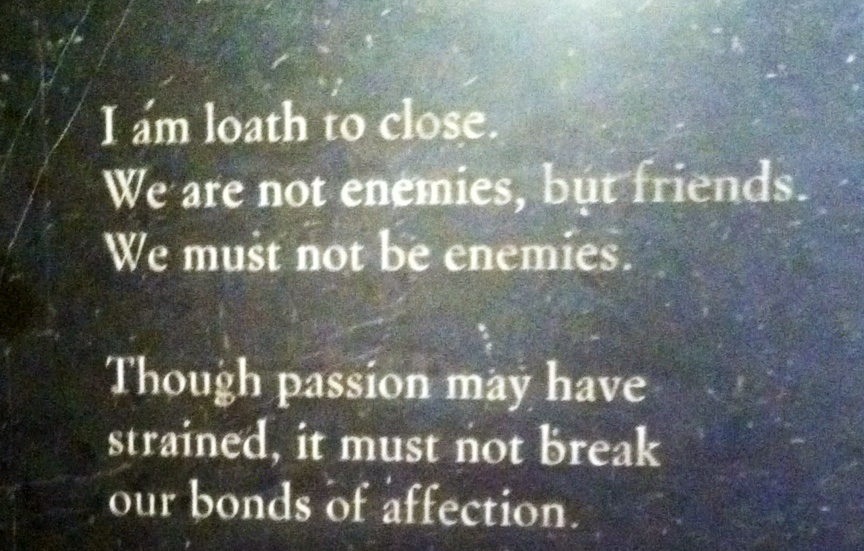
I took this (blurry) photo inside the Lincoln Memorial, on a recent trip to Washington, D.C. The quote comes from Lincoln’s first inaugural address, and it struck me as particularly relevant today since it seems that bonds are strained in so many places. Hopefully, we can remember that those bonds are essential, even if they don’t always come easily. After all, we are cosmically connected primates.
In one of my classes, we play a game known as the Prisoner’s Dilemma. It’s a fun exercise, where students earn ‘points’ by choosing either to cooperate with, or defect on, a partner. We do a few different versions of the game, sometimes with randomly assigned partners for a single round, sometimes with the same partner for multiple rounds, and with different point structures. We also use a deck of playing cards, where students choose a red card to signify defection or a black card for cooperation. All interactions are face-to-face, in real time, and as an incentive there is a prize for the two people who receive the most points.
The main rule of the game is that the number of points one earns depends not only on their own choices, but also the choice their partner makes. The game was originally named after the dilemma that two partners in crime face should they be caught. Here is Eric Johnson’s succinct explanation:
In the game, two people who committed a crime are arrested and each is placed in solitary confinement for interrogation. If one betrays the other, the first goes free while the second is sentenced to three years in prison. If they both betray one another, they each receive two years. But if they both keep silent, they receive the minimum penalty of one year each. Under this scenario, the best individual strategy would be to betray the other.
In our classroom exercise, we invert the scenario and give positive rewards for cooperating (points), since I’m not authorized to give out negative penalties for defecting like years in prison (not that I’d want to do that, anyway).
On my drive into work this morning, I caught the latter half of an interview with Nicholas Winton, the “British Oskar Schindler,” who helped rescue over six hundred Jewish children from Nazi-occupied Czechoslovakia just before World War 2. Recognizing the impending danger, Winton helped coordinate a number of trains to get the children to Britain, where families had volunteered to take them in. He was later reunited with some of those children – since grown – in 1988, recorded by the BBC. It is a very moving scene, particularly considering that the last train carrying children did not make it, and all of its evacuees were believed to have died in concentration camps.
Winton is now 105 years old, and the interviewer asked him a range of questions about his role in the evacuations, his view of himself as a hero (he wanted no part of this), and his thoughts on the changes in the world that he had seen over his very long life. Overall, he said, he was pessimistic about the way the world has changed. We’ve grown more efficient at killing each other, and seem mired in conflict and unable to get out of our own way.
The key, or “the only way out,” as he put it, is finding commonality with each other through ‘ethics.’ As a child, he embraced his own Jewish heritage, but then converted to Christianity. Later, he grew disillusioned with religion altogether when he learned that religious figures on both sides of World War 2 were praying for their own countries to win. I wanted to quote his exact words, so I found thisprint versionof the interview.