Magical Origins of Love

People have come up with various ways to explain the origins of passionate love, including the scientific (we can find answers in our evolutionary past and  in our current biology, particularly the brain) or the mysterious (it’s ineffable, beyond comprehension). Others focus on the magical. The following passage comes from Bronislaw Malinowski’s classic ethnography of the Trobriand Islands, “The Sexual Lives of Savages” where he relayed the Trobriander view on the mythic origins of passionate love, as told by some of his informants, as well as his interpretation of the need for explanation (1929:539-44).

Bronislaw Malinowski with Trobriand Islanders, 1918. (wikipedia)


THE SOURCES OF LOVE MAGIC

Love, the power of attraction, the mysterious charm that comes forth from a woman to a man or from a man to a woman and produces the obsession of a single desire, is, as we know, attributed by the natives to one main source: the magic of love. 

In the Trobriands, most important systems of magic are founded on myth. The origin of man’s power over rain and wind; of his ability to control the fertility of the soil and the movements of fish; of the sorcerer’s destructive or healing powers — all these are traced back to certain primeval occurrences which, to the natives, account for man’s capacity to wield magic. Myth does not furnish an explanation in terms of logical or empirical causality. It moves in a special order of reality peculiar to dogmatic thought, and it contains rather a warrant of magical efficiency, a charter of its secret and traditional nature than an intellectual answer to the scientific why. The facts narrated in myth and the ideas which underlie it, colour and influence native belief and behaviour. The events of a remote past are re-lived in actual experience.This is especially important in the myth we are discussing, since its basic idea is that magic is so powerful that it can even break down the barrier of the strongest moral taboo. This influence of the past over the present is so strong that the myth generates its own replicas and is often used to excuse and explain certain otherwise inexcusable breaches of tribal law.

We have already spoken about the several systems of love magic, and pointed out that the two most important ones are associated with two local centres, Iwa and Kumilabwaga, which are united by a myth of the origin of their magic.

This is the story of the myth as I obtained it from informants of Kumilabwaga, the locality where the tragic events took place.


The story itself is fairly lengthy, but to summarize: long ago, a man made a potion of magical herbs, mint leaves, and coconut oil. He then hung the concoction in a vessel near the door of his family’s hut and left to bathe. His sister returned and accidentally brushed her head against the vessel, which allowed the potion to seep into her hair. She then smelled it, at which point “the power of magic struck her, it entered her inside, and turned her mind.” She then asked her mother where her brother was, found him, and removed her clothes, causing him to flee. Eventually, the magic overtook him as well, after which they copulated three times– in the water, on the beach, and in a nearby grotto. They then fell asleep, and died from shame and remorse for breaking the brother-sister incest taboo.

Malinowski wrote that there were several morals in the story. First, it was not a true origin myth. Rather, it was about how love had been transferred from one part of the islands (Kumilabwaga, where the brother and sister had lived) to another (Iwa). After the brother and sister had died, an Iwa man saw them in a dream, then paddled his canoe to their home and learned what happened from their mother, who –despite her grief– taught him the secrets of the magic, which he took home with him. Therefore, love’s origins had no true beginning. Instead, “most magic is imagined to have existed from the beginning of time, and to have been brought by each sub-clan from underground.” 

Second, Malinowski noted that in the story, the bulk of the blame for the siblings’ shame and ultimate death lay primarily at the feet of women, however unfairly. It was the mother who told her daughter to enter the hut in the first place to find some drinking water because she was too busy to pour some for her.  Malinowski compared the account to the biblical story of Eve giving the apple to Adam, or the legend of Isolde giving a love potion to Tristan: “in most mythological and legendary incidents, the man remains passive and the woman is the aggressor.” 

Finally, the magic of passionate love was powerful enough that it could overpower even one of the strongest taboos in Trobriand society. As Malinowski wrote, magic and myths from the past are “often used to excuse and explain certain otherwise inexcusable breaches of tribal law.” For those with a more scientific mode of thinking, they might remove the magical explanation and substitute it with hormones, neurotransmitters, or a specific brain region. Or, you could combine magical and scientific approaches: “I pull up to the front of your driveway, with magic soaking my spine.” Some of these are extrinsic to the individual, while others are intrinsic. What they have in common is that they fill a void in the search to explain agency and causality.

 

Part 15: Humans Are (Blank)-ogamous: Lessons from Models of Sex and Love

Part 15: Humans Are (Blank)-ogamous: Lessons from Models of Sex and Love

The introduction to this series can be found here.

Summary: There are many ways to put a human life together, including for sex and love. Each path has tradeoffs.

____________________________________________________________________

I thought I knew what love was. What did I know?Don Henley, “Boys of Summer”

There are all kinds of love in this world, but never the same love twice. – F. Scott Fitzgerald


“Mom, love is love, whatever you are.” These words of wisdom came from Jackson, the 12 year-old son of actress Maria Bello, after she revealed to him that she had fallen in love with a woman. Bello’s essay, Coming Out as a Modern Family, appeared in last November’s New York Times, where she bravely reflected on her handful of past romantic relationships (mostly with men), her trepidation in revealing her evolving feelings on love, and the variety of meaningful relationships – platonic, familial, romantic – she had in her life.

In the most important sense, which is of course the sense that Jackson meant, love is love, irrespective of one’s sexuality, gender, or ethnicity. Studies from neurobiology reveal that people in the early stages of romantic love show consistent activation in specific brain regions (the ventral tegmental area and caudate) when viewing a photo of one’s partner. This was true for (1) men and women, (2) hetero- and homo-sexuals, and (3) American, British, and Chinese adults (Zeki and Romaya 2010; Xu et al. 2011). Not that Jackson needed it, because a person’s choices in love should be respected regardless of what neurobiology tells us, but he has science on his side.

Continue reading

Our Essential, Fragile Bonds

Today would have been my brother’s birthday, and I’ve been saving this passage from Boris Pasternik’s Doctor Zhivago to mark it. Here the title character, Yura Zhivago, is speaking to Anna Ivanovna who feared she was terminally ill. He offers what he thinks happens to us when we die, and the primacy of our social connections:

“So what will happen to your consciousness? Your consciousness, yours, not anyone else’s. Well, what are you? There’s the point. Let’s try to find out. What is it about you that you have always known as yourself? What are you conscious of in yourself? Your kidneys? Your liver? Your blood vessels? No. However far back you go in your memory, it is always in some external, active manifestation of yourself that you come across your identity–in the work of your hands, in your family, in other people. And now listen carefully. You in others–this is your soul. This is what you are. This is what your consciousness has breathed and lived on and enjoyed throughout your life–your soul, your immortality, your life in others. And what now? You have always been in others and you will remain in others. And what does it matter to you if later on that is called your memory? This will be you–the you that enters the future and becomes part of it.” (Boris Pasternak, Doctor Zhivago, p. 68)

.

I still haven’t mastered the ability to completely separate the academic and the personal, and I’m not sure I completely want to. Instead of an impenetrable wall between them, perhaps, for me, there is a wrought-iron fence with an open gate. What I mean is that I often go between the two, allowing them to inform each other. The passage from Zhivago is from literature, and is not a scientific statement. But it runs parallel to some aspects of science, which seems poetic to me, particularly on a day I’m thinking of my brother. 

Continue reading

Did Pairbonds Evolve to Be Asymmetrical?

“I know you belong to somebody new, but tonight you belong to me.” Rose and David 

“I wanted love, I needed love. Most of all, most of all.” Auerbach and Carney (1)

.

Several researchers have attempted to reconstruct the very difficult problem of why pairbonding may have evolved in humans (I wrote about this here, but a decent guess is that this began around 2 million years ago. Maybe). Those reconstructions often come with an addendum, which predict that pair-bonds would not be completely symmetrical. Instead, either males or females would have more of an incentive to initiate or maintain a long-term bond, and this would depend on the reasons that pairbonding evolved in the first place.

For example, here is David Buss, explaining why males are more likely to fall in love first:

“Because love is an emotion tethered to long-term mating; because fecundity and reproductive value is so critical to men in selecting a long-term mate; and because physical appearance provides an abundance of cues to a woman’s fecundity and reproductive value, we can predict that men will experience “love at first sight” more often than women. The empirical evidence supports this prediction.” (Buss, 2006: 69)

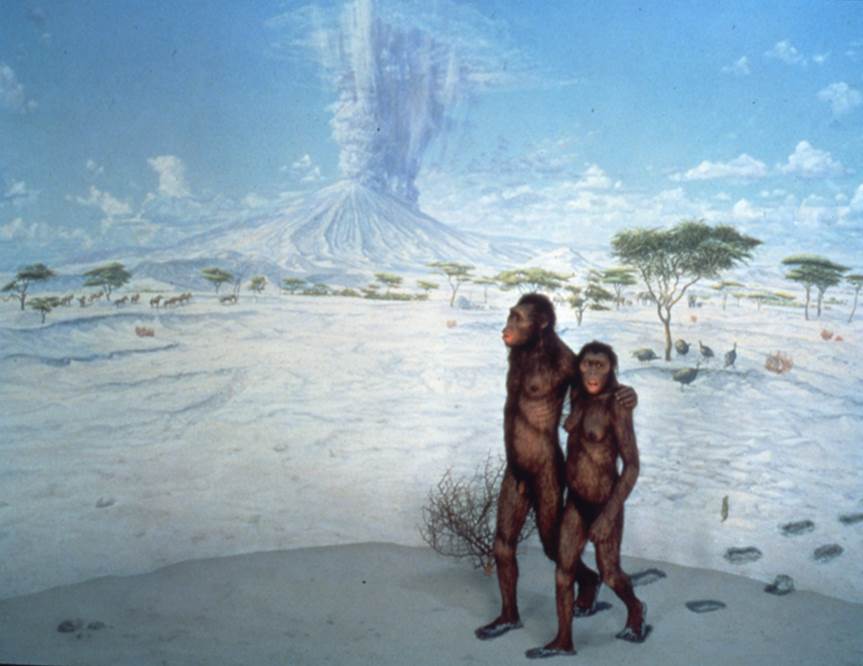
Australopithecus afarensis ("Lucy"), out with her date. Source.

Australopithecus afarensis (“Lucy”), out with her date around 3.6 mya. This portrayal of an early pairbond is speculative, but it ‘s probably not accurate. Source: AMNH.

Continue reading

Part 14: Humans Are (Blank)-ogamous: Paleo Hookups & Archaic Lovers

The introduction to this series can be found here.

Summary: Genetic evidence shows that various Pleistocene populations interbred, including humans, Neanderthals and Denisovans. Is it possible to know whether these could have occurred in pair-bonded relationships? What were the evolutionary origins of pair-bonds in hominins, or are single explanations too simple? 

____________________________________________________________________

.

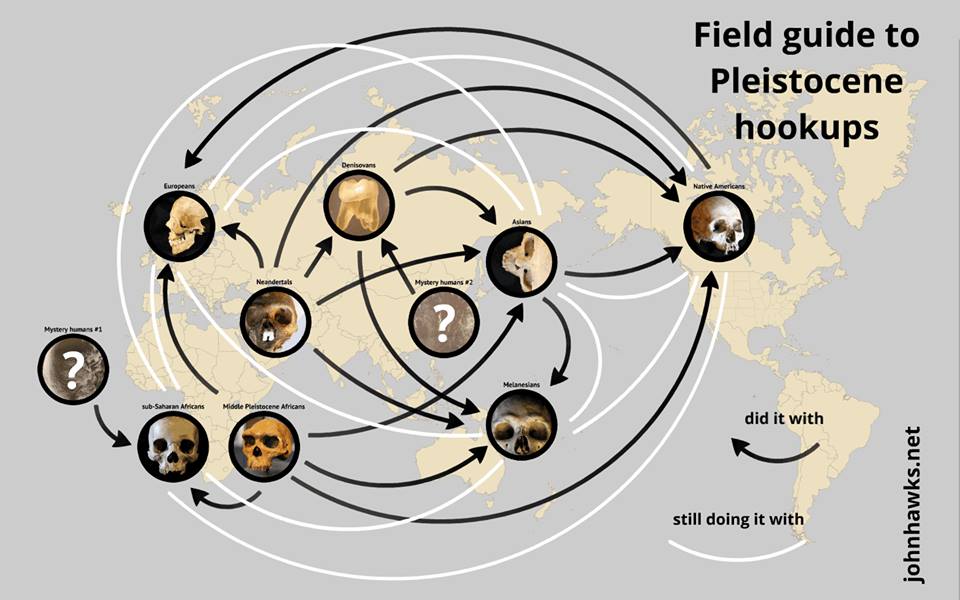
Paleoanthropologist John Hawks created this great infographic that summarizes what we know about ancient human interbreeding, based on recent genetic discoveries (this link to his site has a larger version). The graphic shows that several archaic populations mated with each other, although likely at low rates, including modern humans with Neanderthals and Denisovans. There are also a couple of mystery populations in the mix, whose existence is known solely based on the DNA they left behind. Very cool stuff.

Who Interbred with Whom in the Pleistocene. (Figure by John Hawks).

Who Interbred with Whom in the Pleistocene. (Figure by John Hawks).

Continue reading

For My Daughter

Every so often, some occurrence comes along that throws life into a new orbit. My trajectory was recently shifted by such an event – I fell in love with a girl. She’s much younger than me: not even a week old, in fact. And she happens to have half of my chromosomes, as daughters tend to do. She is healthy, and both she and her mother are doing well. I find myself carrying her around the house, just staring at her face. When she’s awake and looks back at me, which is mostly late at night unfortunately, it’s magical.

Obviously, we knew this day was coming. We’re not ready to plan her entire life out for her just yet (not until she’s at least a month old). But for a while now I’ve been thinking about what it will be like to be a father to a baby girl, and all the possibilities and challenges life has before her. She has two older brothers, who are crazy about her, but there are things that I worry about for their sister that I didn’t have to think about for them, at least not as much. Forgive me for how naïve this is about to sound because I know I’m behind the curve, but I’m trying…

Continue reading

Flexible Love, at Any Age

The New York Times runs a series of short videos titled “Modern Love” (does David Bowie know about this?). The latest installation is narrated by a 71 year-old woman who describes the experience of falling in love at her age, comparing it to her younger days. She talks about differences in preparing for dates, perceptions of the concept of ‘soulmates,’ the sense of urgency, jealousy, ephemerality of life and relationships, and the pain of loss. Pretty thorough for a 2 minute video.   

To me, the most interesting part is that love really can strike at any age, illustrating the gap between proximate and evolutionary levels. Evolutionary hypotheses for the origin of pair-bonding (and love) often highlight some function related to reproduction. Robin Dunbar  summarized four possibilities: 

Continue reading

Part 13: Humans are (Blank)-ogamous: Is Monogamy ‘Natural?’

This is part of a series on the evolution of human mating behavior, comparing evidence for promiscuity and pair-bonding in our species. Please see the Introduction here.

___________________________________________________________________________

(Left) My paternal grandparents with my father as a toddler. (Right) Their 50th anniversary.

Left: My paternal grandparents with my father as a toddler. Right: their 50th wedding anniversary (it’s the best picture I could find).

Are humans naturally monogamous? Oprah Winfrey says ‘no.’That settles it, then. Maybe.

Oprah (she needs no last name) was a guest on a morning talk show, and the topic of discussion was two recent articles on the origins of monogamy in mammals (Lukas & Clutton-Brock, 2013) and another specifically on primates (Opie et al, 2013). Both articles are impressive for their large databases and attention to detail. The first looked at 2545 species of mammals while the Opie article examined 230 primate species.[1]

Both studies focused specifically on social, rather than sexual, monogamy. This distinction is important because sexual exclusivity was not what was being measured here. Rather, social monogamy was defined by both studies as simply living in breeding pairs. The Lukas & Clutton-Brock paper added that in social monogamy the pair shared a common territory, and “associate with each other for more than one breeding season” (p. 526).

Continue reading

Kindness and Regrets

Be excellent to each other.” – Bill and Ted (20th century philosophers)


From a commencement speech by George Saunders: 

“What I regret most in my life are failures of kindnessThose moments when another human being was there, in front of me, suffering, and I responded…sensibly.  Reservedly.  Mildly.”

Saunders then describes a memory from the seventh grade, when he did not defend the new girl in school who was teased for being different. Forty-two years later, he still thinks of her occasionally, and even though he was not personally cruel toward her, he regrets not going out of his way to extend her kindness. He then questions why kindness is often lacking, and he looks for prescriptions to make it more common.

The speech is a good one, and it stirred up some personal memories of instances when I could have used some kindness from someone. Sometimes it came; others it didn’t. There were also situations that called for me to be the one to extend kindness to someone else who needed it. Sometimes I stepped up, although probably not as consistently as I should have. Fear can be a powerful deterrent. Like Saunders, I regret those missed opportunities.

Of course, the opposite of kindness is cruelty, and I’m often distressed by the latest story of human callousness, where someone is belittled for not conforming to another’s standards. For those of us who are not Rhodes Scholar Olympians (which is to say, nearly everyone), we all fall short of socially constructed ideals in some way. Either we’re not attractive enough, or not stylish, athletic, or smart enough (or too smart). Too red. Too blue. Too promiscuous or too chaste. Too tall. Too short. Too neurally atypical. Or, we’re the ‘wrong’ weight, gender, race, sexuality, ethnicity, social class, or speak the wrong dialect. We can be incredibly creative at finding the holes in the armor to bring someone down.

For such an intensely social species, we often seem to go out of our way to make each other want to leave the group.

Continue reading