Developmental Plasticity and the “Hard-Wired” Problem

“Development is the missing link between genotype and phenotype, a place too often occupied by metaphors in the past … But a strong emphasis on the genome means that environmental influence is systematically ignored. If you begin with DNA and view development as “hard-wired,” you overlook the flexible phenotype and the causes of its variation that are the mainsprings of adaptive evolution.” (Mary Jane West-Eberhard, 2003: 89-90)

“Genes, unlike gods, are conditional. They are exquisitely good at simple if-then logic: if in a certain environment, then develop in a certain way… So here is the first moral of the tale: Don’t be frightened of genes. They are not gods; they are cogs. (Matt Ridley, 2003: 250)


Plasticity: actor Christian Bale at two points in time. Same genes, different phenotypes.

Plasticity: actor Christian Bale at two points in time. Same genes, different phenotypes.

In his book The Triple Helix, Richard Lewontin told the story of the molecular biologist and Nobel laureate Sydney Brenner, who – while speaking at a conference – predicted that one day we would be able to “compute” an organism (2002). All we would need are two things: the organism’s full genome and powerful enough computers that were up to the task.

The idea is seductive. Genes are sometimes seen as self-sufficient molecules, almost existing in a vacuum, that contain all the information necessary to code for proteins. From there, it’s not a very big logical leap to think that if you had the genome, you could enter the code in some database, hit “run,” and then watch some digitized version of the organism unfold.

In fact, scientists are doing something much like this for the tiny roundworm C. elegans with the project OpenWorm. Yet even for a relatively simple organism such as this, with only about a thousand cells in total, there are reasons to be cautious. As The Economist warned in its write-up of OpenWorm: “Attempting to simulate everything faithfully would bring even a supercomputer to its knees.” However, this isn’t due solely to the limits of computing power (what if we had a super-duper computer!?). Rather, it’s a matter of how the question is framed.

Continue reading

Magical Origins of Love

People have come up with various ways to explain the origins of passionate love, including the scientific (we can find answers in our evolutionary past and  in our current biology, particularly the brain) or the mysterious (it’s ineffable, beyond comprehension). Others focus on the magical. The following passage comes from Bronislaw Malinowski’s classic ethnography of the Trobriand Islands, “The Sexual Lives of Savages” where he relayed the Trobriander view on the mythic origins of passionate love, as told by some of his informants, as well as his interpretation of the need for explanation (1929:539-44).

Bronislaw Malinowski with Trobriand Islanders, 1918. (wikipedia)


THE SOURCES OF LOVE MAGIC

Love, the power of attraction, the mysterious charm that comes forth from a woman to a man or from a man to a woman and produces the obsession of a single desire, is, as we know, attributed by the natives to one main source: the magic of love. 

In the Trobriands, most important systems of magic are founded on myth. The origin of man’s power over rain and wind; of his ability to control the fertility of the soil and the movements of fish; of the sorcerer’s destructive or healing powers — all these are traced back to certain primeval occurrences which, to the natives, account for man’s capacity to wield magic. Myth does not furnish an explanation in terms of logical or empirical causality. It moves in a special order of reality peculiar to dogmatic thought, and it contains rather a warrant of magical efficiency, a charter of its secret and traditional nature than an intellectual answer to the scientific why. The facts narrated in myth and the ideas which underlie it, colour and influence native belief and behaviour. The events of a remote past are re-lived in actual experience.This is especially important in the myth we are discussing, since its basic idea is that magic is so powerful that it can even break down the barrier of the strongest moral taboo. This influence of the past over the present is so strong that the myth generates its own replicas and is often used to excuse and explain certain otherwise inexcusable breaches of tribal law.

We have already spoken about the several systems of love magic, and pointed out that the two most important ones are associated with two local centres, Iwa and Kumilabwaga, which are united by a myth of the origin of their magic.

This is the story of the myth as I obtained it from informants of Kumilabwaga, the locality where the tragic events took place.


The story itself is fairly lengthy, but to summarize: long ago, a man made a potion of magical herbs, mint leaves, and coconut oil. He then hung the concoction in a vessel near the door of his family’s hut and left to bathe. His sister returned and accidentally brushed her head against the vessel, which allowed the potion to seep into her hair. She then smelled it, at which point “the power of magic struck her, it entered her inside, and turned her mind.” She then asked her mother where her brother was, found him, and removed her clothes, causing him to flee. Eventually, the magic overtook him as well, after which they copulated three times– in the water, on the beach, and in a nearby grotto. They then fell asleep, and died from shame and remorse for breaking the brother-sister incest taboo.

Malinowski wrote that there were several morals in the story. First, it was not a true origin myth. Rather, it was about how love had been transferred from one part of the islands (Kumilabwaga, where the brother and sister had lived) to another (Iwa). After the brother and sister had died, an Iwa man saw them in a dream, then paddled his canoe to their home and learned what happened from their mother, who –despite her grief– taught him the secrets of the magic, which he took home with him. Therefore, love’s origins had no true beginning. Instead, “most magic is imagined to have existed from the beginning of time, and to have been brought by each sub-clan from underground.” 

Second, Malinowski noted that in the story, the bulk of the blame for the siblings’ shame and ultimate death lay primarily at the feet of women, however unfairly. It was the mother who told her daughter to enter the hut in the first place to find some drinking water because she was too busy to pour some for her.  Malinowski compared the account to the biblical story of Eve giving the apple to Adam, or the legend of Isolde giving a love potion to Tristan: “in most mythological and legendary incidents, the man remains passive and the woman is the aggressor.” 

Finally, the magic of passionate love was powerful enough that it could overpower even one of the strongest taboos in Trobriand society. As Malinowski wrote, magic and myths from the past are “often used to excuse and explain certain otherwise inexcusable breaches of tribal law.” For those with a more scientific mode of thinking, they might remove the magical explanation and substitute it with hormones, neurotransmitters, or a specific brain region. Or, you could combine magical and scientific approaches: “I pull up to the front of your driveway, with magic soaking my spine.” Some of these are extrinsic to the individual, while others are intrinsic. What they have in common is that they fill a void in the search to explain agency and causality.


Another Trip to KIPP

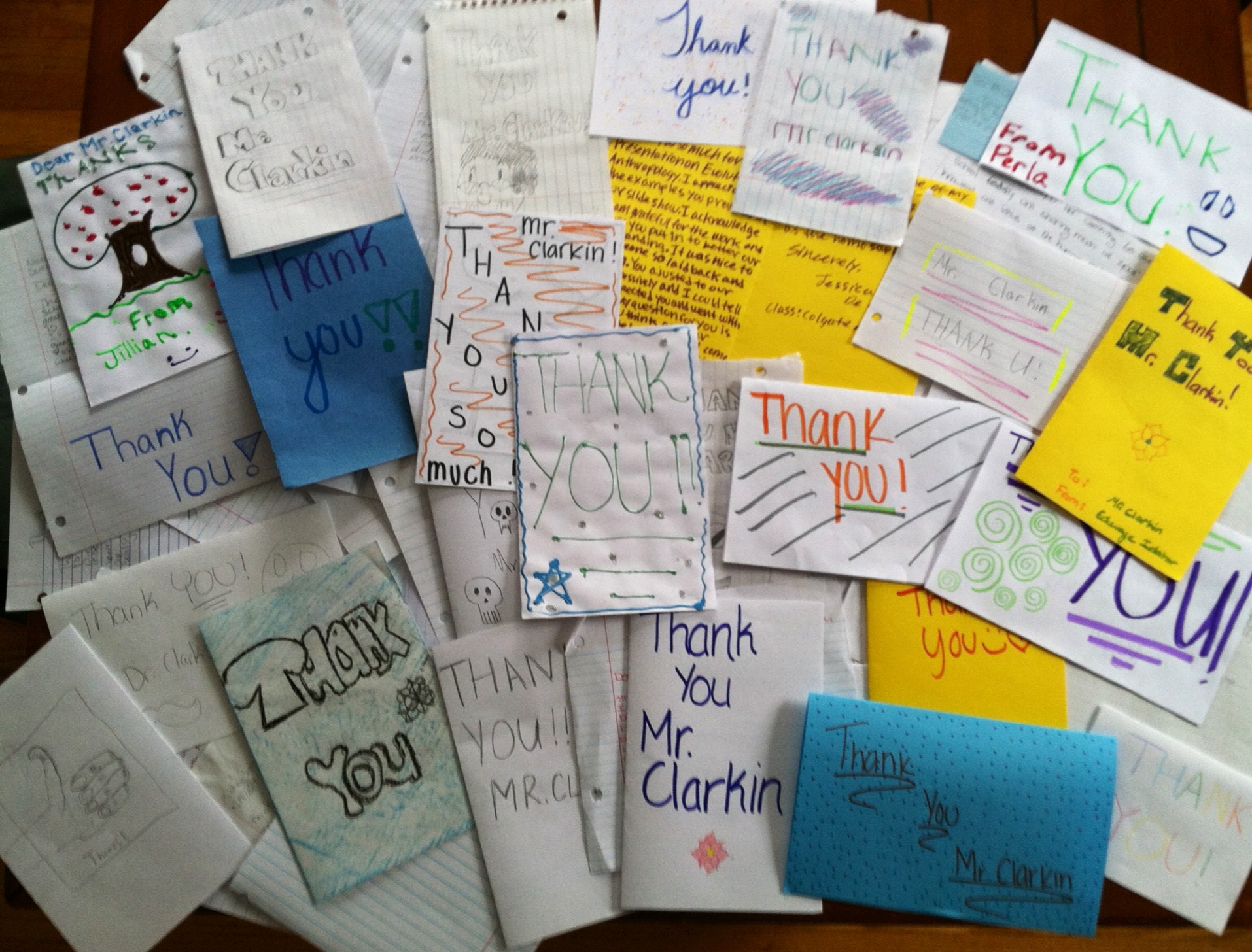
This is the fourth year I’ve visited the 8th graders at the KIPP school in Lynn, Massachusetts to talk about anthropology and evolution for a few hours. Every year, their teacher has them write me thank you notes, about 90 in all over three classes. That alone makes the visit worth it.

KIPP 2014

Related

Public Outreach: Sharing Anthropology Outside the University
Public Outreach 2: KIPP Lynn
More Public Outreach
KIPP Students Rock


Part 15: Humans Are (Blank)-ogamous: Lessons from Models of Sex and Love

Part 15: Humans Are (Blank)-ogamous: Lessons from Models of Sex and Love

The introduction to this series can be found here.

Summary: There are many ways to put a human life together, including for sex and love. Each path has tradeoffs.

____________________________________________________________________

I thought I knew what love was. What did I know?Don Henley, “Boys of Summer”

There are all kinds of love in this world, but never the same love twice. – F. Scott Fitzgerald


“Mom, love is love, whatever you are.” These words of wisdom came from Jackson, the 12 year-old son of actress Maria Bello, after she revealed to him that she had fallen in love with a woman. Bello’s essay, Coming Out as a Modern Family, appeared in last November’s New York Times, where she bravely reflected on her handful of past romantic relationships (mostly with men), her trepidation in revealing her evolving feelings on love, and the variety of meaningful relationships – platonic, familial, romantic – she had in her life.

In the most important sense, which is of course the sense that Jackson meant, love is love, irrespective of one’s sexuality, gender, or ethnicity. Studies from neurobiology reveal that people in the early stages of romantic love show consistent activation in specific brain regions (the ventral tegmental area and caudate) when viewing a photo of one’s partner. This was true for (1) men and women, (2) hetero- and homo-sexuals, and (3) American, British, and Chinese adults (Zeki and Romaya 2010; Xu et al. 2011). Not that Jackson needed it, because a person’s choices in love should be respected regardless of what neurobiology tells us, but he has science on his side.

Continue reading

Our Essential, Fragile Bonds

Today would have been my brother’s birthday, and I’ve been saving this passage from Boris Pasternik’s Doctor Zhivago to mark it. Here the title character, Yura Zhivago, is speaking to Anna Ivanovna who feared she was terminally ill. He offers what he thinks happens to us when we die, and the primacy of our social connections:

“So what will happen to your consciousness? Your consciousness, yours, not anyone else’s. Well, what are you? There’s the point. Let’s try to find out. What is it about you that you have always known as yourself? What are you conscious of in yourself? Your kidneys? Your liver? Your blood vessels? No. However far back you go in your memory, it is always in some external, active manifestation of yourself that you come across your identity–in the work of your hands, in your family, in other people. And now listen carefully. You in others–this is your soul. This is what you are. This is what your consciousness has breathed and lived on and enjoyed throughout your life–your soul, your immortality, your life in others. And what now? You have always been in others and you will remain in others. And what does it matter to you if later on that is called your memory? This will be you–the you that enters the future and becomes part of it.” (Boris Pasternak, Doctor Zhivago, p. 68)

.

I still haven’t mastered the ability to completely separate the academic and the personal, and I’m not sure I completely want to. Instead of an impenetrable wall between them, perhaps, for me, there is a wrought-iron fence with an open gate. What I mean is that I often go between the two, allowing them to inform each other. The passage from Zhivago is from literature, and is not a scientific statement. But it runs parallel to some aspects of science, which seems poetic to me, particularly on a day I’m thinking of my brother. 

Continue reading

Part 14: Humans Are (Blank)-ogamous: Paleo Hookups & Archaic Lovers

The introduction to this series can be found here.

Summary: Genetic evidence shows that various Pleistocene populations interbred, including humans, Neanderthals and Denisovans. Is it possible to know whether these could have occurred in pair-bonded relationships? What were the evolutionary origins of pair-bonds in hominins, or are single explanations too simple? 

____________________________________________________________________

.

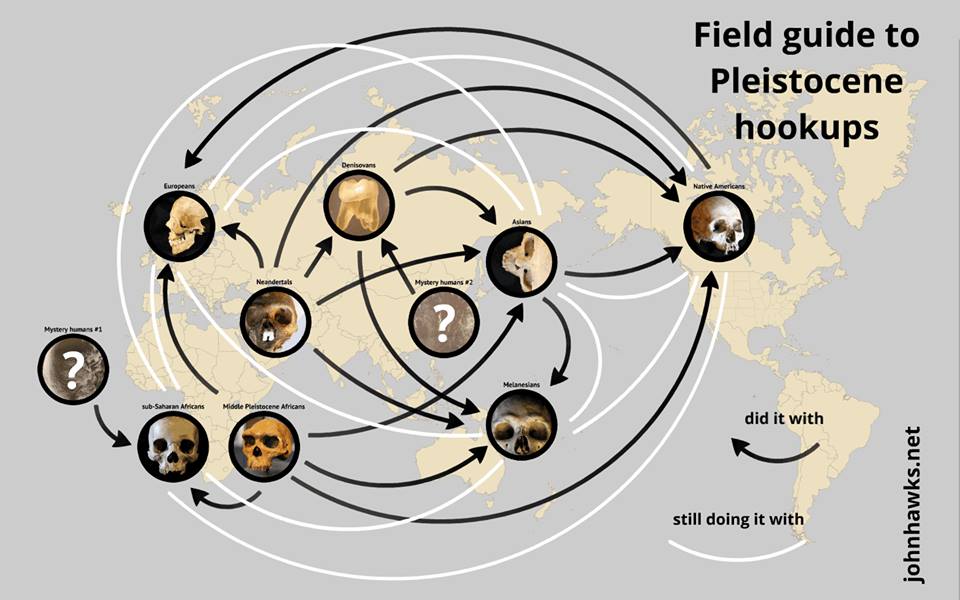
Paleoanthropologist John Hawks created this great infographic that summarizes what we know about ancient human interbreeding, based on recent genetic discoveries (this link to his site has a larger version). The graphic shows that several archaic populations mated with each other, although likely at low rates, including modern humans with Neanderthals and Denisovans. There are also a couple of mystery populations in the mix, whose existence is known solely based on the DNA they left behind. Very cool stuff.

Who Interbred with Whom in the Pleistocene. (Figure by John Hawks).

Who Interbred with Whom in the Pleistocene. (Figure by John Hawks).

Continue reading

Part 13: Humans are (Blank)-ogamous: Is Monogamy ‘Natural?’

This is part of a series on the evolution of human mating behavior, comparing evidence for promiscuity and pair-bonding in our species. Please see the Introduction here.

___________________________________________________________________________

(Left) My paternal grandparents with my father as a toddler. (Right) Their 50th anniversary.

Left: My paternal grandparents with my father as a toddler. Right: their 50th wedding anniversary (it’s the best picture I could find).

Are humans naturally monogamous? Oprah Winfrey says ‘no.’That settles it, then. Maybe.

Oprah (she needs no last name) was a guest on a morning talk show, and the topic of discussion was two recent articles on the origins of monogamy in mammals (Lukas & Clutton-Brock, 2013) and another specifically on primates (Opie et al, 2013). Both articles are impressive for their large databases and attention to detail. The first looked at 2545 species of mammals while the Opie article examined 230 primate species.[1]

Both studies focused specifically on social, rather than sexual, monogamy. This distinction is important because sexual exclusivity was not what was being measured here. Rather, social monogamy was defined by both studies as simply living in breeding pairs. The Lukas & Clutton-Brock paper added that in social monogamy the pair shared a common territory, and “associate with each other for more than one breeding season” (p. 526).

Continue reading

“The Single Most Important Function of Marriage”

It might not be what you think. From Stephanie Coontz’ book Marriage, a History: How Love Conquered Marriage (p. 31): 

“Probably the single most important function of marriage through most of history, although it is almost completely eclipsed today, was its role in establishing cooperative relationships between families and communities.” 

A few pages later, she adds that marriage has historically fulfilled a variety of functions in different societies, so much so that it’s hard to pin down exactly what marriage is. These functions also occur in different combinations, which could alternatively be performed by other institutions. The exception, according to Coontz, is not reproduction or even love, but the extended ties created through in-laws. Here is the whole quote:

Continue reading

Part 11. Humans Are Blank-ogamous. Sexaptation: The Many Functions of Sex

This is part 11 of a series on the evolution of human mating behavior. Please see the introduction here. P.s. Does anybody actually read of all this?

____________________________________________________________________

“When the gods gave people sex, say the !Kung, they gave us a wonderful thing. Sex is often referred to as food: just as people cannot survive without eating… hunger for sex can cause people to die.” (Shostak 2000: 237) 

“sex can be many things to many people, including but not limited to a blend of personalities, social rules, desire, intimacy and performance, moral order and national image that speak to processes of sexual embodiment, varieties of sexual practice and the dynamics of culture.” (Donnan and Magowan, 2010: 175)

E unum, pluribus. (Out of one, many).


Penis Festival

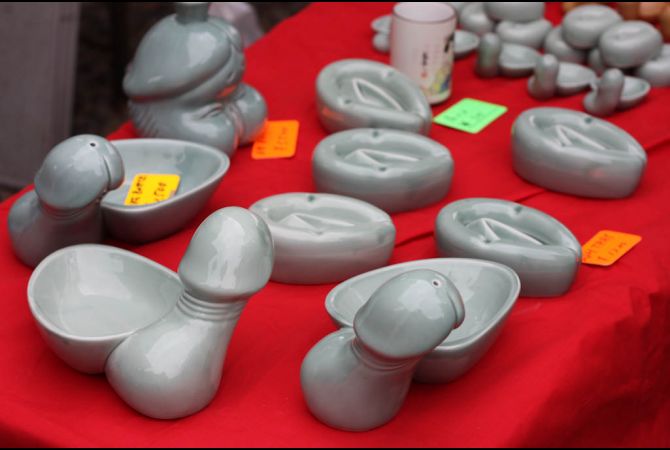
Genital-themed ashtrays from the Komaki Penis Festival in Japan. For humans, sex is more complex than just getting genitals together. (globalpost.com).

Last month, representatives in Montana debated whether to repeal an old law that made homosexual sex illegal in that state (the law was in fact overturned). Apart from the fact that private, consensual sexual behavior is still considered a matter to be legislated, there were other interesting developments from the discussion. A representative named Dave Hagstrom raised a deep question when he asked: “What is the purpose of sex?” I appreciate Hagstrom’s line of inquiry, as we could probably use more reflection on human sexuality. Unfortunately his own answer did not live up to the profundity of the question: 

“To me, sex is primarily purposed to produce people. That’s why we’re all here. Sex that doesn’t produce people is deviate. That doesn’t mean it’s a problem, it just means it’s not doing its primary purpose.”

Continue reading

Part 10: Humans are (Blank)-ogamous: Wondrously Complex Paleo-Sex

This is the tenth(!) part on the evolution of human mating behavior, comparing evidence for promiscuity and pair-bonding in our species. Please see the Introduction here.

_______________________________________________________________


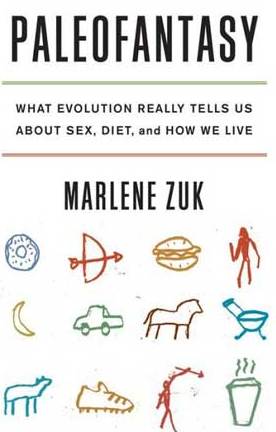
In her new book “Paleofantasy,” Marlene Zuk (2013) takes on the notion that our diet, exercise, and mating Zuk Paleofantasypatterns are out of synch with our evolutionary biology. Some have argued that we have modified our environments too quickly for our own good, leading to the position that we would be better off if we could return to the days of old, before the modern world messed things up. There is probably some truth to this argument (an example I use in classes is that in only a few seconds, inserting $1.00 into a vending machine could return you over 400 empty calories bereft of other nutrients, a scenario our ancestors never encountered). But Zuk counters that the idea that we are stuck with hunter-gatherer bodies and minds in a modern world is overly simplistic.

Zuk notes that attempts to find health and happiness by returning to our idyllic, ancestral past (i.e., paleofantasies) face a few challenges. Among these are:

1. The methodological difficulties in determining exactly how our ancestors lived.
2. The variation among human groups across time and geography.
3. The idea that we were ever fully (perfectly?) adapted to our environment.
4. The fact that evolution does not stop; we are not ‘stuck’ evolutionarily in time.


 In sum, she writes:

Continue reading