Solved it.


Solved it.
The introduction to this series can be found here.
Summary: Genetic evidence shows that various Pleistocene populations interbred, including humans, Neanderthals and Denisovans. Is it possible to know whether these could have occurred in pair-bonded relationships? What were the evolutionary origins of pair-bonds in hominins, or are single explanations too simple?
____________________________________________________________________
.
Paleoanthropologist John Hawks created this great infographic that summarizes what we know about ancient human interbreeding, based on recent genetic discoveries (this link to his site has a larger version). The graphic shows that several archaic populations mated with each other, although likely at low rates, including modern humans with Neanderthals and Denisovans. There are also a couple of mystery populations in the mix, whose existence is known solely based on the DNA they left behind. Very cool stuff.
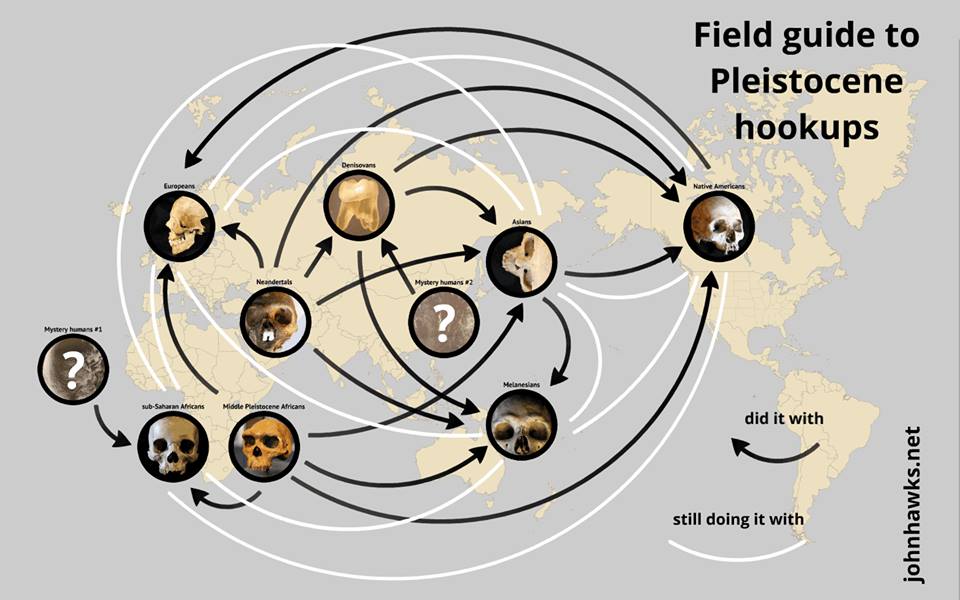
Who Interbred with Whom in the Pleistocene. (Figure by John Hawks).
This photo from a BBC report on the ongoing fighting in South Sudan made its rounds on the internet today, showing refugees being segregated by ethnicity at a UN compound. As of last month, an estimated 93,000 people had been displaced by the conflict, indicating the scale of the crisis (source: reliefweb).

Sign at a camp in Bentiu, South Sudan, segregating refugees by ethnicity. (Source: BBC)
Over at Scientific American, Kate Wong compiled a list of some of the most compelling discoveries in human evolution from 2013. I won’t rehash her entire list here, but the ones that will stick with me for a while include the variation found among the Dmanisi hominins, probably all within the same species. The other is the genetic evidence for interbreeding between Neanderthals, Denisovans, and other extinct humans. Fascinating.
Below are some of the most viewed posts of 2013. Some popular themes this year: sex, love, kindness, conflict, Laos, and some personal stuff as well (including the birth of my daughter).
This isn’t a large website that gets a lot of traffic. It’s just a place to help me organize and share some thoughts, and I really appreciate the fact that people visit and consider some of these things worth reading and even sharing with others.Thank you all for visiting. Happy New Year.
.
From UNHCR:
“Fifteen countries now have internal displacement crises.”
“To change this, the world must pay attention. It must help now.”
I finished my dissertation on how the war in Laos was correlated to the physical growth of Hmong refugees in 2004. The general idea was that early stressors, particularly prenatally and in infancy, can have long-term impacts on growth and health. The model I was working with came largely from David Barker’s (and others’) ‘fetal origins hypothesis,’ based on evidence that low birth-weight infants tended to grow up to have higher rates of things like type 2 diabates, coronary heart disease, hypertension, etc. A classmate in graduate school, Stephanie Rutledge, introduced me to Barker’s work and told me that I’d find it really enlightening. I did. Sadly, Barker passed away earlier this year, but his work helped spawn a new direction in research.
Here is a handy graphic on several recent civil wars, their duration, and the number of lives cost (source: The Economist). To explain the relative decline in number of deaths in more recent years…
“So far, nothing has done more to end the world’s hot little wars than winding up its big cold one. From 1945 to 1989 the number of civil wars rose by leaps and bounds, as America and the Soviet Union fueled internecine fighting in weak young states, either to gain advantage or to stop the other doing so.”

.
.
Every so often, some occurrence comes along that throws life into a new orbit. My trajectory was recently shifted by such an event – I fell in love with a girl. She’s much younger than me: not even a week old, in fact. And she happens to have half of my chromosomes, as daughters tend to do. She is healthy, and both she and her mother are doing well. I find myself carrying her around the house, just staring at her face. When she’s awake and looks back at me, which is mostly late at night unfortunately, it’s magical.
Obviously, we knew this day was coming. We’re not ready to plan her entire life out for her just yet (not until she’s at least a month old). But for a while now I’ve been thinking about what it will be like to be a father to a baby girl, and all the possibilities and challenges life has before her. She has two older brothers, who are crazy about her, but there are things that I worry about for their sister that I didn’t have to think about for them, at least not as much. Forgive me for how naïve this is about to sound because I know I’m behind the curve, but I’m trying…

Kant (wiki commons)
Today is birthday 39. Odd. I’m finding inspiration from Immanuel Kant:
He was of the rather curious conviction that a person did not have a firm direction in life until their thirty-ninth year; when this came and passed and he was just a minor metaphysician in a Prussian University a brief mid-life crisis ensued; perhaps it can be credited with some of his later direction.
We all take different paths and bloom at different times.

