Part 12. Humans Are Blank-ogamous. Jankowiak’s Tripartite Conundrum

This is part 12 of a series on the evolution of human mating behavior. Please see the introduction here.

This video is a lecture by the cultural anthropologist William Jankowiak speaking at my alma mater, Binghamton University, on what he calls the “tripartite conundrum” between romantic love, companion love, and sexual desire. I think he has several insights, but realize that the lecture is lengthy.  If you can’t listen to it in its entirety, here is the heart of the matter:

Continue reading

Part 11. Humans Are Blank-ogamous. Sexaptation: The Many Functions of Sex

This is part 11 of a series on the evolution of human mating behavior. Please see the introduction here. P.s. Does anybody actually read of all this?

____________________________________________________________________

“When the gods gave people sex, say the !Kung, they gave us a wonderful thing. Sex is often referred to as food: just as people cannot survive without eating… hunger for sex can cause people to die.” (Shostak 2000: 237) 

“sex can be many things to many people, including but not limited to a blend of personalities, social rules, desire, intimacy and performance, moral order and national image that speak to processes of sexual embodiment, varieties of sexual practice and the dynamics of culture.” (Donnan and Magowan, 2010: 175)

E unum, pluribus. (Out of one, many).


Penis Festival

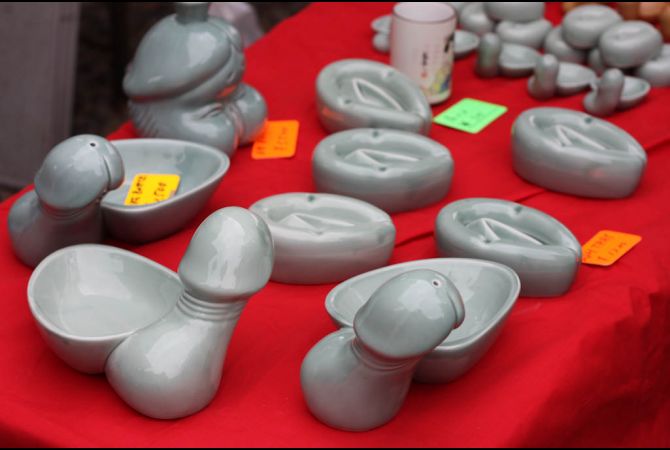
Genital-themed ashtrays from the Komaki Penis Festival in Japan. For humans, sex is more complex than just getting genitals together. (globalpost.com).

Last month, representatives in Montana debated whether to repeal an old law that made homosexual sex illegal in that state (the law was in fact overturned). Apart from the fact that private, consensual sexual behavior is still considered a matter to be legislated, there were other interesting developments from the discussion. A representative named Dave Hagstrom raised a deep question when he asked: “What is the purpose of sex?” I appreciate Hagstrom’s line of inquiry, as we could probably use more reflection on human sexuality. Unfortunately his own answer did not live up to the profundity of the question: 

“To me, sex is primarily purposed to produce people. That’s why we’re all here. Sex that doesn’t produce people is deviate. That doesn’t mean it’s a problem, it just means it’s not doing its primary purpose.”

Continue reading

Part 10: Humans are (Blank)-ogamous: Wondrously Complex Paleo-Sex

This is the tenth(!) part on the evolution of human mating behavior, comparing evidence for promiscuity and pair-bonding in our species. Please see the Introduction here.

_______________________________________________________________


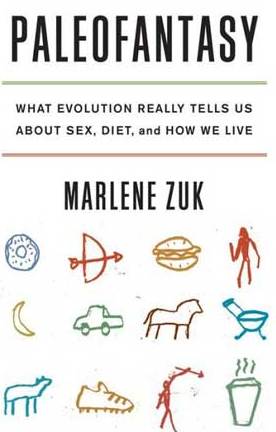
In her new book “Paleofantasy,” Marlene Zuk (2013) takes on the notion that our diet, exercise, and mating Zuk Paleofantasypatterns are out of synch with our evolutionary biology. Some have argued that we have modified our environments too quickly for our own good, leading to the position that we would be better off if we could return to the days of old, before the modern world messed things up. There is probably some truth to this argument (an example I use in classes is that in only a few seconds, inserting $1.00 into a vending machine could return you over 400 empty calories bereft of other nutrients, a scenario our ancestors never encountered). But Zuk counters that the idea that we are stuck with hunter-gatherer bodies and minds in a modern world is overly simplistic.

Zuk notes that attempts to find health and happiness by returning to our idyllic, ancestral past (i.e., paleofantasies) face a few challenges. Among these are:

1. The methodological difficulties in determining exactly how our ancestors lived.
2. The variation among human groups across time and geography.
3. The idea that we were ever fully (perfectly?) adapted to our environment.
4. The fact that evolution does not stop; we are not ‘stuck’ evolutionarily in time.


 In sum, she writes:

Continue reading

Part 9. Humans are (Blank)-ogamous: Love Is an Evolutionary Compromise

This is part 9 of a series on the evolution of human mating behavior, comparing evidence for promiscuity and pair-bonding in our species. Please see the introduction here.

____________________________________________________________________

I want love to roll me over slowly,
Stick a knife inside me, and twist it all around.
I want love to grab my fingers gently,
Slam them in a doorway, put my face into the ground. – Jack White (Love Interruption[1]  

“Everything is a double-edged sword… Even single-edged swords are a double-edged sword. Because you can cut something with it, but the other edge is kind of flat and it doesn’t cut very well.” – Louis CK (comedian)

.

.

Yesterday’s post looked at the neurobiology of romantic love, asking whether evolutionary perspectives are sufficient to explain this highly significant part of what it means to be human. It also raised the question as to why love seems to be a painful experience for so many people.

Before going further, it’s important to remember that while humans are undoubtedly evolved, biological organisms, we are also animals with complex behavior, language, and culture. Others have said this better than I can. To Jon Marks (2010), we are “biocultural ex-apes,” while Agustin Fuentes wrote that “human behavior is almost always ‘naturenurtural’ ” (2012:16). Just as human modification of the environment can affect natural selection (Hawks et al 2007; Laland et al. 2010), so can culture profoundly influence the way we interpret powerful emotional impulses, including those related to desire and love.

Continue reading

Part 8. Humans are (Blank)-ogamous: Evolution, Love, & Suffering

This is part 8 of a series on the evolution of human mating behavior, comparing evidence for promiscuity and pair-bonding in our species. Please see the introduction here.


____________________________________________________________________

we are never so defenceless against suffering as when we love, never so helplessly unhappy as when we have lost our loved object or our love.” – Sigmund Freud (Civilization and Its Discontents)

.

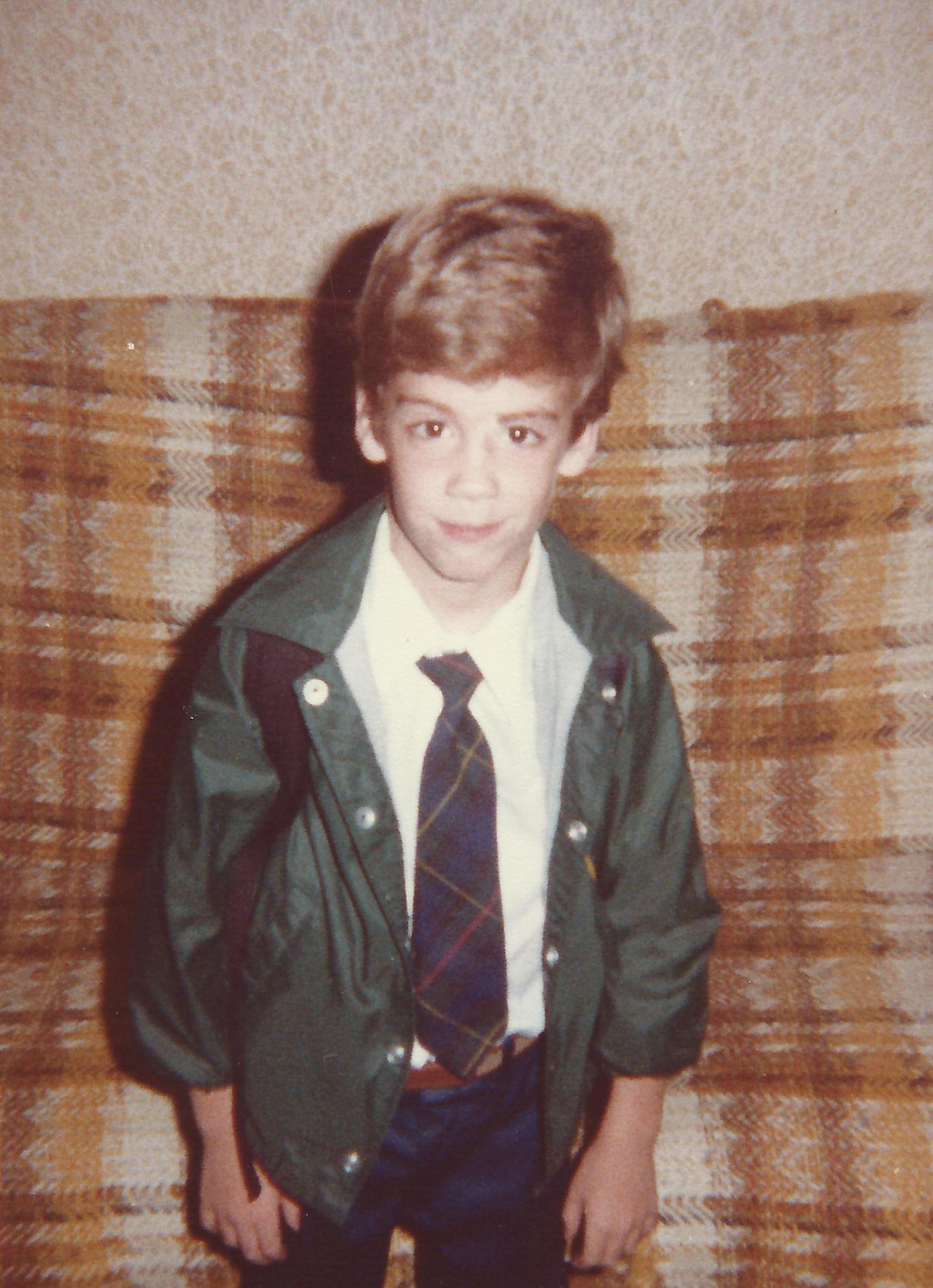
One of my more vivid memories from early childhood is of Tammy and her two friends. I was about 6 years old, and in the first grade. They were third graders, a couple of years older. By coincidence, our two classes had arrived simultaneously at the hallway outside the girls’ lavatory. In those days, teachers took their entire class to ‘the lav’ for efficiency’s sake, and every day the boys finished our business promptly then lined up in front of the teacher as we waited for the girls to finish theirs. On that day, our schedule happened to align with grade three.
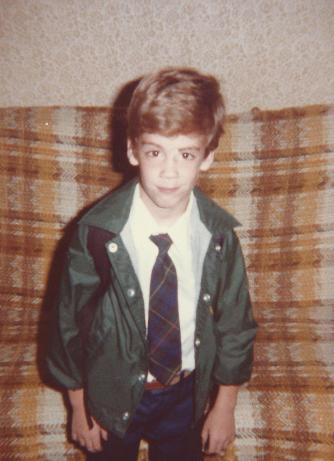
1st grade

1st grade

I can still remember Tammy looking at the note I had written her, passed along by a friend earlier in the day, with her friends on either side. Exactly what I wrote is lost to time, but I recall the romantic sentiment behind it and drawing a picture of a boy and a girl kissing. Today, such behavior (or going even further) could actually get a young child suspended from school.

What compelled me to write the note, I don’t know. I do remember that Tammy seemed kind and pleasant to look at, and that it felt right – even at that age – to try to express it. However, that feeling quickly turned to embarrassment, when she and her friends waved, laughed in unison, and –in sing-song fashion – said “Hi, Patrick.” We were all just kids and no harm was intended, but at that point, I wanted to hide. And, though I can’t remember this part very well, I probably wondered why the third grade teacher was so slow in taking her students back to class.

It wasn’t clear where I went wrong, but my interpretation of Tammy’s behavior was that my private feelings of attraction, which came pretty easily, somehow violated the rules. Early experiences carry a lot of weight, and that incident taught me that revealing private emotions was a risky endeavor. It’s tempting to want to hide them away[1]

With Valentine’s Day just behind us, I wanted to develop on some of the elements in this innocent story in a couple of posts (update: part 9 here), such as where attraction and its hypertrophic cousin, romantic love, originate, and even why they might show up in early childhood.

The other element is the more negative aspects of romantic pursuits, which extend well beyond the embarrassment of childhood puppy love and into profound despair and suffering. Perhaps the cynics have good reasons to feel that it is somewhat myopic to give love its own day to be celebrated while glossing over the countless people it has wounded over the millennia. Homer Simpson, in his toast to inebriation, once referred to alcohol as “the cause of, and solution to, all of life’s problems.” I don’t think too many people would object if we replaced the word ‘alcohol’ with love.

So, what is this thing that nature has given us?

Continue reading

Part 6. Humans are (Blank) -ogamous: Many Intimate Relationships

This is the sixth part on the evolution of human mating behavior, comparing evidence for promiscuity and pair-bonding in our species. Please see the Introduction here.

_______________________________________________________________

So be sure when you step, Step with care and great tact. And remember that life’s A Great Balancing Act.” Dr. Seuss

…………………………………………………………………………………………………………………………………………………………………. Varieties of Intimate Relationships. Click for larger image. (from Informationisbeautiful.net)

David McCandless at “Information Is Beautiful” gave me permission to reproduce the above image. I though it fit well with the series I started months ago titled Humans are (blank)-ogamous, which looked at the evidence for pair-bonding and promiscuity in human evolution. In the first post of the series, I wrote:

To begin, let me say that I side with Sapolsky. Individuals may figure out what works best for themselves in terms of balancing sex, love, intimacy, and commitment, but collectively we are a tragically confused species. …

Across the spectrum of human cultures, we can find examples of heterogamy, endogamy, polyandry, polygyny, monogamy, non-monogamy, polyamory, and so on. However, these do not all occur in equal frequencies, so I don’t think we are truly “blank-ogamous.” There is also lots of room for variation within each culture. Being good Popperians committed to the principle of falsifiability, it is probably easier to say what we are not than what we are. One thing is clear: we are not simple.”

Continue reading

Roundup (Jan 10, 2012)

I generally don’t do roundups, but below are a few things I thought worth sharing. If “a scholar is just a library’s way of making another library,” as Daniel Dennett put it, then this is what I’ve checked out lately.

#1.

Greg Downey at Neuroanthropology has begun a new series on anthropology and the evolution of human sexuality, titled: “The Long, Slow Sexual Revolution.” I’ve been looking forward to it for a few weeks since Greg first told me he was working on this, and I can say that the wait was worth it (and not just because he kindly cites some of my stuff from the Blank-ogamous series). He takes a *very* big picture approach, and what I liked most about it was that it stressed the need to confront the evidence while also keeping an eye on context and complexity, and avoiding overly simplistic narratives. As he wrote:

Continue reading

Part 5. Humans are (Blank) -ogamous: Pair-Bonding and Romantic Love

This is the fifth part on the evolution of human mating behavior, comparing evidence for promiscuity and pair-bonding in our species. Please see the introduction here.

____________________________________________________________________

One of these days I will wake up – which I think I have done already – and realize to myself that I really do love. I find it very difficult to allow my whole life to rest on the existence of another creature. I find it equally difficult, because of my innate arrogance, to believe in the idea of love. There is no such thing, I say to myself. There is lust, of course, and usage, and jealousy, and desire and spent powers, but no such thing as the idiocy of love. Who invented that concept? I have wracked my shabby brains and can find no answer. (Letter from Richard Burton to Elizabeth Taylor)

“Emotions and motivations (are) hierarchically ordered in the brain. Fear can overcome joy, for example. Jealousy can stifle tenderness…But in this pecking order of basic and complex emotions, background feelings and powerful drives, romantic love holds a special place: close to the zenith, the pinnacle, the top. Romantic love can dominate the drive to eat and sleep. It can stifle fear, anger, or disgust. It can override one’s sense of duty to family or friends. It can even triumph over the will to live. As Keats said, ‘I could die for you.’ ” (Helen Fisher 2004: 97-8)

“Only love can leave such a mark / But only love can heal such a scar.” (Paul Hewson)

Attempting to summarize the evolution of romantic love and pair-bonding in humans is an enormous task. This is exacerbated by many complications: the literature on these topics is vast; the term ‘pair-bond’ has been used in different ways by different primatologists in the past and is often erroneously confused with ‘monogamy’; the neurobiology of romantic love – which is not a prerequisite of pair-bonding – is complex; the question of when/if humans became pair-bonded in our evolutionary history is highly speculative; and then there is the complicating factor of culture. Furthermore, parts two through four in this series addressed ten biological traits indicating that humans have promiscuity built into us to some degree, and that monogamy, or at least lifelong monogamy, does not come easily.

Gibbons (Hylobates lar). From Wikipedia.

Continue reading

Part 4. Humans are (Blank) -ogamous: Promiscuity & Physiology

This is the fourth part on the evolution of human mating behavior, comparing evidence for promiscuity and pair-bonding in our species. Please see the introduction here.

____________________________________________________________________


We left off with a list of eight traits in humans suggesting promiscuity in humans. Admittedly, the previous post was a little thick, as it dealt with imprinted genes and population genetics. The current one concerns human reproductive physiological and anatomical traits consistent with a multiple-partner mating structure, building on a couple of points addressed by Ryan and Jethá in their book. If you’re paying attention, that’s three posts concerning promiscuity and one (yet-to-be-written) on pair-bonding. Perhaps it seems I’m stacking the deck, but please reserve judgment. One reason more space is needed to make the case for the evolution of promiscuity is that the biology is less well known, and more effort is needed to bring it into the light. That single post on pair-bonding will be an important one, and quality matters just as much as quantity.

Continuing on with our list of traits hinting at promiscuity…

9. Sexual dimorphism in body size. This point remains somewhat contentious. In the majority of anthropoid species (monkeys, apes, and humans), males are the larger sex, with the degree of dimorphism ranging from slight to extreme (Plavcan 2001). This pattern correlates strongly with mating structure and male-male competition (Plavcan and van Schaik 1997). For monogamous species like gibbons, males and females tend to be roughly the same size. In species where females prefer larger males or where males compete for access to females, bigger males will leave behind more descendants. This is true for polygynous gorillas and dispersed, territorial orangutans, where males are physically about twice as large as females. A good non-primate example is elephant seals. On the other hand are horseshoe crabs, where smaller males cling to the backs of larger females and wait for the release of her eggs. This ‘reverse dimorphism’ is found in a few primates, but is slight and only in some prosimians such as lorises and lemurs.

Former sumo wrestler Konishiki and his wife Chie Iijima, an obviously cherry-picked example of extreme dimorphism. (From smh.com.au).

Continue reading

Part 3. Humans are (Blank) -ogamous: More on Promiscuity, & Genetics

This is the third part on the evolution of human mating behavior, comparing evidence for promiscuity and pair-bonding in our species. Please see the introduction here.

____________________________________________________________________

Part 2 pertained to human behaviors that suggested a human propensity for promiscuity (primate sexuality, the excessive sexual capacity of humans, infidelity rates, cultural variation in marriage practices, number of lifetime sex partners, etc.). This post and the next are concerned more with clues from our genes, anatomy, and physiology suggesting promiscuity. I realize these things are not clearly demarcated. My advisor at Binghamton, Mike Little, liked to say that “biology is behavior, and behavior is biology.” But I think in general most people would agree that while behavior has a genetic component, it is more plastic than are anatomical structures.

We left off with a list of six traits hinting at promiscuity. I don’t want to simply rehash what Ryan and Jethá address, so this post addresses some additional points on genetics before returning to their book in the next submission. Continuing with that list…

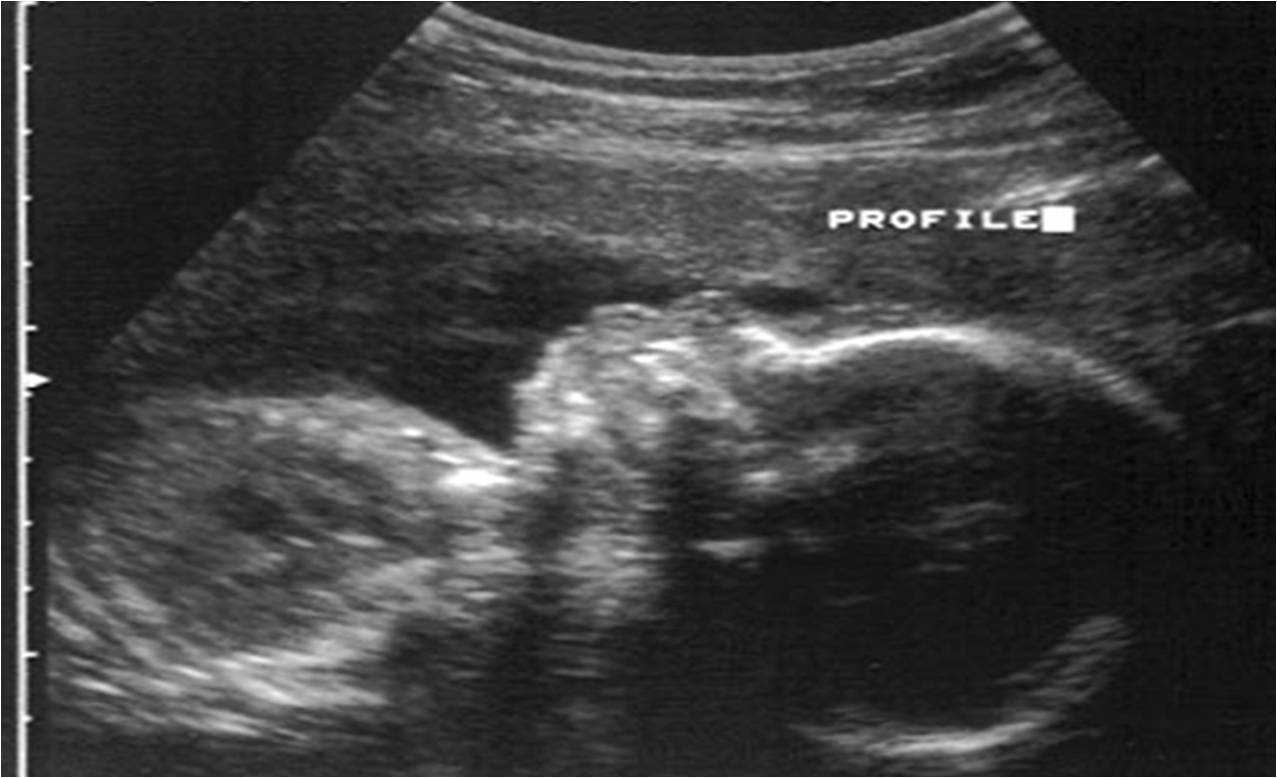
Fetal ultrasound at 4.5 months, profile view

Continue reading