Sex and Love in the Long Run

[I hope you like graphs … ]

♪ Now everyone dreams of a love lasting and true, / But you and I know what this world can do. / So let’s make our steps clear, so the other may see./ I’ll wait for you, and should I fall behind, will you wait for me? 

— Bruce Springsteen & Patti Scialfa (“If I Should Fall Behind”)

“Contrary to what has been widely believed, long-term romantic love (with intensity, sexual interest, and engagement, but without the obsessive element common in new relationships), appears to be a real phenomenon that may be enhancing to individuals’ lives—positively associated with marital satisfaction, mental health, and overall well-being.”

— Bianca Acevedo and Arthur Aron (2009: 64)

In the 2013 film “Before Midnight,” we caught up with Celine and Jesse (played by Julie Delpy and Ethan Hawke) who had fallen in love during a chance, whirlwind evening in Vienna eighteen years earlier. After nine years apart between the first and second parts of the trilogy, they have been together for the last nine and are now in their early forties, and have twin girls together as well as a son from Jesse’s first marriage.

The first part of the trilogy, “Before Sunrise,” focused on Celine and Jesse’s incipient romantic connection as they explored the city, talking all night about a variety of topics before ultimately having to separate. In part two they reconnected. By the third film we see that there is still love, but with more complexity within their long-term relationship. We see themes of restlessness, resentments over suspected past infidelities, and the struggles that come with balancing parenting, career, sexual desire, domestic life, and having family spread out over long distances. They lament that passion (for all things) came easier to them when they were younger, and Jesse suggests that maybe “this is the natural human state – always a little dissatisfied, perpetually discontented.” We are left wondering if their relationship will survive.

The New York Times critic A.O. Scott reviewed “Before Midnight” jointly with the European film “Amour,” released the previous year. In that movie, we saw an elderly couple struggling with failing health. Scott pondered why such films, with their focus on a couple already-in-progress, were less common than ones centered around early romance. In his view, the reason is that unlike romantic comedies, marriage “has no story arc.”

“A marriage plot, which is to say a comedy, is a story with a wedding at the end. The exchange of vows provides a satisfying and efficient exit from an intricate story. After the chaos of misbehavior, misunderstanding and missed connection, order is restored, the curtain falls, and love’s essential labor is done. But if the story starts in the middle, sometime after the honeymoon, at the breakfast table or the parent-teacher conference, where then does it conclude? There are only two logical possibilities, both of them sad.”

Continue reading

Love is Wise. Hatred is Foolish.

“The moral thing I should wish to say to them is very simple. I should say love is wise; hatred is foolish. In this world, which is getting more closely and closely interconnected, we have to learn to tolerate each other. We have to learn to put up with the fact that some people say things that we don’t like. We can only live together in that way; if we are to live together and not die together, we must learn a kind of charity and a kind of tolerance which is absolutely vital to the continuation of human life on this planet.”

Ten Lessons on Love, from the Wise

I started teaching a new class this semester on patterns of human mating. One of our assignments was what we called “Interviews with the Wise.” I asked students to speak informally with older people, asking them what they had learned about sex, love, marriage, and relationships, and what lessons they would like to pass along to young people. We collectively came up with the questionnaire as a class. 

The interviewees ranged in age from their late 50s to their early 90s (‘older’ is always a relative term, I suppose). Most would probably be described as traditional, most were married once, but some were married a few times or none at all. Several were raised Catholic (it is New England), and we had a range of people from different ethnicities.I was very impressed with how seriously the students took the assignment, and how open their interviewees were. 

Below are some of the patterns I noticed from the interviews:

Continue reading

Gordon’s Story

We had a visitor in our Patterns of Human Mating class this week, a 70-something year-old gay man named Gordon. One of our assignments is that students must speak, informally, with older people about sex, love, marriage, long-term relationships, etc., and what they’ve learned and what advice they had for young adults. This was inspired by a conversation I had a few years ago with an 83 year-old woman named Evelyn, which I found enlightening. Other than age, we weren’t looking for people from any specific demographic, or people with any orientation. We just wanted to listen to whatever wisdom and experience is out there.  

We asked around to find people to speak with, and found Gordon through a local organization that works with older adults. He kindly shared some of his life story, the progress he’s seen on acceptance on LGBT people over the course of his life, and we had a nice discussion for about 25 minutes. He then stayed for the rest of the class to hear the lecture. He even asked a few questions during the lecture, and asked if I could email him some of the studies we discussed in the class.

Continue reading

“Love Will Win”


Refugeee Love

A young refugee couple kiss in a tent in Keleti station in Budapest, Hungary. Photograph: Istvan Zsiros. Source

From the article in The Guardian:

 “I hope every refugee finds a their place in the world, finds peace as quickly as possible,” (photographer) Istvan Zsiros says. “That everyone is happy. It’s a very difficult situation, a very complex situation.”

And he hopes his photograph might change the way people see the situation: “Love,” he says, quoting the movie Interstellar, “is the one thing we’re capable of perceiving that transcends time and space.” And, perhaps, borders.”

Facing Mortality

Oliver Sacks’ essay on learning that, at age 81, he has terminal cancer is one of the most beautiful things I have read. I hope that one day I can confront my own mortality with such perspective and dignity. Life is still beautiful.

Sacks concludes: 

There will be no one like us when we are gone, but then there is no one like anyone else, ever. When people die, they cannot be replaced. They leave holes that cannot be filled, for it is the fate — the genetic and neural fate — of every human being to be a unique individual, to find his own path, to live his own life, to die his own death.

I cannot pretend I am without fear. But my predominant feeling is one of gratitude. I have loved and been loved; I have been given much and I have given something in return; I have read and traveled and thought and written. I have had an intercourse with the world, the special intercourse of writers and readers.

Above all, I have been a sentient being, a thinking animal, on this beautiful planet, and that in itself has been an enormous privilege and adventure.


Over-thinking Love

Since yesterday was Valentine’s Day….

https://kevishere.com/category/love/

Love Models

Sapiosexuality & Our Behavioral Complexity

You know, animals have sex. It’s biology, it’s natural instinct. We are the only ones who have an erotic life, which means that it’s sexuality transformed by the human imagination.”  — Esther Perel

One of the reasons some cultural elitists – political pundits, novelists, intellectuals – tend to be so unsettled by the Internet is that it has revealed how oceanically broad are the interests of the public in general. Before the Internet, with no way of observing the obsessions of the masses, it was a lot easier to pretend that these obsessions simply didn’t exist; that the nation was “united” around caring about the same small number of movies, weekly magazines, novels, political issues, or personalities. This was probably always a self-flattering illusion for the folks who ran things. The Internet destroyed it. When you gaze …upon the Pacific of strangeness online, you confront the astonishing diversity of human passion.”  — Clive Thompson (2013) Smarter Than You Think: How Technology is Changing Our Minds for the Better

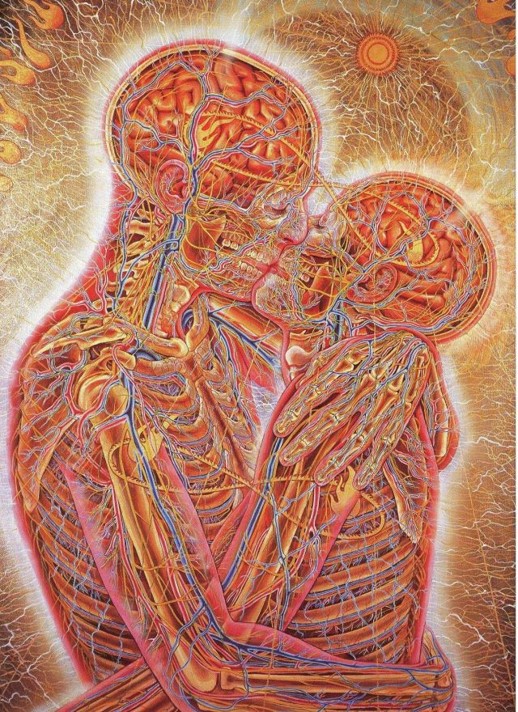
Kissing, by Alex Grey.

Kissing, by Alex Grey. (alexgrey.com)

                                                                                 ~~~~~~~

Please bear with me as I try to connect two not very obviously connected ideas: romantic love and our species’ behavioral flexibility. I don’t have it all worked out. Perhaps I’m going down the wrong path altogether.

I started thinking about these things after several friends on social media shared this Mandy Len Catron essay: “To Fall in Love With Anyone, Do This”. Catron describes a time that she and a male acquaintance intentionally tried to induce feelings of romantic love. To do this, they followed two steps, borrowed from a study done by the psychologist Arthur Aron. First, they asked each other a series of 36 increasingly intimate questions. Next, they stared into each other’s eyes for four uninterrupted minutes.

My first reaction when I went through the questions was that I can see how they could elicit feelings of intimacy under the right circumstances and with the right person. To work through all 36 of them would take some time, as they are not typical of everyday conversation. Time itself is could be a factor in bonding. To answer each question would require some thought, as they do not have prepared, canned responses. Some examples from Aron’s list:

  • Name three things you and your partner appear to have in common.
  • Take four minutes and tell your partner your life story in as much detail as possible.
  • Is there something that you’ve dreamed of doing for a long time? Why haven’t you done it?
  • What is your most treasured memory? Continue reading

Early Romantic Love & Selecting Mates

Explorer, mess-maker

Explorer, mess-maker

A few weeks ago, my infant daughter found a stash of old letters I’d written to my wife (longhand!) when we first started dating in college many years ago. With a big grin on her face, she pulled several of them out and scattered them all over the floor. As I began to clean up the mess, I pulled one out at random and started to read it. [Long story short: early romantic love is gross.] 

The handwriting was instantly recognizable, but it had been so long since I wrote the letter that it almost seemed like I was reading someone else’s words. That would probably be true about anything I wrote that long ago, but given the tone of the letter, I assumed that it would all come back to me instantly. Some of it did, but with the passage of time, much has been forgotten. A quote from Joan Didion seems appropriate here: “I have already lost touch with a couple of people I used to be.” (But there is always room to become re-acquainted).

Continue reading

Bonobos

Apropos of nothing. Just felt like sharing two related images.

Bonobos, by Tim Flach. (Source)

The Kiss, by Gwenn Seemel.

The Kiss, by Gwenn Seemel. (Source)