Neil de Grasse Tyson on the cosmic perspective:
“I assert that if you are depressed after being exposed to the cosmic perspective, you started your day with an unjustifiably large ego.”
Existence itself is awe-inspiring enough.
.

Neil de Grasse Tyson on the cosmic perspective:
“I assert that if you are depressed after being exposed to the cosmic perspective, you started your day with an unjustifiably large ego.”
Existence itself is awe-inspiring enough.
.
This is part 12 of a series on the evolution of human mating behavior. Please see the introduction here.
This video is a lecture by the cultural anthropologist William Jankowiak speaking at my alma mater, Binghamton University, on what he calls the “tripartite conundrum” between romantic love, companion love, and sexual desire. I think he has several insights, but realize that the lecture is lengthy. If you can’t listen to it in its entirety, here is the heart of the matter:
____________________________________________________________________
“When the gods gave people sex, say the !Kung, they gave us a wonderful thing. Sex is often referred to as food: just as people cannot survive without eating… hunger for sex can cause people to die.” (Shostak 2000: 237)
“sex can be many things to many people, including but not limited to a blend of personalities, social rules, desire, intimacy and performance, moral order and national image that speak to processes of sexual embodiment, varieties of sexual practice and the dynamics of culture.” (Donnan and Magowan, 2010: 175)
E unum, pluribus. (Out of one, many).

Genital-themed ashtrays from the Komaki Penis Festival in Japan. For humans, sex is more complex than just getting genitals together. (globalpost.com).
Last month, representatives in Montana debated whether to repeal an old law that made homosexual sex illegal in that state (the law was in fact overturned). Apart from the fact that private, consensual sexual behavior is still considered a matter to be legislated, there were other interesting developments from the discussion. A representative named Dave Hagstrom raised a deep question when he asked: “What is the purpose of sex?” I appreciate Hagstrom’s line of inquiry, as we could probably use more reflection on human sexuality. Unfortunately his own answer did not live up to the profundity of the question:
“To me, sex is primarily purposed to produce people. That’s why we’re all here. Sex that doesn’t produce people is deviate. That doesn’t mean it’s a problem, it just means it’s not doing its primary purpose.”
Here’s a reprieve from the bombardment of bad news and encroaching cynicism. Thank you, Russians and your dash-cams.
.
Related: Optimism and Human Nature
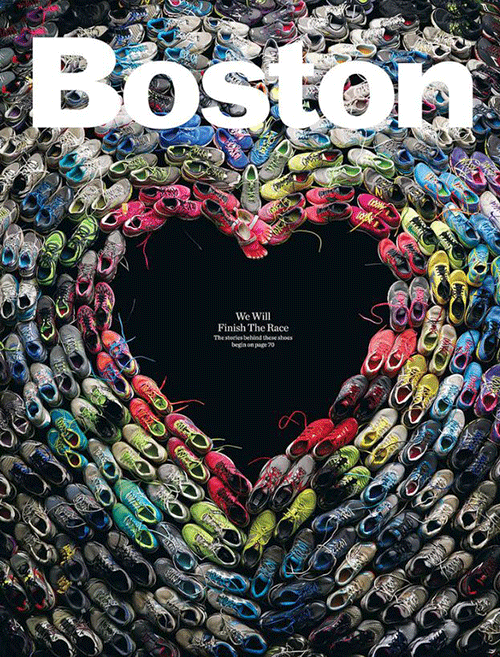
Cover of ‘Boston Magazine,’ by Mitch Feinberg
Less than a week after the Boston Marathon bombings, which left 3 people dead and over 280 injured, Cardinal Sean O’Malley emphasized the importance of forgiveness during Mass at the Cathedral of the Holy Cross. According to the Boston Globe, Cardinal O’Malley gave the congregation two reasons to consider forgiveness. The first was to avoid the “eye for an eye, tooth for a tooth mentality.” In that way, forgiveness offered a potential means to avoid further hostilities between groups. In fact, local tensions seemed to be simmering. O’Malley was likely cognizant of this, hoping to help defuse things before they progressed any further.

No more hurting people. (Martin Richard).
I’m at a loss as to how to properly address yesterday’s tragedy here in Boston, on Patriots’ Day. Following the attacks at the marathon and a nearby scare for our neighbors at the JFK Library, our university was closed yesterday afternoon and for most of the day today as a precaution. I’ve been wondering how, as teachers, we’ll get back to normal so soon after the event. Do we ignore it, and go on as if nothing happened, or address it head on? I don’t know, and will probably make some gut decision during tomorrow’s morning commute.
I’ve liked this for a long time. That is all.
“For the great enemy of the truth is very often not the lie—deliberate, contrived, and dishonest—but the myth—persistent, persuasive, and unrealistic. Too often, we hold fast to the clichés of our forebears. We subject all facts to a prefabricated set of interpretations. We enjoy the comfort of opinion without the discomfort of thought.”
.
.
This is the tenth(!) part on the evolution of human mating behavior, comparing evidence for promiscuity and pair-bonding in our species. Please see the Introduction here.
_______________________________________________________________
In her new book “Paleofantasy,” Marlene Zuk (2013) takes on the notion that our diet, exercise, and mating 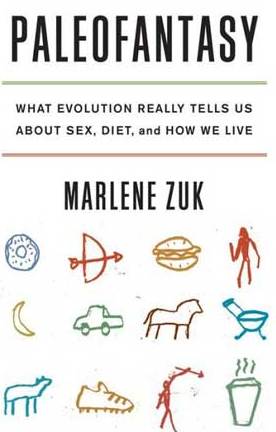 patterns are out of synch with our evolutionary biology. Some have argued that we have modified our environments too quickly for our own good, leading to the position that we would be better off if we could return to the days of old, before the modern world messed things up. There is probably some truth to this argument (an example I use in classes is that in only a few seconds, inserting $1.00 into a vending machine could return you over 400 empty calories bereft of other nutrients, a scenario our ancestors never encountered). But Zuk counters that the idea that we are stuck with hunter-gatherer bodies and minds in a modern world is overly simplistic.
Zuk notes that attempts to find health and happiness by returning to our idyllic, ancestral past (i.e., paleofantasies) face a few challenges. Among these are:
1. The methodological difficulties in determining exactly how our ancestors lived.
2. The variation among human groups across time and geography.
3. The idea that we were ever fully (perfectly?) adapted to our environment.
4. The fact that evolution does not stop; we are not ‘stuck’ evolutionarily in time.
In sum, she writes:
Today, my son told me he had figured out how to never make a mistake again. His solution: just never try or do anything anymore. He said it with a smile, but I think he half wishes this was an option. Unfortunately, he seems to have inherited a personality quirk (defect?) from me, which is that we are both incredibly good at self-flagellation when we make mistakes.
To cite a minor example, sometimes I’ll dwell for a couple of days on a student’s question that I couldn’t answer in class. Or if I forget somebody’s name who I am definitely supposed to know, I will swear at myself under my breath far too many times, more than most people would. And those are just minor examples. It can be a problem, one that I wish I hadn’t passed along. Dammit (see?).
To reassure my son, he is actually on the same wavelength as Alain de Botton, one of the better known modern philosophers out there. And he’s not even 10 yet. Good for him.


Goodall with Flint as an infant
I use the above photo in many of my classes. It paints an iconic scene of a young Jane Goodall in 1964 reaching out to the infant Flint. From there, I often elaborate on the number of years Goodall invested in her work and life into studying and advocating for chimpanzees, and for nature more generally.
By now, most people have heard that Goodall’s new (co-authored) book “Seeds of Hope” contains not only several lifted passages, but fabricated interviews and poor research. Here is one particularly harsh but even-handed review, which notes that the criticism of Goodall has been muted because of who she is and her long track record as a gentle ambassador of primatology.
 Patrick F. Clarkin, Ph.D.