
“(This is) a lecture on the mingling and merging and therefore on the oneness and unity of all the races of mankind...Let no Irishman throw a stone at the foreigner; he may hit his own clansman. Let no foreigner revile the Irish; he may be vilifying his own stock.”
– James Connolly, 1908
.
Years ago, on a trip to the Baseball Hall of Fame in idyllic Cooperstown New York, my father called me over to see something he found in the next exhibit. He pointed me to an 1860s job advertisement for a baseball club in Washington D.C. searching for top players, while also promising them a government job, a “first-rate position” in the Treasury Department (so much for meritocracy). The ad concluded with the disclaimer: “No Irish need apply.”
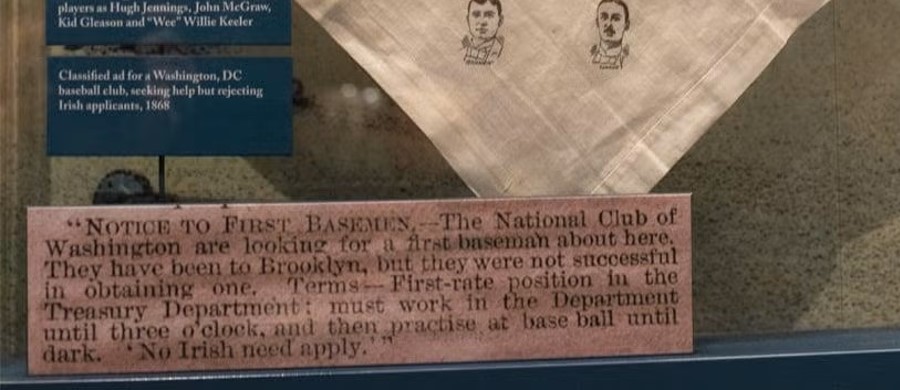
It wasn’t for lack of ability. The historian Jerrold Casway (2006: page X) referred to the late 19th century as “the Emerald Age of Baseball,” with Irish Americans becoming “baseball’s dominant ethnic group” and eventually making up as much as 40% of major league rosters. Casway noted that the game provided “a shortcut to the American Dream” for the sons of Irish immigrants, mere decades after the Great Famine. These would include early stars and Hall of Famers (often with colorful nicknames) such as Ed Delahanty, “Pud” Galvin, “Orator Jim” O’Rourke, and Mike “King” Kelly.[1]
But this isn’t an essay about 19th century baseball, as tempting as that topic might be to me (only me?), as an aficionado of the beautiful game that has marked the time.[2] Nor is it about discrimination against Irish immigrants being unique (it categorically was not). Rather, it’s about striking nativist parallels seen in the United States today, particularly against so-called “Third World” immigrants. And I suppose for that reason it’s also about empathy, and decency. In many ways the species of nativism seen today is even more pernicious than yesteryear in ideology and its effect on actual human lives and deaths in the streets and in custody. And, I think lamentably, such nativistic thought is often exhibited by people whose ancestors faced similar discrimination, of which many seem to have forgotten.[3]
As we’ll see in Part 2, the phrase “Third World” has had a recent resurgence. Although it originated in the Cold War and didn’t exist before the 20th century, the sentiment behind how that phrase is used today certainly existed—that the “backward” people of the world are somehow substandard or defective deep in their character, therefore making them unwanted. Had the term “Third World” existed in the 1730s or 1790s or 1840s or 1870s, it is highly probable that the nativists of the day would have applied it to Irish immigrants, and many other immigrant groups. Your family may be among them.
The site of these unwanted people’s (not just Irish immigrants) supposed defectiveness has shifted over the centuries, with nativists locating it someplace in one of their “wares” (hard- or soft-). The software camp would find fault in the unwanted having the wrong religion, wrong language, wrong culture, wrong temperament, wrong wealth, wrong attitude, wrong morality, wrong marriage patterns, wrong cuisine and food practices, etc. The hardware school would blame their wrong origins, wrong race, wrong biology, wrong genes, or evolution itself. Some wondered if the unwanted people were even fully human. Hypotheses varied, but nativists were convinced that the defects were deeply set and stubborn, possibly ineradicable.
Being a descendant of Irish immigrants, whose parents had a “Céad Míle Fáilte” sign in our front hallway (of course), I was already aware anti-Irish discrimination had existed in the U.S. and elsewhere prior to my visit to Cooperstown. Some have argued such overt forms of discrimination were rare, such as historian Richard Jensen (2002) referring to “No Irish need apply” (or NINA) advertisements as “a myth of victimization.” In 2015, however, the NY Times documented that variants of NINA were quite frequent in their own classified ads during the 1850s. The following year Rebecca Fried (2016), then just a middle school student, reported dozens more instances in newspaper archives across the US from 1842 to the early 1900s.
I also knew that the barriers faced by Irish immigrants in the US far surpassed not being considered for a position on a baseball club, or as a cook or child caretaker. Irish people on both sides of the Atlantic were often dehumanized and depicted as apes; portrayed as terrorists and religious threats; and stereotyped as stupid, drunk, criminal, dirty, and belligerent. Some were virtually kidnapped by the state and thousands were deported against their will (Hirota 2017), reminiscent of the current climate. In the US, they were portrayed as unassimilable (“undigested, undigestible,” according to Handlin [1991:55]), despite the fact they would go on to permeate “America’s pastime” and just about every other sphere of American life.

The Golden Rule
In any case, I knew some of this history, but wasn’t expecting to encounter it at the Hall of Fame, and it made me wrestle with what it means to have connections, however faded to time, to people considered pariahs. We merely took the trip to appreciate the game’s lengthy history, see some artifacts, and admire the achievements of the game’s great players, especially from our favorite team, the Boston Red Sox (of course). On the car ride home, my father reminisced about an argument he once had with a fellow Irish American who worked at his fire station (of course) who felt recent immigrants and minorities were lazy, stupid, and criminal. “Don’t you know your history?,” my father asked him. “That’s the same stuff they said about us!” This was years ago, but I remember him turning to me in the car and saying something like “what was wrong for people like us is wrong for everyone.”
That basic lesson—do unto others—had been instilled in me from a young age at home and at Catholic school (of course). While the “Golden Rule” is held as an ideal around the world, such empathy is not as common in practice, and is occasionally even met with outright contempt. For example, Elon Musk has derided “the empathy exploit” as “the fundamental weakness of Western civilization” driving those societies toward “civilizational suicide” (all of which he got seriously wrong).
For one, empathy is not unique to any culture, not even “Western civilization.” It is not even uniquely human. Monkey and ape infants, for example, have been observed to surround and embrace others in obvious distress, and seem to experience distress themselves (deWaal 2011). For a bonobo case study, see here. And among apes, there are thousands of cases of adults consoling others who were victims of aggression (p. 96). Therefore, empathy in some form is evolutionarily ancient, predating our species, rather than some construct of any given cultural tradition. However, we aren’t genetically predetermined to be constantly empathetic at all times, and it is also certainly true that individuals and groups can try to turn the empathic dial up or down. Some people seem to want to turn it off altogether.
This isn’t to say empathy is perfect. For one, we cannot empathize with everyone equally, and we tend to favor people closer to us. The psychologist Paul Bloom (2017) has compared some forms of empathy to a “spotlight,” illuminating one person or group but overlooking others. It can sometimes take effort to empathize with people who differ from us. But not too much effort. It shouldn’t be harder to find shared humanity with someone than becoming a trillionaire, flying rockets to space, or dismantling the life support system of millions of people (Cavalcanti et al 2025). Nor should it be easier for a young monkey to exhibit compassion than for an adult human.
Like any group of people, Irish Americans were never a monolith. They arrived on this continent in waves from different regions, circumstances, and religions. I can’t do the entire history justice in these brief essays; cherry picking is unavoidable. But it’s the persistence of contempt for Irish immigrants in US history that stands out to me: not quite omnipresent but enthusiastically popping its head out when invited. It’s easy to find examples of virtually every wave of Irish immigrants to the US being met with nativist disdain, to different degrees (I’ll get to this; I promise). This went well beyond “no Irish need apply” and wasn’t limited to the wave of Famine refugees, although I don’t know how aware the 30 million+ Americans who claim Irish ancestry are aware of it.
When I consider what it means to have Irish American roots, I take my father’s words to heart. He’s in his 80s now, a veteran who always had a strong sense of fairness. I asked him recently if he remembered our trip to Cooperstown and the conversation during the car ride home. He said he did, and added that he told his fellow firefighter: “Don’t do the same damn thing people did to your ancestors.”
.
“But prejudice soon fades away/When you find a heart that’s true”
One need not have experienced a specific trauma to feel empathy toward those undergoing one. It isn’t necessary to have lost a loved one or lived through an earthquake to imagine what those experiences might feel like. Still, some groups have used the traumas and injustices experienced in their past as reminders to advocate on others’ behalf, almost as a duty.
The Japanese American Citizens League, for example, advocated against racial profiling of Muslims after Sept 11, citing the stripped rights and internment of Japanese Americans in WW2. The NAACP made similar statements. When asked about the prospect of Muslim American children being taunted at school, 74 year-old Aiko O. King, in a display of empathy, said: “I can tell how they feel…I don’t want this to happen to another innocent group.”
Likewise, Japanese American organizations have spoken out against immigration officials in the US targeting and detaining people based on ethnicity, adding that “Japanese Americans were unjustly singled out based on race during WW2 and that no other group should suffer a similar fate.” Nidoto Nai Yoni (“Let It Not Happen Again”) they say, succinctly and eloquently. Or, “Never Again” say former targets of genocide. Native groups, too, have spoken up for others based on their historic experiences. Here are two quick examples. Levi Rickert (Prairie Band Potawatomi) said, “Native people know oppression… We cannot—we should not—profit from the oppression of others.” And Marcus Lopez (Chumash), citing the interconnectedness of all life, called on indigenous people to “defend the defenseless, the children, women and men; who are being rounded up, jailed and mistreated in violation of not only global human rights but the spiritual essence of our Indigenous culture.” Biblical scholars have pointed to passages like Exodus 23:9, which served as a reminder for Jewish people not to oppress the foreigner, and to remember how they were treated in Egypt.
To what extent have Irish Americans displayed similar obligations to others, based on their history? The story is messy, as expected, and beyond my ability to summarize here (this essay is already too long). In February of this year, the Ancient Order of Hibernians, an Irish American Catholic advocacy organization, cited their ancestors’ maltreatment when they condemned the depiction of Black Americans—in this case the Obamas—as apes on Donald Trump’s social media account. They wrote:
“we cannot—and will not—remain silent when any human being is dehumanized through the racist imagery that once targeted our own community. An apology is owed. Not for political expediency, but because it is right. The dehumanizing of people as apes was wrong in the 19th century, it certainly (h)as no place in the 21st.”
A friend who studies immigration told me that the phenomenon of immigrant groups “pulling up the ladder” or “closing the drawbridge” once inside the castle is somewhat common, even among first-generation immigrants. They wrote that several factors might explain this, including (1) hierarchy, since no one wants to be at the bottom; (2) immigrants positioning themselves as more deserving than others because they immigrated “the right way” while other groups just want to manipulate the system (even formerly undocumented immigrants sometimes claim this); and (3) assimilation, as some immigrant groups simply come to identify with the mainstream over generations.
To this list one might add that immigrants may forget how their ancestors were treated. But not always. As seen above, some immigrant and minority groups who’ve spent time at the bottom of the hierarchy, even temporarily, have made a conscious effort to remember the past and not to recycle the traumas once inflicted on them unto others. As Frederick Douglas once wrote, years after escaping slavery, he could not allow himself “to be insensible to the wrongs and sufferings of any part of the great family of man.”
[1] I started to make a longer list of these players, but know this may only appeal to a small audience of baseball enthusiasts: Ed Delahanty, “Pud” Galvin, Tony Mullane, Ed Walsh, Eddie Collins, Tim Keefe, Hugh Duffy, Tommy McCarthy, “Orator Jim” O’Rourke, Roger Connor, and Mike “King” Kelly.
[2] As Walt Whitman wrote in 1846, “The game of ball is glorious.”
[3] In 2016, Irish Senator Aodhán O’Ríordáin, lamented the fact that many Irish Americans were now guilty of the same xenophobia once directed at their ancestors, calling it “an odious irony” that several people working to curtail (non-white) immigration in the Trump administration had Irish surnames: (House Speaker Paul) Ryan, (Steve) Bannon, (Kellyanne) Conway and (Homeland Security Secretary John) Kelly.
References
Bloom P (2017) Empathy and its discontents. Trends in cognitive sciences. 2017 Jan 1;21(1):24-31.
Casway JI (2006) Ed Delahanty in the Emerald Age of Baseball. University of Notre Dame Press.
Cavalcanti DM, de Sales LD, Da Silva AF, Basterra EL, Pena D, Monti C, Barreix G, Silva NJ, Vaz P, Saute F, Fanjul G. Evaluating the impact of two decades of USAID interventions and projecting the effects of defunding on mortality up to 2030: a retrospective impact evaluation and forecasting analysis. The Lancet. 2025 Jul 19;406(10500):283-94. Link
deWaal, FBM (2011) Empathy in primates and other mammals. In Jean Decety (ed) Empathy: From Bench to Bedside (pp. 87-106). MIT Press. Link
Fried RA (2016). No Irish need deny: Evidence for the historicity of NINA restrictions in advertisements and signs. Journal of Social History. 49(4):829-54. Link
Handlin O (1991) Boston’s Immigrants, 1790–1880: A Study in Acculturation. Belknap.
Hirota H (2017) Expelling the Poor: Atlantic Seaboard States and the Nineteenth-Century Origins of American Immigration Policy. Oxford University Press. Link


Pingback: The Unwanted People: My “Third World” Ancestors (and Yours), Part 3 – Patrick F. Clarkin, Ph.D.