
“(This is) a lecture on the mingling and merging and therefore on the oneness and unity of all the races of mankind...Let no Irishman throw a stone at the foreigner; he may hit his own clansman. Let no foreigner revile the Irish; he may be vilifying his own stock.”
– James Connolly, 1908
.
Years ago, on a trip to the Baseball Hall of Fame in idyllic Cooperstown New York, my father called me over to see something he found in the next exhibit. He pointed me to an 1860s job advertisement for a baseball club in Washington D.C. searching for top players, while also promising them a government job, a “first-rate position” in the Treasury Department (so much for meritocracy). The ad concluded with the disclaimer: “No Irish need apply.”
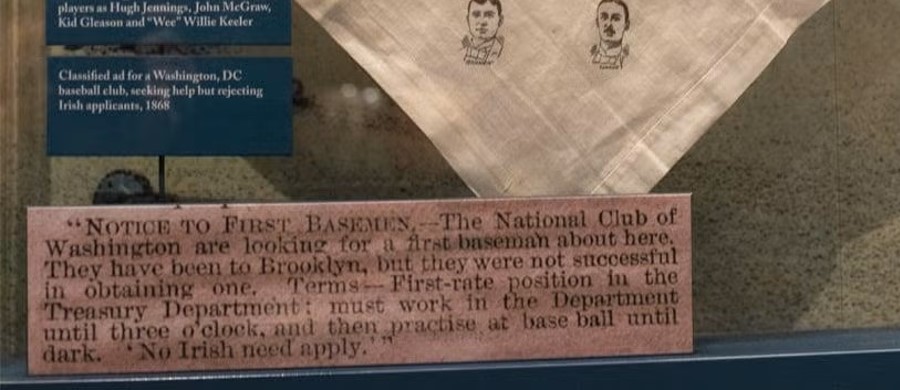
It wasn’t for lack of ability. The historian Jerrold Casway (2006: page X) referred to the late 19th century as “the Emerald Age of Baseball,” with Irish Americans becoming “baseball’s dominant ethnic group” and eventually making up as much as 40% of major league rosters. Casway noted that the game provided “a shortcut to the American Dream” for the sons of Irish immigrants, mere decades after the Great Famine. These would include early stars and Hall of Famers (often with colorful nicknames) such as Ed Delahanty, “Pud” Galvin, “Orator Jim” O’Rourke, and Mike “King” Kelly.[1]
But this isn’t an essay about 19th century baseball, as tempting as that topic might be to me (only me?), as an aficionado of the beautiful game that has marked the time.[2] Nor is it about discrimination against Irish immigrants being unique (it categorically was not). Rather, it’s about striking nativist parallels seen in the United States today, particularly against so-called “Third World” immigrants. And I suppose for that reason it’s also about empathy, and decency. In many ways the species of nativism seen today is even more pernicious than yesteryear in ideology and its effect on actual human lives and deaths in the streets and in custody. And, I think lamentably, such nativistic thought is often exhibited by people whose ancestors faced similar discrimination, of which many seem to have forgotten.[3]
Continue reading
