
(You may want to read Part 1 here. Or not. Your call.)
And still they teach you in your school
About those glorious days of rule
And how it’s your destiny to be
Superior to me
But if you’ve any kind of mind
You’ll see that all humankind
Are the children of this earth
And your hate for them will chew you up and spit you out
—Damien Dempsey, Colony (2000)
.
Part 2 examined the resurgence of the phrase “Third World” and it being used to single out unwanted immigrant groups, almost exclusively non-white. I noted the parallels to the way this phrase has been used in past portrayals of Irish immigrants, promising to go into more detail. Importantly, negative perceptions were used to justify ill treatment and discriminatory policies, as they are today toward other groups.
Why were Irish immigrants so frequently targets of discrimination? Much of this animus was transferred from Britain in the form of stereotypes that extend at least as far back as the 16th century.[1] These depicted the Irish as ‘wilde,’ wicked, ‘bloud-thirsty’ cannibals and animals, ‘Devills in humane shape,’ and full of ‘naturall fury’ (Holland 2017). By the 1700s Irish people were also painted as fools, drunks, and idiots such “that the Irish were no longer singularly an object of fear, but now one of ridicule and mockery” (Holland 2017).
Eventually, Irish people on both sides of the anglophone Atlantic were racialized as qualitatively different and inferior, ascribed either due to their “hardware” (biology, lineage, evolution) or “software” (culture, religion, language, upbringing, etc.).
St. Patrick’s Vermin: A Violent Case of Social Indigestion
As early as 1718, Bostonians blamed Irish immigrants for creating a food shortage, with Thomas Lechmere writing that “these confounded Irish will eat us all up” (Shipton, 1936: 238).[2] Harvard historian Clifford K. Shipton (1936) referred to the 1730s as “the first Celtic invasion” of New England, with Irish of different religions making up the bulk of the imported servant class, indentured for terms of roughly four to seven years (p. 233). According to Shipton, “It was the Celtic temperament and manners of this group of immigrants which produced the violent case of social indigestion from which New England suffered” (emphasis added). Old newspapers, such as The New England Courant (Sept 21, 1724) mocked the Ulster Irish in their midst as “greasy Teaguelandish Slubberdegullians[3],” while the Jan 11, 1725 edition referred to Irish Catholics as “St. Patrick’s Vermin,” adding that:
“They serve us for no other Purposes than to plague their Masters and Mistresses and debauch their Children. This gives us an ill Opinion of Foreigners, expecially (sic) those coming from Ireland.” (cited in Shipton 1936, p. 235).
.
“Hoards” of Third World Irish
Later Irish waves were also met with hostility. The Alien and Sedition Acts of the late 1790s were written, in part, to curtail people from Ireland from coming to the US and becoming citizens. This was borne out of fear of Irish immigrants and exiles joining the French if that nation should invade the US. For some quick background, revolutionary France had allied itself with the United Irishmen rebellion of the 1790s, which called for equality for Catholics and Presbyterians as well as Ireland’s independence from the British Empire. Some voices in the US depicted United Irish immigrants as an ultimately destabilizing population: wild, vicious, and part of a conspiracy to overthrow the government.
Under the pseudonym “Peter Porcupine,” the pamphleteer William Cobbett (1798) warned Americans of the alleged Franco-Irish conspiracy. In his telling, United Irish emigres were akin to modern-day sleeper cells which the French sought to use as instruments of mayhem. Cobbett claimed to know on good authority that in the city of Philadelphia alone there were over fifteen hundred United Irishmen who would “lie in wait” until called upon for “cases of urgency” (p.24). At that time, they would “proceed in the same manner as the Jacobins,” too cowardly to directly attack the government but presumably open to commit acts of terrorism. Cobbett added that the French chose the United Irish “wretches” for their “Real, sincere, villainy, then without property, without principles, without country and without character; dark and desperate, unnatural and bloody-thirsty ruffins” (p.2). So the stereotype of Irish as objects of fear clearly didn’t go away completely.
Cobbett also warned that America was uniquely vulnerable to this supposed Franco-Irish alliance for a couple of reasons. First, the United Irishmen expressed a belief in freedom of thought for all: an “uncontrouled (sic) opinion on all subjects, to be the common rights of all the human species” (p.7) and had already admitted “free negroes” into their cause. Relatedly, they had the potential to create slave revolts: “to set their negroes free, in order to excite discontents amongst those of their neighbours, and thus involve the whole country in rebellion and bloodshed” (p. 27).
Cobbett’s estimate of 1,500 potential Irish threats in Philadelphia came during a period when 5,514 new Irish immigrants settled in the city between 1790 and 1800 according to Edward C. Carter II (1970: 342). Carter did not give a breakdown of these new immigrants by age or gender, so it is unclear whether Cobbett’s alleged 1,500 terrorists were all men of certain age.
Whatever. The upshot is that Cobbett painted a sizable proportion of the Irish immigrant population as worthy of deep suspicion, and not just in Philadelphia, but in Baltimore, “New-York,” and elsewhere. There is a thin line between fearing a specific group of imagined United Irish conspiracists and extending that fear to all Irish immigrants generally, with Cobbett referring to the UI as “that restless rebellious tribe” (p. 2). Could any members of the larger “tribe” be trusted?
And it wasn’t just Cobbett. Boston Congressman Harrison Gray Otis wrote in a letter to his wife, that “If some means are not adopted to prevent the indiscriminate admission of wild Irishmen & others to the right of suffrage, there will soon be an end to liberty & property” (Carter 1970: 333-4). In a 1797 speech before Congress, Otis pronounced that he did “not wish to invite hoards of wild Irishmen” who made up a “mass of vicious and disorganizing characters who can not live peaceably at home” and who would “disturb our tranquility, after having succeeded in the overthrow of their own governments” (p. 334). Wild!? Wild how!?
Long story short: the United Irishmen did not overthrow the US or end liberty or property. The late Notre Dame historian Jay P. Dolan wrote that “having survived this period of nativist paranoia, the Irish exiles proceeded to make their mark in American society” (2010: 32). New bouts of nativist paranoia were never far away.
.
More Expendable than a Tub of Butter
Fast forward a few decades. The historian Hidetaka Hirota (2017) wrote that in Massachusetts alone, at least 50,000 people were deported back to Ireland, Britain, or Canada between the 1830s and early 1880s, under a revived colonial policy that allowed poor, destitute people to be “removed.” Other states had similar policies as well, though the bulk of 19th century deportations occurred in New York and Massachusetts, inspired by “an exceptionally strong anti-Catholic and anti-Irish tradition” and “economic concerns about their poverty” (p.2).
At the time, individual states had more direct authority over immigration, and new immigrants who were “likely to become a public charge” or who were ascertained to be lunatics, idiots, or infirm were prevented from disembarking altogether and returned to Europe, with wide latitude given to on-the-ground state officials as to whom fit these criteria.
For those who managed to come ashore, poor Irish Catholics were referred to as “ignorant and vicious” and “leeches” (sound familiar?) who were drains on charity and taxes (p. 2). Hirota wrote that practices in the removal of the poor and infirm were often “harsh,” extrajudicial, and against the will of those being deported, and sometimes amounted to virtual kidnapping.
Peleg Chandler, a two-term state legislator in Massachusetts noted that the “Superintendent of Alien Passengers” often defied a state law that required “paupers” to be brought to trial before removal (Hirota, p. 112). Consequently, people were disappeared without a paper trail, shipped overseas, and dumped in Ireland or Britain without any financial support. One newspaper, the Boston Daily Courier added, “Paupers have been sent away by the score in this indecent and reckless manner by irresponsible magistrates… with less of recorded and documentary evidence—than goes to the sending of a tub of butter, or a barrel of apples, from Fitchburg to Boston” (p. 114). Furthermore, deported individuals included elderly Irish people who had resided in the US for decades, including children of Irish descent who were born in the U.S., in defiance of state law against removing citizens (p.4).
There was also violence, of course. The 1844 Bible Riots in Philadelphia saw Irish homes and Catholic churches burned, and dozens killed, over ethnic tensions and disagreement over which version of the Bible should be read in schools (Schrag 2013). Similar riots led by the Know-Nothings would occur in other places as well, including the towns of Ellsworth and Bath, Maine, and in Louisville, Kentucky where perhaps a hundred people were killed (Klein 2025).
.
Inferior Irish Wares: Hard- and Soft-
By the 19th century, anti-Irish stereotypes had long morphed away from them bloodthirsty cannibals (progress!), but remained decidedly negative and often dehumanizing, including among prominent thinkers, politicians, and periodicals in the US and Britain. Remove the words “Irish” or “Celt,” from the following passages, and it isn’t too hard to imagine some of these things being said about other unwanted groups of “Third World” people today.
In 1836, future Prime Minister Benjamin Disraeli (then in his early thirties), wrote the following under the pseudonym “Runnymede”:
“[The Irish] hate our free and fertile isle. They hate our order, our civilisation, our enterprising industry, our sustained courage, our decorous liberty, our pure religion. This wild, reckless, indolent, uncertain and superstitious race have no sympathy with the English character. Their fair ideal of human felicity is an alternation of clannish broils and coarse idolatry. Their history describes an unbroken circle of bigotry and blood .”
By mid-19th century, early naturalists would attempt to apply a scientific lens to human variation, including for describing the Irish. In the view of British anatomist and ethnologist Robert Knox race was “everything in human history.” To his credit Knox “was strongly opposed to the use of race and racial difference to justify domination” and even expressed sympathy for indigenous South Africans in how they were treated by the Boers. Yet he made an exception in his loathing for “the Celtic race” of Scotland, Wales, and Ireland, singling out the “Irish Celt” as “the most to be dreaded” and pondered “how to dispose of them” (Knox, 1850: 252). Further, he concluded that the source of their “evil” resided not in misrule or oppression but in “the race, the Celtic race of Ireland,” putting him firmly in the hardware camp. He declared that all Celts were a threat to England and should be “removed from the soil.”
Also in the hardware school, Anglican clergyman Charles Kingsley would write an infamous 1860 letter to his wife that upon visiting Ireland he was shocked by the Irish “human chimpanzees” he saw there:
“I am haunted by the human chimpanzees I saw along that hundred miles of horrible country. … [T]o see white chimpanzees is dreadful; if they were black one would not see it so much, but their skins, except where tanned by exposure, are as white as ours.” (Kingsley 1860: 111)
Kingsley was an early defender of Darwinian evolution, and Darwin himself (as am I, for the most part). But the tendency of some early evolutionary thinkers to rank groups of humans as more or less evolved was a problem that still endures in some thinking today. The Irish were frequently placed at the lower end of the scale and dehumanized by comparing them with apes. They were often referred to as the “white negro,” (Dolan: p. 103), while Black people in the US were sometimes called “smoked Irish” (Dolan, p. 54).[4]
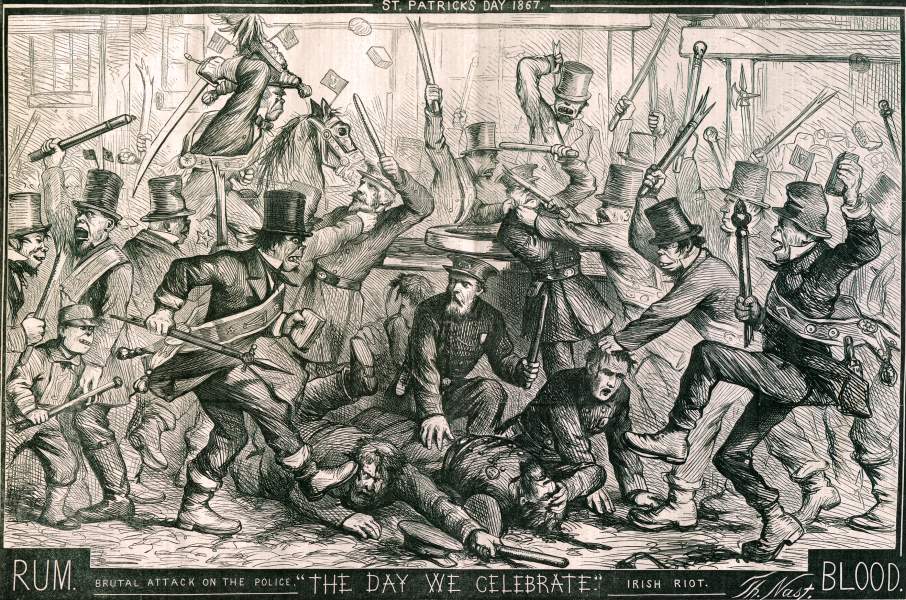
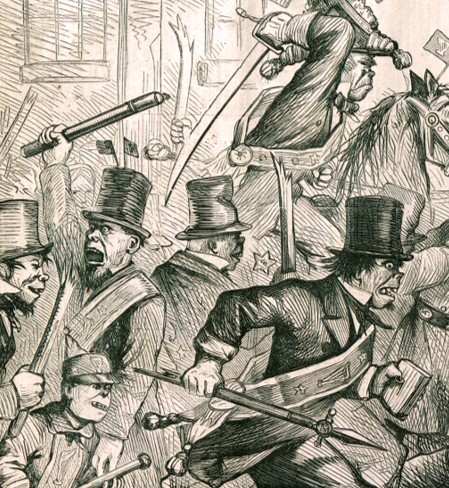
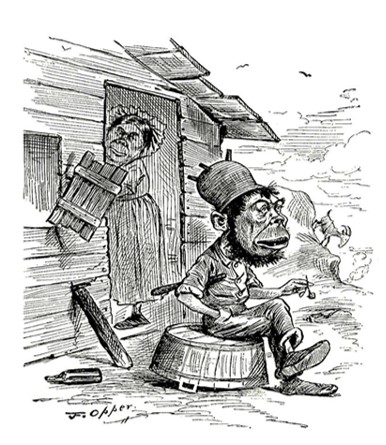
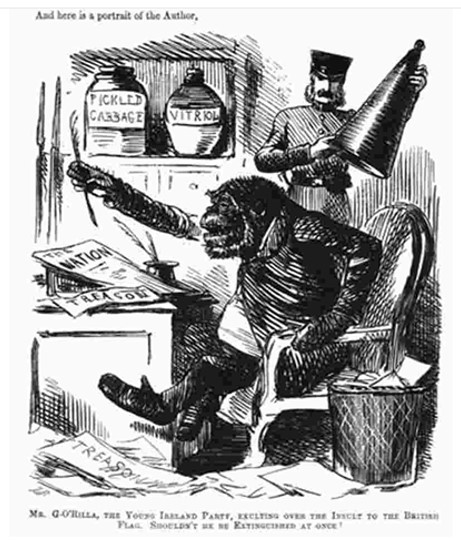
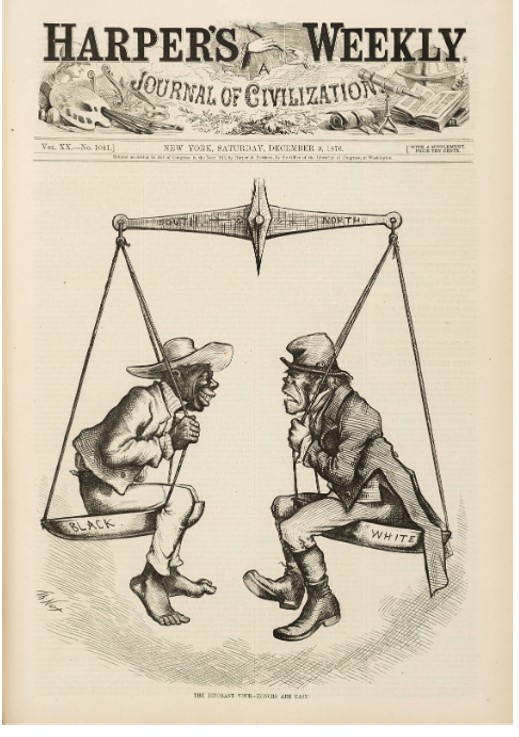
Interestingly, Holland (2017) noted British narratives in the 17th century compared the Irish to various animal species including bears, lions, boars, leopards, and (most commonly) wolves. It’s one thing to use human/animal comparisons in metaphoric sense. When it comes to comparing human groups to apes, its meaning is often more literal. The difference is that this is often an attempt to hijack the authority of science and evolutionary biology to claim that Group X is innately of lower status. The human-ape insult would follow the Irish (and Black people) for decades. The Irish would be granted a reprieve from this eventually, and the insult would be forgotten by most. “By World War I cartoonists had on the whole ‘lost their taste for simianized Paddies,’ although anti-Irish jokes and caricatures in general would continue to be somewhat acceptable for decades” (Casey, 2015: 12-13). Tragically the ape insult would last longer for Black people, as seen in Part 1.
In the US, perceptions of the Irish weren’t much better. An article on prohibition in the February 26, 1855 issue of the Chicago Tribune asked: “Who does not know that the most depraved, debased, worthless and irredeemable drunkards and sots which curse the community are Irish Catholics?”[5] Likewise, the Chicago Post declared in 1898:
“Scratch a convict or a pauper and the chances are that you tickle the skin of an Irish Catholic at the same time — an Irish Catholic made a criminal or a pauper by the priest and politicians who have deceived him and kept him in ignorance, in a word, a savage, as he was born.”
I guess we can put the Chicago Post in the software camp. Their claim was the Irish were still ignorant savages, but due to their environment (malevolent priests and politicians), not their genes. Is that progress? It’s still bigotry, just a different type.
Note the tricky logic in the above claims: it wasn’t that all Irish were “worthless,” or convicts, or paupers. But if you encountered any of those types of people, then—the claim went—they were probably Irish. It’s akin to saying something like: not all dogs are hounds, but all hounds are dogs. Three caveats about such claims: 1) they may or may not have empirical support (it’s statistically possible some ethnic groups exhibit more social problems than others), (2) they often flail at explaining why such problems might exist, and (3) they easily slip into blanket stereotyping and attaching pariah status to entire groups. Somehow those lessons still elude many people in power today, such as calling an entire ethnic group “garbage,” as seen in Part 2.
Unlike the Chicago Post, The New York Times (the so-called paper of record) did attempt to couch such views of Irish inferiority in evolutionary, scientific terms:
“Most of the individuals who make up this mass are links in a descending chain of evolution. In Ireland or Italy, or whatever may be the land of their origin, their ancestry for generations back have dwelt in squalid huts or noisome cellars, subjected year in and year out to the degenerating influences of an environment of wretchedness… This story of retrogression is the genealogy of thousands of immigrants who have settled among us. It is absurd to expect hearty co-operation in sanitary observances from a man whose whole life and lineage are steeped in filth and ignorance.” (“Compulsory Cleanliness,” New York Times, July 11, 1880, emphasis added)
Therefore, this pseudo-scientific argument went, there was something intrinsically defective about Irish immigrants (and Italians, and others), deep in their character. They were viewed as evolutionary throwbacks, retreads, “steeped in filth and ignorance,” of whom nothing positive should be expected. After all, how could such people have any hope of escaping their ‘ancestry,’ ‘genealogy,’ ‘life and lineage?’
.
Conclusions
When we consider just how supremely confident the above people were about Irish inferiority and undigestibility (for centuries, mind you), we are left with a pretty big question. How did Disraeli’s “wild, reckless, indolent, uncertain and superstitious race,” those “bloud-thirsty” cannibals, “Devills in humane shape,” those human chimpanzees, those foolish drunken idiots, those leeches, those “greasy Teaguelandish Slubberdegullians” who debauched their children, those wretches, “that restless rebellious tribe,” those ignorant and vicious criminals, “Saint Patrick’s vermin,” go from being the unwanted people to something else? Acculturation, familiarity, and time can profoundly shape perceptions.
The anthropologist Jon Marks (2014) wrote that “History is not an organic property. That is to say, if you want to understand our world, the stuff inside peoples’ heads (neurons and genes) seems to be much less important than the stuff between people’s heads (social relations and cultural forms).” A changing social environment can cause large shifts in status. Dolan (2010: 104) wrote that by 1900, American-born Irish began to outnumber the foreign-born, and the nativism that once targeted them was redirected at more recent immigrant groups from Southern and Eastern Europe. There were new people to hate, and some old ones too, as we’ll see in Part 4. Being physically white in a place that advantages whiteness certainly helps. But whiteness is a slippery thing, and not just a matter of complexion.
In 1882, a 24-year old Teddy Roosevelt wrote an entry in his diary that straddled the line between invective and grace. He wrote that by the third generation, a few descendants of Irish immigrants in the NY State legislature could be “pretty good men.”[6] However, he declared that most of the first-generation were part of a “stupid, sodden and vicious lot…equally deficient in brains and virtue” and “low, venal, corrupt and unintelligent brute(s).” He went so far as to say that two of the “best members of the house” were the grandsons of Irish immigrants.
Perhaps they weren’t so different after all. Centuries of stereotypes were profoundly inadequate explanations for explaining human behavior, as they are today against so-called “Third World” people. It shouldn’t take centuries to learn that lesson again.
.
References
Carter EC (1970) A “wild Irishman” under every Federalist’s Bed: Naturalization in Philadelphia, 1789-1806. The Pennsylvania Magazine of History and Biography. 94(3):331-46. Link
Casey D (2015) 19th-Century Irish ‘Ape-Man’ Cartoons and the Aesthetic of the Grotesque. MPhil Dissertation. Trinity College Dublin. Link
Cobbett W (1798) Detection of a conspiracy, formed by the United Irishmen, with the evident intention of aiding the tyrants of France in subverting the government of the United States, By Peter Porcupine. Philadelphia. Link
Dolan JP (2010) The Irish Americans: A History. Bloomsbury Press. Link
Hirota H (2017) Expelling the Poor: Atlantic Seaboard States and the Nineteenth-Century Origins of American Immigration Policy. Oxford University Press. Link
Holland E (2017) Anti-Irish sentiment in early modern Britain. The York Historian: The University of York Student History Magazine. Link
Klein C (2025) When America despised the Irish: The 19th Century’s refugee crisis. Link
Knox R (1850) The Races of Men: a Fragment. London: Henry Renshaw. Link
Mahon B (1991) Land of Milk & Honey: The Story of Traditional Irish Food & Drink. Mercier Press.
Marks J (2014) The Genes Made Us Do It. The new pseudoscience of racial difference. In These Times. Link
Schrag ZM (2013) Nativist Riots of 1844.Link
Shipton CK (1936) Immigration to New England, 1680-1740. Journal of Political Economy, 44 (2): 225-239. Link
[1] Negative stereotypes aren’t unique to Irish people. But the lengthy British-Irish colonial relationship, the proximity of the two islands, and the extensive written history certainly adds something here.
[2] This is likely the same Thomas Lechmere who married Ann Winthrop, granddaughter of Massachusetts Bay Colony Governor John Winthrop. They also had 9 children, which could help explain why he was worried about food. One of their children Richard, owned land that would be the landing place for British soldiers heading from Boston to Concord on April 19, 1775. Lechmere Square and subway station are also named for Richard. Anyway, small world.
[3] “Greasy Teaguelandish Slubberdegullians” was a new insult to me. Apparently, “Teagueland” was a pejorative term for Ireland, based on the given name Tadgh (akin to using “Paddy” or “Mick” as an insult). “Slubberdegullian” has also fallen out of fashion, and meant dirty, worthless, and slovenly. Only “greasy” has stood the test of time. Go figure.
[4] To be clear, this isn’t to say that it’s insulting for Irish people to be compared with darker skinned people. The point is that it’s insulting to refer to any group as inherently inferior and not fully human, which was how these ill-conceived classification schemes were often intended. I’ll have more on Black-Irish comparisons in Part 4.
[5] See the original here (2nd page, mid-part of the 2nd column): https://archive.org/details/per_chicago-daily-tribune_1855-02-26_9_48/page/n1/mode/2up?q=irish+catholic
[6] It’s important to remember that government representatives are not a random sample and aren’t the same as the general population.

