
(You may want to read Part 1 here. Or not. Your call.)
.
“As a nation, we began by declaring that ‘all men are created equal.’ We now practically read it ‘all men are created equal, except negroes’ When the Know-Nothings get control, it will read ‘all men are created equal, except negroes, and foreigners, and Catholics.’ When it comes to this I should prefer emigrating to some country where they make no pretence of loving liberty — to Russia, for instance, where despotism can be taken pure, and without the base alloy of hypocracy.”
– Abraham Lincoln, 1855
.
In 1992, Thérèse Caherty and colleagues in Ireland published a series of short essays with the provocative title “Is Ireland a Third World Country?” In response to that question, one of the editors, Caitríona Ruane, wrote that “the answers were as various and diverse as those participating” (p. ix), highlighting the ambiguity of the concept and Ireland’s unique status. One chapter by Queens University sociologist Liam O’Dowd noted that at the time (early 1990s, remember) Ireland was among the 30 richest industrialized economies in the world. Therefore, he said directly, by that criterion most people would not categorize it as “Third World.” For comparison, Ireland today ranks in the top 10 for GNI per capita according to the World Bank and 11th for the Human Development Index.
However, O’Dowd pointed out that Ireland still faced high levels of poverty. Other authors noted Ireland’s parallels with other countries typically thought of as “Third World”, including its former colonial status, its semi-peripheral position in the global economy, political patronage and clientelism, the largescale displacement of its population abroad, human rights abuses in Northern Ireland, a reliance on foreign corporations for employment, and inequality. The chapter by economist Andy Storey and sociologist Ronaldo Munck reminded the reader that colonialism can leave “a legacy of distorted economic structures” and that upon independence Ireland emerged as an agricultural economy with relatively little industrialization, and therefore “Ireland’s developmental reference points are in the Third World rather than the First” (p. 61-2). Journalist Carol Coulter suggested Ireland was “somewhere between the First and the Third worlds,” and obviously not quite Second World either, for that matter (p. 13). Keep this in mind for later.
As mentioned in Part 1, this isn’t meant to take these categories too seriously. The phrase “Third World” began to fall out of fashion in the 1990s after the collapse of the Soviet Union. The phrase also came to be seen as pejorative. To quote political scientist Jorge Heine, it was “associated with countries plagued by poverty, squalor and instability (and a) …synonym for banana republics ruled by tinpot dictators.” Similarly, Georgetown epidemiologist Ngozi Erondu referred to the term as “very antiquated and offensive,” adding that “I feel like it connotes this superiority and inferiority.” When I was in graduate school in the mid-1990s, I recall a classmate from Algeria rebuking another for using the term “Third World” because it was belittling and even dehumanizing. That lesson still hasn’t caught on with some people, thirty years later. Or perhaps it has. Perhaps that’s why some people use it today.
Third World Resurgence
In some factions, the phrase has seen a recent resurgence on both sides of the Atlantic. In this usage “Third World” is meant not to describe governments, but ordinary people themselves: human beings from low-income countries, and (not coincidentally) almost always these are places with majority non-white populations.
In the UK, the rightwing Restore Britain party has written that it aims to “reverse the third-worldification of our country,” a position Elon Musk has supported. Musk has also endorsed the idea of prosecuting officials who allowed “dangerous third world savages” to enter the UK. In the United States, Fox News’ conservative commentator Tomi Lahren described Somali-born Congresswoman Ilhan Omar as “the perfect poster child for why we need a closed border and why we need to stop importing people from third-world countries who have no respect for this country.”
Likewise, Texas Congressman Brandon Gill wrote that NYC mayor Zohran Mamdani should “go back to the Third World” for the crime of eating briyani with his hands, calling the practice uncivilized and contrary to “Western customs” (for context, Mamdani initially used the term “Third World” in the video Gill referenced). The Council on American-Islamic Relations (CAIR) referred to Gill’s comments as Islamophobic, racist, and idiotic, and pointed out that Americans eat many types of foods with their hands. As a side note, Gill might also be surprised to learn that adoption of the dining fork was relatively recent in different parts of Europe, with some early Christians denouncing their use (instead of their God-given hands) as vanity, pretension, even femininity. In Ireland the dining fork was still virtually absent in the early 1700s, while noggins acted in place of cups and seashells stood in for spoons (Mahon 1991: 8). It wasn’t until mass production that dining forks became more common in many places. This is a reminder that culture affects perceptions of just about everything. Also, cutlery is a silly yardstick for measuring human worth (as is whether someone uses yardsticks, or stones).
As another example from Texas, former Tarrant County GOP Chairman Bo French called for the deportation of 100 million people from the US in overtly racist language, including “third world savages,” “third world subtards,” Native Americans, as well as all Muslims (and at least one Chinese-American). French won his primary election in May, proving that –at least in some quarters– these ideas are not disqualifying. The 100 million deportation figure is not random and has been pushed by others, including former Border Patrol “commander-at-large” Greg Bovino and (notoriously) the official Department of Homeland Security X account, which cynically described the US as “besieged by the third world.”
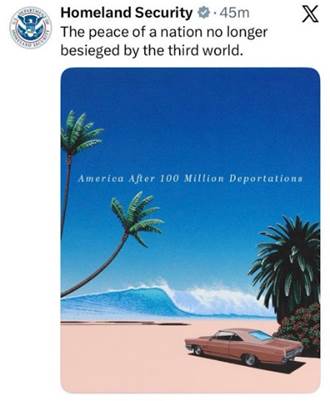
One hundred million anything is a number almost too large to comprehend, let alone the idea of uprooting 100 million individual human lives, roughly 30% of the US population. Where that number came from in the first place has also received differing explanations. Bo French wrote that his targets were the “50 million illegal aliens” and “55 million foreign visa holders” in the US. This figure has no basis in reality and far surpasses the estimated 11.8 million to 14 million undocumented immigrants in the US. Another hypothesis from social media was that 100 million was the approximate number of Black and Hispanic people in the US. A third (and probably the likeliest) explanation is that this is roughly equal to the 97.2 million people in the US who are immigrants (regardless of legal status) and their U.S.-born children (i.e., citizens), according to the Migration Policy Institute. What all three explanations have in common is that they primarily target non-white people, and that they effectively reveal a strong desire in certain quarters for ethnic cleansing of “Third World” people, with immigration status being a secondary concern.
Stephen Miller, the principal architect of Trump’s anti-immigration project, has also used the term multiple times. In December 2025, he told Fox News:“We need a moratorium on immigration from Third World countries until we can heal ourselves as a nation.” That same month, he suggested the US would have been a technological wonderland if it had “never open(ed) our borders to the entire Third World for sixty years.” Shortly before that in Nov 2025, Homeland Security Secretary Kristi Noem wrote that she recommended “a full travel ban on every damn country that’s been flooding our nation with killers, leeches, and entitlement junkies.”
The official website of the current White House boastfully describes its actions to curtail immigration, including that: “The Trump Administration terminated temporary protected status for a variety of dangerous, third-world countries, including Somalia, Venezuela, and Haiti.” Trump himself wrote in June 2026 that: “Sadly, if you import people from Third World Countries, you quickly become a Third World Country — And there’s not a thing you can do about it.” Singling out Somalia, Trump blamed that country’s recent struggles on its population, saying it was “no good for a reason” and that people from there were “garbage.” This mirrors his 2023 comments that immigrants from Africa and Asia were “pouring into” the US and “poisoning the blood of our country.”
What is left unspoken here is that such rhetoric equates the current condition of a nation’s economy and political stability with the population themselves. Somehow, the logic goes, either larger social forces have become embedded in the character of the people from those places, or the character of the people is responsible. In a throwback to centuries past, “nation” is used as shorthand for race, culture, and the quality of human beings en masse.
For one last example, Georgia Republican Congressman Mike Collins wrote pretty much the same thing Trump did about the US becoming “Third World” because of immigrants, an expression common in right-wing, anti-immigrant circles. Given that Mike Collins shares a name with the famed Irish revolutionary and Chairman of the Provisional Government of the Irish Free State, this is good place to segue back to the Irish (which is why I saved it for here, of course).
Third World Irish?
In Feb 2026, Elon Musk tweeted that the reason people come to the US is its culture, with “its English-Scotts-Irish origin.” Musk has had an obsession with race, culture, and immigration recently, and he obviously has a wide influence as the world’s only trillionaire and owner of a major social media platform. Despite that obsession, he might be surprised to learn that the “Irish” part of his equation wasn’t always thought of highly in US history. In fact, it was recurrently met with outright scorn and contempt from nativists, and not just from the anti-Catholic Know Nothings Lincoln referred to at the top of this essay. Also, I don’t know who Scott is, but he sounds important.
As we’ll see in more detail in Part 3, all the above components of the phrase “Third World” were applied to Irish immigrants to the United States in the past. Virtually every wave of Irish immigrants was met with suspicion and hostility, each with unique rationales. At different times they were painted as “savage,” unintelligent, backward, subhuman and unevolved (or “subtard”), dangerous, disrespectful, puppets of the Pope, poisonous, incompatible, unassimilable, and a drain on society.
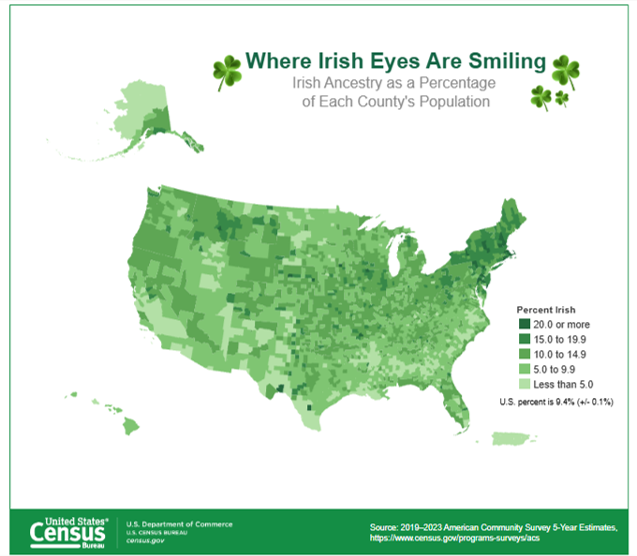
Despite the confidence that nativists, Know Nothings, and the like of yesteryear had in their claim that Irish immigrants were incompatible and inferior (possibly even subhuman), they would go from being pariahs to one day listening to Spancil Hill in the White House. Eventually, people who claimed Irish ancestry in the US would number 31.5 million (including 23 Presidents), second only to those claiming German heritage (43 million). They would be found in all 3,142 U.S. counties and comprise 20% of the population in some, particularly in New England states. They would become Americans and have their successes, struggles, and flaws, just like every other group of human beings. Some would retain memories and traditions of the past; others less so. The late Notre Dame historian Jay P. Dolan wrote that it even became chic to have Irish ancestry, and that “the example of the Irish, many of whom arrived in America destitute, can only offer hope for today’s immigrants. The Irish in America are a prototypical immigrant success story” (2010: 305).
Back in Ireland itself (assuming immigrants and those who stayed there are cut from similar cloths), one might wonder how the descendants of those allegedly inferior, backward (“Third World?”) people would one day rank so high for things like GNI and human development. The obvious conclusion is that the assumptions of the nativist, Know-Nothing camp were empty and bankrupt. Not much has changed.
.
References
Caherty T, A Storey, M Gavin, M Molloy, C Ruane, editors. (1992) Is Ireland a Third World Country?: The Report of a Conference Held in the Teachers’ Club, Dublin on 20th April 1991, organised by the Centre for Research and Documentation, Belfast. Belfast: Beyond the Pale Publications.
Dolan JP (2010) The Irish Americans: A History. Bloomsbury Press.
Mahon B (1991) Land of Milk & Honey: The Story of Traditional Irish Food & Drink. Mercier Press.


“We’re a third world country. What can you do?” – Jimmy Rabbitte, The Commitments
Pingback: The Unwanted People: My “Third World” Ancestors (and Yours), Part 3 – Patrick F. Clarkin, Ph.D.