Together with my brilliant colleagues Delaney Glass (UToronto) and Meredith Reiches (UMass Boston), we recently published our article “Coming of age in war: Early life adversity, age at menarche, and mental health” in the journal Psychoneuroendocrinology.
This was a special issue on forced migration and physiology, guest edited by Lee Gettler (Notre Dame) and Jelena Jankovic-Rankovic (University of South Carolina), and I think we probably compiled one of the most comprehensive reviews to date about armed conflict and menarche (first menstruation).
There are a couple of hypotheses about how child and adolescent bodies respond to early stressors: one is that bodies should mature quicker in times of uncertainty to increase one’s chances of reaching reproductive maturity. (The literature suggests that this does seem to happen under certain circumstances and types of stressors). The other is that maturation would be delayed, possibly due to energetic constraints.
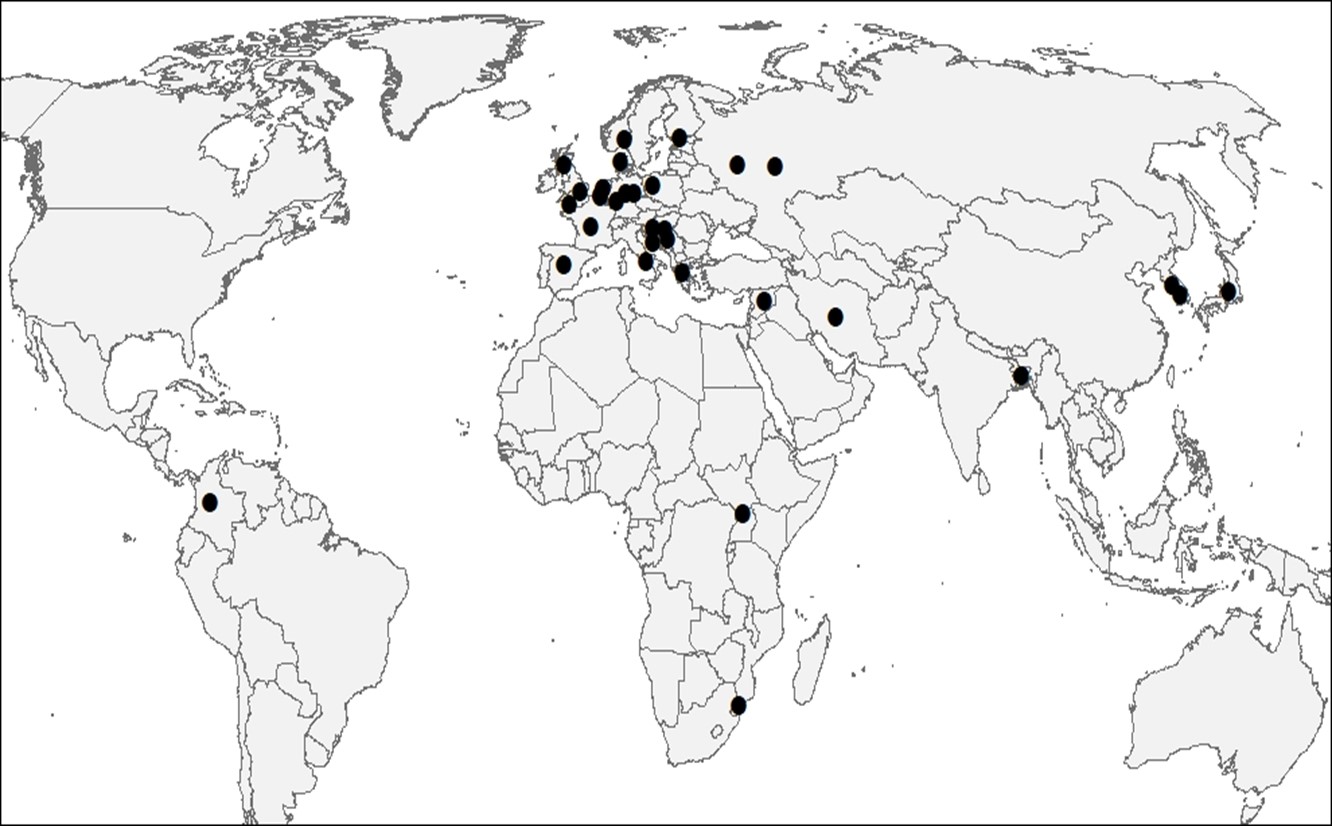
We identified 36 samples from 29 studies in the literature that looked at armed conflict and menarche, with a range of methods and populations from around the globe. Here’s some of what we found…
Locations of samples on conflict and menarche we identified from the literature.
In graduate school, my advisor Mike Little recommended I take a class outside of the Anthropology Department, since our class offerings were slim that semester. He suggested I go over to Biology and sign up for David Murrish’s class “The Biology of Extreme Environments,” which explored how different species adapted to their worlds. Dr. Murrish kindly accepted me. On the first day of class, before getting into any subject matter, he asked the students for examples of extreme environments.
People suggested some of the ones you’re probably thinking of—deserts because of their heat, polar regions, the deep oceans, etc. I recall one student suggested outer space. I raised my hand and asked, “What about war?” Dr. Murrish smiled and said with a chuckle, “You anthropologists… always looking at the social side of things!”
Of course, biological anthropologists recognize that there is a natural world to which species adapt, which existed long before humans ever evolved roughly 300,000 years ago (Hublin et al 2017). Not everything about human biology can be attributed solely to “the social side of things.” In Mike Little’s classes we learned about his research with Quechua people in highland Peru and Turkana pastoralists in northwestern Kenya, and they how they adapted biologically to stressors in their respective environments: hypoxia, cold, aridity, seasonal rainfall (Leslie and Little, 1999; Little et al., 2013). But Dr. Murrish’s question that day made me think about other types of extreme environments that we create for ourselves, and war certainly applies.
I didn’t get to explore war much further that semester, but the idea percolated. A couple of years later for my dissertation, I eventually explored how the Second Indochina War impacted the growth and body composition of Hmong refugees living in the US and French Guiana (Clarkin 2008). From there I thought about war as an environment in a general sense, including the various stressors they can create and the ways these things leave a mark on human biology and get “under the skin,” particularly among the very young who are still growing.
I recently saw the video below of a boy in Gaza describing how excruciating his life is, to the point that he wishes for death. I shake my head at how the world (particularly my country, the United States) allows this to continue. These people are beyond the breaking point, and it is a moral failure to allow innocent people to live exist under these conditions, for months on end.
(In case the video is taken down or lost to time, here is the given translation…)
“My only wish is that the Zionists leave us alone, and I get to live out my childhood! And that’s it!! Nothing else!
“I’m tired of everything! Everything! I’m wishing that I could just say ‘O Lord!’ and I die, and then come back to life again! Come to another life!”
I’m wishing that I could just die, I’ll die and be done with all this here! It’s what I want! Because we’re tired of this! We’re tired! We’re tired! We’re being tortured!
We’re being tortured! By Allah, my uncle, we are being tortured! By Allah, we are being tortured! I haven’t lived my own childhood! We’re just children and we’re being tortured! We’re young (children) and we’re (always) filling (containers with) water (everyday) and I never used to even think about water, or anything else!
I suffer from everything! From everything from water, from everything, from food, from drink, from everything! We go through torture just to get anything! We’re being tortured!”
Childhood growth is a mirror for “the material and moral condition” of a society.
– Dr. James Tanner, pediatrician and auxologist (1986:3)
.
In 2015, Lital Keinan-Boker and colleagues published a study in The Israel Medical Association Journal that examined whether the Holocaust during WW2 had impacted the long-term health of older Israeli adults (mean age 69 years). They were working within the framework of the Developmental Origins of Health and Disease (DOHaD) paradigm, a body of evidence that shows that an array of stressors including malnutrition early in life (prenatally and/or during infancy) can increase risk for various chronic diseases in adulthood.
The study design compared people who were born between 1940–1945 in Nazi-occupied countries in Europe (which they categorized as the ‘exposed’ group; n=653) to those in Israel to Europe-born parents (‘non-exposed’; n=433). After adjusting for confounding variables, Keinan-Boker et al concluded that those born in Europe during WW2 were significantly more likely to have dyslipidemia, type 2 diabetes, hypertension, and cardiovascular disease. As they wrote, “The results of the current study on fetal and early childhood exposure to malnutrition and hunger and the subsequent long-term outcomes are in accordance with previously published data from research on non-Jewish populations.”
“Empathy is a finite resource. You can run out. As a normal, psychological response, you cannot give yourself of again and again and again without replenishing.” —Emmett Fitzgerald
I keep thinking of the psychologist Paul Slovic’s term “compassion fade,” or our inability to sustain empathy as greater numbers of people require aid. Slovic has pointed out that we have a much easier time empathizing with single individuals than with nameless statistics. So when we hear of numbers like 108 million people being displaced globally, 13,000 killed in the war in Sudan, or 30,000 people killed in Gaza, it doesn’t fully register with us. As the numbers go up, and the people with power seem unwilling to stop it, we can feel numb.
But when I see a single innocent girl in Gaza —not much older than my daughter— crying that she just wants her leg back again, any numbness instantly fades away.
The Finnish-Soviet wars will seem like an esoteric topic and a slight departure from the things I usually write about. I am doing this because of my interests in war and health in a general sense, particularly how conflict-related stress and malnutrition may affect long-term health. It’s important to remember that not all places are affected by war equally, and local details are essential. This is just a place for me to make some notes about how Finnish civilians, especially food supplies, were affected by the different wars from 1939-45. The main source is Olli Vehviläinen’s 2002 book Finland in the Second World War: Between Germany and Russia, in particular Chapter 7, “A Society Under Stress.” I’m also including some relevant photos from Thérèse Bonney’s 1943 photo-essay book “Europe’s Children.”
“War may sometimes be a necessary evil. But no matter how necessary, it is always an evil, never a good. We will not learn how to live together in peace by killing each other’s children.
The bond of our common humanity is stronger than the divisiveness of our fears and prejudices. God gives us the capacity for choice. We can choose to alleviate suffering. We can choose to work together for peace. We can make these changes – and we must.”
–Jimmy Carter Nobel Lecture, Oslo, (December 10, 2002)
“From the individualistic point of view it matters not at all that a million people perish, what matters is that one person dies a million times.”
—Lidiya Ginzburg (1902-90) siege of Leningrad survivor, “Notes from the Blockade”, p. 85
“I am not a number and I do not consent to my death being passing news. Say, too, that I love life, happiness, freedom, children’s laughter, the sea, coffee, writing, Fairouz, everything that is joyful—though these things will all disappear in the space of a moment.”
—Nour al Din Hajjaj, Palestinian writer (2006 -2023)
~~~~~~~~
Palestinians mourning their relatives, killed in an overnight Israeli strike on the Al-Maghazi refugee camp, during a mass funeral at Al-Aqsa Hospital in Deir Al-Balah, in the central Gaza Strip, on Monday. Source: Mahmud Hams/Agence France-Presse — Getty Images
Numbers can be a double-edged sword.
They can help us perceive the scale of an issue, or the difference between two things. We can use them to detect how patterns may change over time. They can aid us in finding associations between variables. And they can allow us to see a pattern from above and help us gain some emotional distance from it. To quantify, wrote Carl Sagan, was one of our most important “scientific tools” (though he also left room for qualitative approaches). Similarly, in Errol Morris’ outstanding documentary “The Fog of War,” one of Robert McNamara’s eleven lessons was simply “Get the data.” In sum, numbers are essential.
Yet numbers also have some limitations, particularly when it comes to war and human suffering. Sometimes, numbers seem to numb our humanity. As psychologist Paul Slovic has written, we are more apt to empathize with individuals in a way that is difficult when thinking about a multitude, an effect he referred to as “psychic numbing” (Slovic, 2007). For example, people are more likely to donate to charity after being presented with the story of a single affected person than statistics from a humanitarian disaster.
Delaney Glass, a graduate student in biological anthropology at the University of Washington, kindly invited me to be part of a project on the effects of the Vietnam War (or Second Indochina War or the American war, depending on your perspective) on the health of older Vietnamese adults. The article is now in press in the Journal of Psychosomatic Research and titled: “Weathering within war: Somatic health complaints among Vietnamese older adults exposed to bombing and violence as adolescents in the American war.”
There’s a lot in here, but to me the main takeaway is that proximity to intense US bombing in adolescence, particularly early adolescence, was associated with health complaints decades later in older Vietnamese adults. I think it speaks to the long reach of war, and it adds to what we know about the many ways war can become embodied, lasting for a very long time in the health of survivors. It also provides another example of how the Second Indochina War disrupted health, as was the case in Laos and Cambodia.
“I know what I’m talking about when I talk about war, and it’s the most disgusting thing that you could ever think of. And I’ve also noticed with every single war, it’s been declared by men who were too old to go, and it’s made me suspicious.”



 Patrick F. Clarkin, Ph.D.