Strained Bonds of Affection

image

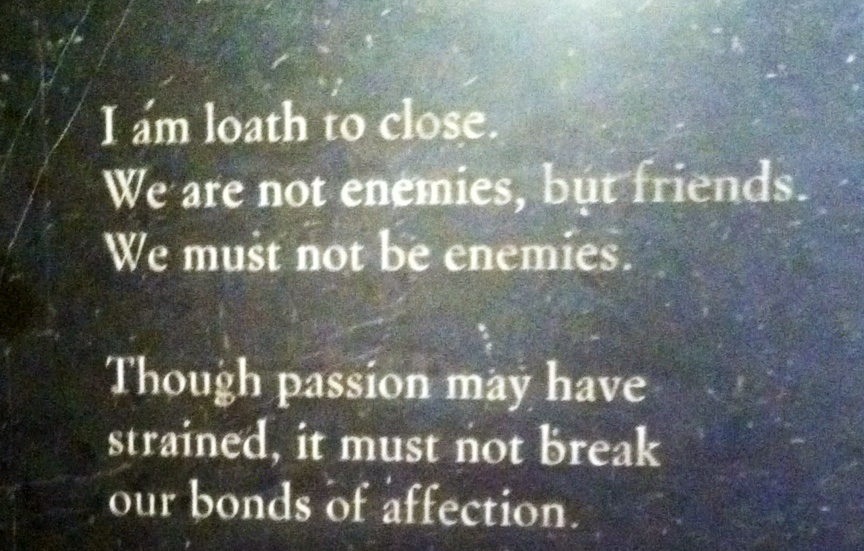
I took this (blurry) photo inside the Lincoln Memorial, on a recent trip to Washington, D.C. The quote comes from Lincoln’s first inaugural address, and it struck me as particularly relevant today since it seems that bonds are strained in so many places. Hopefully, we can remember that those bonds are essential, even if they don’t always come easily.  After all, we are cosmically connected primates


The Kindness of Strangers

In one of my classes, we play a game known as the Prisoner’s Dilemma. It’s a fun exercise, where students earn ‘points’ by choosing either to cooperate with, or defect on, a partner. We do a few different versions of the game, sometimes with randomly assigned partners for a single round, sometimes with the same partner for multiple rounds, and with different point structures. We also use a deck of playing cards, where students choose a red card to signify defection or a black card for cooperation. All interactions are face-to-face, in real time, and as an incentive there is a prize for the two people who receive the most points.

The main rule of the game is that the number of points one earns depends not only on their own choices, but also the choice their partner makes. The game was originally named after the dilemma that two partners in crime face should they be caught. Here is Eric Johnson’s succinct explanation:

In the game, two people who committed a crime are arrested and each is placed in solitary confinement for interrogation. If one betrays the other, the first goes free while the second is sentenced to three years in prison. If they both betray one another, they each receive two years. But if they both keep silent, they receive the minimum penalty of one year each. Under this scenario, the best individual strategy would be to betray the other. 

In our classroom exercise, we invert the scenario and give positive rewards for cooperating (points), since I’m not authorized to give out negative penalties for defecting like years in prison (not that I’d want to do that, anyway). 

Scenario

You get

Partner gets

You both cooperate w/each other 

3 pts

3 pts

You cooperate, but partner defects 

0 pts

5 pts

You defect, partner cooperates

5 pts

0 pts

Both defect 

1 pt

1 pt

.

.

Continue reading

Nicholas Winton & “The Only Way Out”

“And you think it’s easier
To know your own tricks
Well, it’s the hardest thing you’ll ever do.”


On my drive into work this morning, I caught the latter half of an interview with Nicholas Winton, the “British Oskar Schindler,” who helped rescue over six hundred Jewish children from Nazi-occupied Czechoslovakia just before World War 2. Recognizing the impending danger, Winton helped coordinate a number of trains to get the children to Britain, where families had volunteered to take them in. He was later reunited with some of those children – since grown – in 1988, recorded by the BBC. It is a very moving scene, particularly considering that the last train carrying children did not make it, and all of its evacuees were believed to have died in concentration camps. 


Winton is now 105 years old, and the interviewer asked him a range of questions about his role in the evacuations, his view of himself as a hero (he wanted no part of this), and his thoughts on the changes in the world that he had seen over his very long life. Overall, he said, he was pessimistic about the way the world has changed. We’ve grown more efficient at killing each other, and seem mired in conflict and unable to get out of our own way. 

The key, or “the only way out,” as he put it, is finding commonality with each other through ‘ethics.’ As a child, he embraced his own Jewish heritage, but then converted to Christianity. Later, he grew disillusioned with religion altogether when he learned that religious figures on both sides of World War 2 were praying for their own countries to win. I wanted to quote his exact words, so I found this print version of the interview. 

Continue reading

Feeding the Voices Within Us

From a David Barash piece in the New York Times (Are We Hard-Wired for War?):

“There is a story, believed to be of Cherokee origin, in which a girl is troubled by a recurring dream in which two wolves fight viciously. Seeking an explanation, she goes to her grandfather, highly regarded for his wisdom, who explains that there are two forces within each of us, struggling for supremacy, one embodying peace and the other, war. At this, the girl is even more distressed, and asks her grandfather who wins. His answer: “The one you feed.”

I like the story and the premise, that we may have multiple internal forces or ‘voices,’ but that there is also some executive decision maker within us that can choose which ones to nurture and cultivate. However, circumstances also play a large role — socialization, perceptions of injustice, fear of insecurity, relationships with our neighbors — in which voices we listen to. The rational executive is not always in complete control; instead, it’s a complex dialogue. As Jaak Panskepp once wrote:

Despite the appeal of (the) rational fallacy, our higher brain areas are not immune to the subcortical influences we share with other creatures. Of course, the interchange between cognitive and emotional processes is one of reciprocal control, but the flow of traffic remains balanced only in nonstressful circumstances. In emotional turmoil, the upward influences of subcortical emotional circuits on the higher reaches of the brain are stronger than top-down controls. Although humans can strengthen and empower the downward controls through emotional education and self-mastery, few can ride the whirlwind of unbridled emotions with great skill.” (Panksepp, 2004: 301)


Who’s in charge here?


Reference

Panksepp J. 2004. Affective Neuroscience: the Foundations of Human and Animal Emotions. Oxford Univ Press.


Related: Tradeoffs, Happiness, & the Biology of Our Cacophonous Selves

“Love For My Enemies”

When we first met again, what could I say? I was petrified to see him again. As if you killed someone, and a month later you discover he’d been resurrected. But running away from him didn’t help. I needed to ask him for forgiveness. So I went to his house. We talked about normal things, just small talk. After a while I said, “Innocent?” He said, “Yes?” “I have truly offended you. I have come to ask you for forgiveness.


– A Hutu man, Wellars Uwihoreye, who asked his childhood friend, a Tutsi man named Innocent Gakwerere, to forgive him for being involved in his mutilation and near death twenty years earlier.

The above came from a very moving essay, “Love For My Enemies.” It’s well-written, interspersed with videos of a handful of Rwandans trying to come to terms with the atrocities committed two decades ago. I find accounts like these to be simultaneously tragic and inspiring. Please go read it.

.

rwanda


The Success of Nonviolence

I just came across the work on nonviolence by the University of Denver’s Erica Chenoweth. In this TED talk, she says that she began as a skeptic about the ability of nonviolence to make meaningful change. Someone challenged her to look into the topic further, and she says she was shocked by the results. I am too, in a good way.

“From 1900 to 2006, nonviolent campaigns worldwide were twice as likely to succeed outright as violent insurgencies. And there’s more. This trend has been increasing over time, so that in the last 50 years nonviolent campaigns are becoming increasingly successful and common.”

Below is the key figure from Chenoweth’s presentation, illustrating the percent of violent and nonviolent movements that succeeded in overthrowing a government or liberating a territory. It’s clear that nonviolent movements are not a panacea to reducing violence in the world. They aren’t always successful, and sometimes violent movements may be necessary.

Continue reading

Acts of Reconciliation in Rwanda

“The world breaks everyone and afterward many are strong at the broken places. But those that will not break it kills. It kills the very good and the very gentle and the very brave impartially. If you are none of these you can be sure it will kill you too but there will be no special hurry.”
                                                                                             – Ernest Hemingway, A Farewell to Arms


The New York Times Magazine published a photo essay of case studies of forgiveness and reconciliation in Rwanda, two decades after the genocide there. The photos show a Hutu perpetrator with his Tutsi victim, along with a brief description of their individual stories of violence and the long road to asking for forgiveness. In the above picture, the woman, Vivianne, says of her former perpetrator, Jean Pierre: Continue reading

Ancient Ethnic Hatreds

This photo from a BBC report on the ongoing fighting in South Sudan made its rounds on the internet today, showing refugees being segregated by ethnicity at a UN compound. As of last month, an estimated 93,000 people had been displaced by the conflict, indicating the scale of the crisis (source: reliefweb).  

Signposts in Bentiu camp

Sign at a camp in Bentiu, South Sudan, segregating refugees by ethnicity. (Source: BBC)

Continue reading

Kindness and Regrets

Be excellent to each other.” – Bill and Ted (20th century philosophers)


From a commencement speech by George Saunders: 

“What I regret most in my life are failures of kindnessThose moments when another human being was there, in front of me, suffering, and I responded…sensibly.  Reservedly.  Mildly.”

Saunders then describes a memory from the seventh grade, when he did not defend the new girl in school who was teased for being different. Forty-two years later, he still thinks of her occasionally, and even though he was not personally cruel toward her, he regrets not going out of his way to extend her kindness. He then questions why kindness is often lacking, and he looks for prescriptions to make it more common.

The speech is a good one, and it stirred up some personal memories of instances when I could have used some kindness from someone. Sometimes it came; others it didn’t. There were also situations that called for me to be the one to extend kindness to someone else who needed it. Sometimes I stepped up, although probably not as consistently as I should have. Fear can be a powerful deterrent. Like Saunders, I regret those missed opportunities.

Of course, the opposite of kindness is cruelty, and I’m often distressed by the latest story of human callousness, where someone is belittled for not conforming to another’s standards. For those of us who are not Rhodes Scholar Olympians (which is to say, nearly everyone), we all fall short of socially constructed ideals in some way. Either we’re not attractive enough, or not stylish, athletic, or smart enough (or too smart). Too red. Too blue. Too promiscuous or too chaste. Too tall. Too short. Too neurally atypical. Or, we’re the ‘wrong’ weight, gender, race, sexuality, ethnicity, social class, or speak the wrong dialect. We can be incredibly creative at finding the holes in the armor to bring someone down.

For such an intensely social species, we often seem to go out of our way to make each other want to leave the group.

Continue reading