Sapiosexuality & Our Behavioral Complexity

You know, animals have sex. It’s biology, it’s natural instinct. We are the only ones who have an erotic life, which means that it’s sexuality transformed by the human imagination.”  — Esther Perel

One of the reasons some cultural elitists – political pundits, novelists, intellectuals – tend to be so unsettled by the Internet is that it has revealed how oceanically broad are the interests of the public in general. Before the Internet, with no way of observing the obsessions of the masses, it was a lot easier to pretend that these obsessions simply didn’t exist; that the nation was “united” around caring about the same small number of movies, weekly magazines, novels, political issues, or personalities. This was probably always a self-flattering illusion for the folks who ran things. The Internet destroyed it. When you gaze …upon the Pacific of strangeness online, you confront the astonishing diversity of human passion.”  — Clive Thompson (2013) Smarter Than You Think: How Technology is Changing Our Minds for the Better
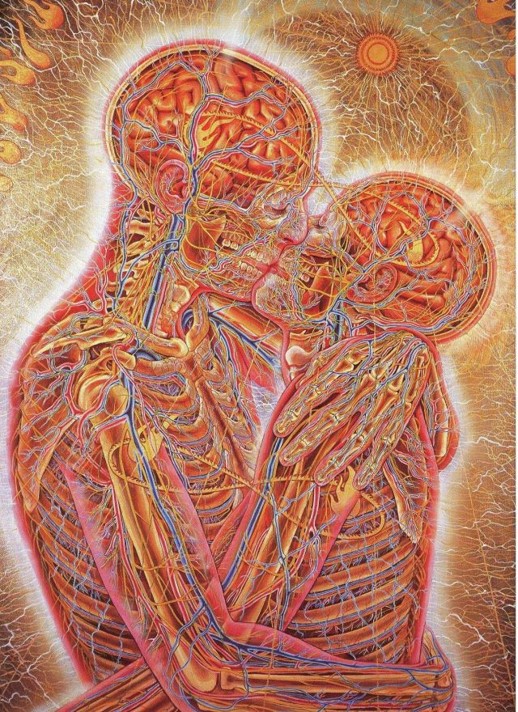
Kissing, by Alex Grey.

Kissing, by Alex Grey. (alexgrey.com)

                                                                                 ~~~~~~~

Please bear with me as I try to connect two not very obviously connected ideas: romantic love and our species’ behavioral flexibility. I don’t have it all worked out. Perhaps I’m going down the wrong path altogether.

I started thinking about these things after several friends on social media shared this Mandy Len Catron essay: “To Fall in Love With Anyone, Do This”. Catron describes a time that she and a male acquaintance intentionally tried to induce feelings of romantic love. To do this, they followed two steps, borrowed from a study done by the psychologist Arthur Aron. First, they asked each other a series of 36 increasingly intimate questions. Next, they stared into each other’s eyes for four uninterrupted minutes.

My first reaction when I went through the questions was that I can see how they could elicit feelings of intimacy under the right circumstances and with the right person. To work through all 36 of them would take some time, as they are not typical of everyday conversation. Time itself is could be a factor in bonding. To answer each question would require some thought, as they do not have prepared, canned responses. Some examples from Aron’s list:

  • Name three things you and your partner appear to have in common.
  • Take four minutes and tell your partner your life story in as much detail as possible.
  • Is there something that you’ve dreamed of doing for a long time? Why haven’t you done it?
  • What is your most treasured memory? Continue reading

Fragile Beauty

Nothing is permanent. That doesn’t mean beauty does not exist.

Tibetan sand painting (mandala). Source: wikicommons.

Tibetan sand painting (mandala). Source: wikicommons.

.

Life, Big and Small

A few years ago, I attended a conference on war and health in Seattle, and one of the keynote speakers was Chris Hedges, a former journalist who had covered several conflicts around the world. After he finished his presentation, the floor was opened for questions. I’ve since forgotten much of his speech and nearly all of the Q&A session, except for the final question. Someone in the audience asked him how his life had been affected by what he had seen, and how he readjusted to a life of relative comfort in the US.

At that point, he sighed and said that one of his young children had asked him something similar when he was preparing her lunch. I’m paraphrasing, but it was something like “how can you be happy here making me a peanut butter and jelly sandwich when you’ve seen so many big, important things like war around the world?” And he replied that “it’s because I’ve seen so many wars that I know how important the little things are, like making sandwiches” (again, I’m paraphrasing).

Continue reading

Some Thoughts on Syrian Casualty Figures

The New York Times reported yesterday that in 2014 more than 76,000 people were killed in the ongoing war in Syria. This was actually the highest figure since the conflict began (with 73,447 deaths in 2013; 49,294 in 2012; and 7,841 in 2011), so things have not gotten better. 

The statistics came from the British-based organization The Syrian Observatory for Human Rights, and the newspaper admitted that the figures could not be independently verified. That is probably to be expected. Estimating casualties during a time of war is a nearly impossible task, for obvious reasons. Even demographic surveys conducted after a war give a wide range of casualty estimates, as was the case with Iraq. Still, any attempt to quantify casualties is admirable, and a reminder of the damage done by war. 

One pattern stood out to me, which was the proportion of deaths attributed to civilians. If their estimates are correct (as much as possible), then civilians comprised 23% of deaths. The rest were divided among various factions of combatants. 

Syria casualties

Continue reading

This Blog

I just found out that this site made a list of frequently read science-y blogs. It’s one of the smaller dots on the radar, but it’s flattering just to be mentioned.

Apparently, Paige Brown Jarreau conducted a survey of 600 science bloggers, asking them to name three science blogs, other than their own, that they read on a regular basis. So, thanks to those people who mentioned this site. 

The other interesting feature was that Jarreau mapped the blogs into nodes, where sites that were commonly mentioned by the same reader were tied together. It looks like this site has connections to a couple of other excellent bioanthro blogs: Katie Hinde’s Mammals Suck…Milk! and Kate Clancy’s Context and Variation, as well as Ed Yong’s Not Exactly Rocket Science (Ed Yong is connected to more people than Kevin Bacon). 

On a related note, this blog is approaching its fifth anniversary, and I’ve been thinking of making some changes. However, I’m torn. I originally named it for personal reasons, in memory of my brother Kevin. But I think that can be confusing to people, since it has no direct correlation with anthropology or other things I write about here. So I’m not sure which way to go. Any advice?

A family of science blogs. The yellow arrow points to this site. (Source)

A family of science blogs. The yellow arrow points to this tiny site. (Source)

Time and Reconciliation: the Christmas Truce

The biologist Robert Sapolsky had a recent essay in The Wall Street Journal on the Christmas Truce of WWI, where he discusses how cooperation might develop under difficult circumstances. I wrote a blogpost on the same topic here a few years ago (in fact, it is still the most viewed thing on this site), and I think we cover much of the same ground. Sapolsky’s essay is better, which I’m fine with; it’s Robert Sapolsky after all.

At the end of the essay, he presents a thought experiment about trying to fast-forward mentally through the passage of time and seeing the present through the eyes of our older, wiser selves. 

Continue reading

2014 in Review

These were the ten most read posts of 2014, with #1 being the most read. As I look for patterns, I think they fall into three categories: War, cooperation & conflict; Evolution & plasticity; and Sex, love & relationships. You know, easy uncontroversial topics. 🙂

As always, nothing on this site would be read if not for you all. Thanks to everyone who visits here, particularly for the regular readers (you know who you are), and for your comments and sharing these posts. Happy New Year!  

10. The Kindness of Strangers (Nov 27)

An in-class academic exercise suggests that we are always somewhat dependent on the kindness of others, regardless of our own disposition as cooperators or defectors.

PD

9. Civilian Casualties Are a Feature, Not a Bug, of War (Jul 20)

Although we often think of war as a contest between competing militaries, data suggest that since the Second World War, 67% to 90% of casualties occur among non-combatants. I wrote this to help contextualize some of the conflicts occurring in the summer of 2014.

War deaths 2

Continue reading

We Are Complex

A list of claims of what humans are, with ‘human nature’ overtones. It’s meant to be in fun, and the list isn’t complete. 

  • We are moral animals. (1)
  • We are killer apes. (2)
  • We are risen apes, not fallen angels. (3)
  • We are aquatic apes. (4) No we’re not.
  • Man the hunter. (5)
  • Woman the gatherer. (6)
  • Man the firemaker. (7)
  • Homo, the endurance runner. (8)

    runners

    Born to run? (Source: Wikipedia)

  • Homo, the high-velocity thrower. (9)
  • We have an instinct for art. (10)
  • We have an instinct for language. (11)
  • We do not have an instinct for language. (12)
  • We are Homo economicus. (13)
  • Man the tool-maker. (14)
  • Pan the tool-maker. (15) Not us, but it’s clever.
  • We are social animals. (16)
  • We are cooperative breeders. (17)
  • We are hypersexual animals. (18)
  • We are sexy beasts. (19)
  • We are political animals. (20)
  • We are rational animals. (21)
  • We are irrational animals. (22)
  • We are no longer just apes; we are biocultural ex-apes. (23)
  • We are complex.


It is not our intention to make you suffer more

Both sides are motivated by fear, by anger, and by wrong perception. But wrong perceptions cannot be removed by guns and bombs. They should be removed by deep listening, compassionate listening, and loving space. 

…. We should be able to say this: “Dear friends, dear people, I know that you suffer. I have not understood enough of your difficulties and suffering. It is not our intention to make you suffer more. It is the opposite. We don’t want you to suffer. But we don’t know what to do and we might do the wrong thing if you don’t help us to understand. So please tell us about your difficulties. I’m eager to learn, to understand.”  

                                                             — Thich Nhat Hahn, on empathy and averting conflict

That sounds very pollyannaish, doesn’t it? But imagine if it worked.