
Together with my brilliant colleagues Delaney Glass (UToronto) and Meredith Reiches (UMass Boston), we recently published our article “Coming of age in war: Early life adversity, age at menarche, and mental health” in the journal Psychoneuroendocrinology.
This was a special issue on forced migration and physiology, guest edited by Lee Gettler (Notre Dame) and Jelena Jankovic-Rankovic (University of South Carolina), and I think we probably compiled one of the most comprehensive reviews to date about armed conflict and menarche (first menstruation).
There are a couple of hypotheses about how child and adolescent bodies respond to early stressors: one is that bodies should mature quicker in times of uncertainty to increase one’s chances of reaching reproductive maturity. (The literature suggests that this does seem to happen under certain circumstances and types of stressors). The other is that maturation would be delayed, possibly due to energetic constraints.
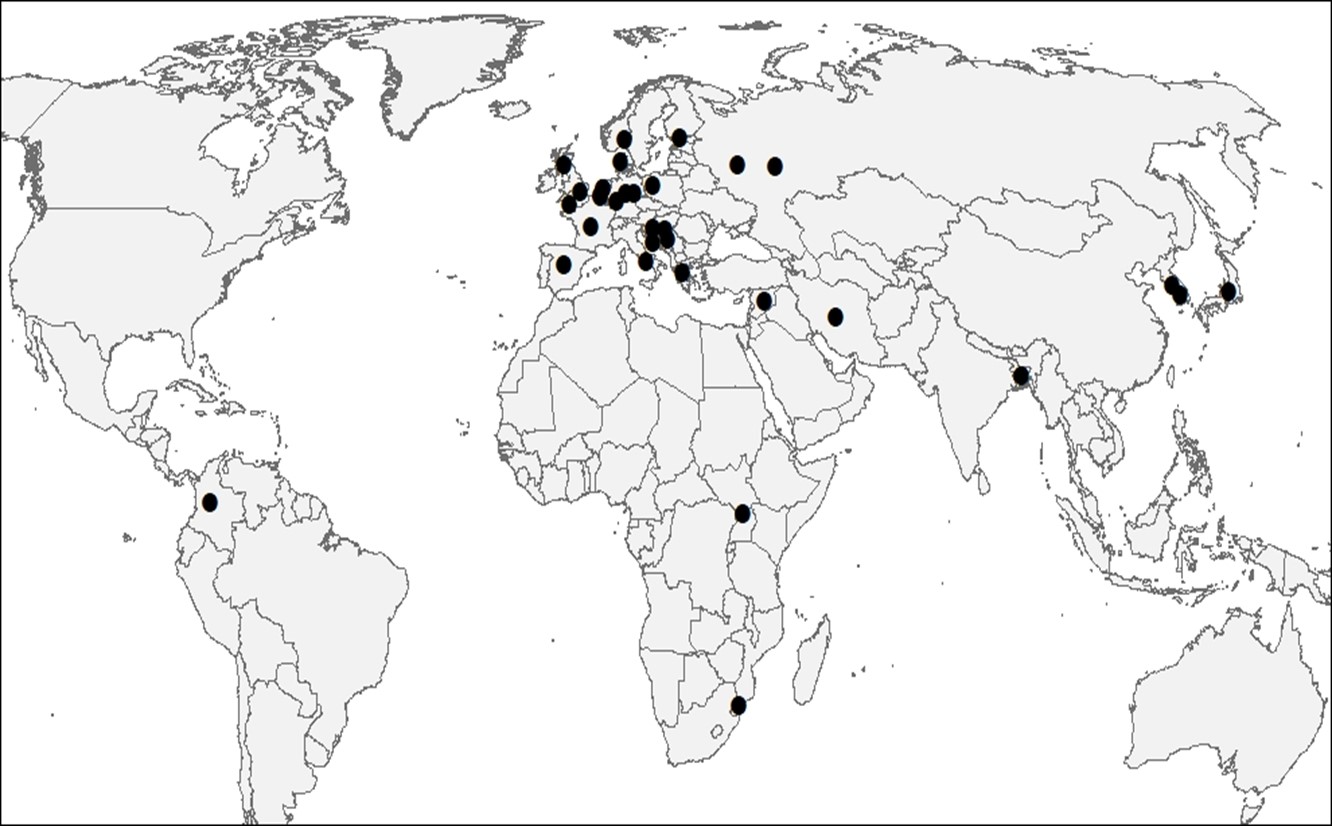
We identified 36 samples from 29 studies in the literature that looked at armed conflict and menarche, with a range of methods and populations from around the globe. Here’s some of what we found…
.
We found that conflict was more likely to be associated with a delay in menarche, which was true of nearly two-thirds (63.9%) of samples. Just one study found an acceleration. Two samples found that a previous secular trend toward earlier age at menarche stagnated during conflict. The remaining samples (27.8%) showed no discernible effect.
Several samples found a delay in menarche of a year or more, on average, including the occupied island of Guernsey during WW2 (+1.0 yrs), Germany during WW1 (+1.0 yrs), several German cities during WW2, including Leipzig (+1.2 yrs), Cologne (+1.4 yrs), Nuremburg (+1.5 yrs), a separate Leipzig sample (+1.5 yrs), as well as girls in Srebrenica (+1.4 yrs).
We discuss the different types of stressors involved in war and how these may differ from more secure contexts, as well as the importance of adolescence as a critical period of life, and intersections between war, maturation, and mental health.
Delaney and Meredith are incredibly bright and wonderful to work with (those aren’t platitudes – they’re super sharp and kind). We’re grateful to the editors for giving us their approval to join this special issue and for ultimately deciding to publish it. We’re proud of the article and hope it does some good.
Citation
Glass, Delaney J., Meredith Reiches, and Patrick Clarkin. “Coming of Age in War: Early Life Adversity, Age at Menarche, and Mental Health.” Psychoneuroendocrinology (2024): 107153. Link
 Patrick F. Clarkin, Ph.D.