Apologies Are in the Air

Hopeful news comes in threes (I think that’s how the saying goes). I just happened to come across three stories today related to apology and forgiveness.

1. In Bolivia, Pope Francis apologized for the role of the Catholic Church in the harm done to Native Americans:

“Some may rightly say, ‘When the pope speaks of colonialism, he overlooks certain actions of the church. I say this to you with regret: Many grave sins were committed against the native people of America in the name of God.”

He added: “I humbly ask forgiveness, not only for the offense of the church herself, but also for crimes committed against the native peoples during the so-called conquest of America.”

Continue reading

Thoughts on PTS and “Moral Injuries”  


Over the past five years, a good percentage of this blog has been focused on the effects of war on health. Some of these topics have included:

  • Other effects of war, such as forced displacement, food shortages, and destroyed infrastructure (here, here, here, here, here, & here)


I’ve largely stayed away from one of the most recognized effects of war: psychological impacts such as post-traumatic stress (PTS), perhaps with one notable exception: “Reconciliation, Biology, and the Second Indochina War.” This remains one of my favorite posts on this site. However, it dealt not with PTS per se, but with guilt and the desire for forgiveness and reconciliation, with many examples stemming from war.

I bring this up now because a few months ago I first encountered the idea of the long-term effects of ‘moral injury.’ According to Litz et al. (2009), a moral injury stems from “events, such as perpetrating, failing to prevent, or bearing witness to acts that transgress deeply held moral beliefs and expectations may be deleterious in the long-term, emotionally, psychologically, behaviorally, spiritually, and socially.”

In other words, while both have long-term psychological effects, moral injury may be distinct from PTS. As Thomas Gibbons-Neff wrote “unlike post-traumatic stress, which is a result of a fear-conditioned response, moral injury is a feeling of existential disorientation that manifests as intense guilt.” Neither idea is new, though both may have been unintentionally intertwined in psychology (at least in my non-expert understanding of this).

The terminology has been fickle, and PTS has been called many different names over the past several decades including shell shock, soldier’s heart, or combat fatigue. More recently, there have been efforts to drop the word ‘disorder’ from PTSD to simply PTS, in an effort to minimize stigma as well as to shift how those suffering from stress see themselves. Vocabulary really matters, and re-framing the terminology helps everyone see people with PTS simply as fellow human beings undergoing a very difficult period, rather than as permanently damaged.   

According to one study, references to post traumatic stress may extend as far back to the Assyrians in Mesopotamia between 1300BC and 609BC. Some ancient soldiers reportedly described “hearing and seeing ghosts talking to them, who would be the ghosts of people they’d killed in battle.” However, to me, this seems more like moral injury and manifestations of guilt, rather than fear, so perhaps these would be better categorized as moral injuries. Though it is almost impossible to do this retrospectively.

Some, like the primatologist Frans deWaal (2012), have suggested that the frequency of PTS among soldiers indicates that committing acts of violence does not come easily to humans, and that war is not a deep part of human nature:

“If there were truly a genetic basis to our participation in lethal combat, we should willingly engage in it. Yet soldiers report a deep revulsion to killing and shoot at the enemy only under pressure. After these experiences, they often end up with substantial psychological damage. Far from being a recent phenomenon, haunting memories of combat were already known to the ancient Greeks, such as Sophocles, who described Ajax’s “divine madness,” now known as posttraumatic stress disorder (PTSD).”

I’m not so sure. There is evidence that some people are drawn to violence and enjoy participating in it. A recent powerful essay by Tage Rai argued that the key to understanding human violence is that people are most apt to engage in it when they believe they are morally justified:

“Across practices, across cultures, and throughout historical periods, when people support and engage in violence, their primary motivations are moral. By ‘moral’, I mean that people are violent because they feel they must be; because they feel that their violence is obligatory. They know that they are harming fully human beings. Nonetheless, they believe they should. Violence does not stem from a psychopathic lack of morality. Quite the reverse: it comes from the exercise of perceived moral rights and obligations.”

If there is any good news, perhaps it’s that individuals who suffer a moral injury must, almost by definition, have some deep reservations about certain acts of violence. After all, one’s sense of morality cannot be injured if it didn’t exist in the first place. Secondly, the concept of ‘injury’ implies that healing is possible. Marek Kopacz (2014) wrote that after trauma, military personnel often seek out “support in an effort to realign their existential beliefs and reaffirm the meaning and purpose of life.” My guess is that — evolutionarily speaking — because humans have such a long history as social primates, it is likely that a person’s moral sense is integral to their meaning of life. Therefore, it is also likely that attempts at moral healing/ re-alignment could go a long way in terms of psychological health and overall well-being.


References

De Waal F. 2012. The antiquity of empathy. Science 336: 874-6. Link

Litz BT, Stein N, Delaney E, Lebowitz L, Nash WP, Silva C, & Maguen S. 2009. Moral injury and moral repair in war veterans: A preliminary model and intervention strategy. Clinical Psychology Review 29: 695–706. Link

Kopacz MS. 2014. Moral injury – A war trauma affecting current and former military personnel.  International Journal of Social Psychiatry  60: 722-3. Link

More Outreach: A Return to KIPP, Year Five

mandibles

I brought some friends to show variation in the mandibles of some apes and hominins.

This is the fifth (and likely final) year that I’ve visited the 8th graders at the KIPP school in Lynn, Massachusetts. Each Spring I visit for about three hours to talk about anthropology, evolution, and what life in college is like. This coincides with the time in the school year they are discussing evolution in their science classes.

In my most recent visit last week, the theme of the day was how all living things are biologically related, though we focused mostly on humans and other primates. In a way, all humans are ‘cousins’, as is everything that lives. I also brought some fossil casts with me to enhance the presentation, including a new addition to our lab at UMass Boston — that of a Gigantopithecus. Of course, it was a big hit. Who can resist the concept of Gigantopithecus?  

When I started doing this, I asked around if any teachers in the area wanted me to come speak with their students. Only one teacher responded, and she kept inviting me back each year. This time she told me that she’s moving on to another position, so it will likely be my last year visiting KIPP unless something changes. I may have to find another way to share anthropology with middle schoolers.

Continue reading

More Reconciliation: Multiplying the Exceptions

Is it impossible to multiply the exceptions so as to make them the rule? Must man always be brute first, and man after, if at all?” – MK Gandhi (1926)


I have a soft spot for stories that showcase the better parts of humanity. This isn’t to ignore all of the horrible things that people often do to one another. In fact, I think I’ve done a decent job at describing the ways that humans can alternate between being completely horrible or wonderful to each other (ex., see “Genocidal Altruists”). Overall, I think that focusing exclusively on either the good or the bad cannot accurately do justice to describing our complexity.

With that said, here are three stories of forgiveness or reconciliation that fall on the courageous and hopeful end of human behavior. As amazing as they are, perhaps consolidating them in one place will help make them seem not so unattainable for the rest of us.

Continue reading

40 Years After the Second Indochina War

Today does not escape easily from yesterday.

Several media outlets have published stories in the last few days marking the 40th anniversary of the ‘end’ of the Vietnam War (although it is more accurately known as the Second Indochina War because it also involved the neighboring countries of Laos, Cambodia, and Thailand).  

Some of these stories are about families of American veterans still searching for the remains of lost loved ones.  Others are about the lingering divisions between northern and southern Vietnamese, even within the same family.

Perhaps Viet Thanh Nguyen, an associate professor of English and American studies at the University of Southern California, best summarized these accounts with his NYTimes essay “Our Vietnam War Never Ended”. He describes moving to the US as a young boy and then growing up in San Jose, California with a foot in two cultures, as well as the struggles and successes of Vietnamese and other refugee groups in the US. And despite the fact that his family members have achieved a lot, such as producing a professor at a prestigious university, he writes that their story is not a fairy tale: 

“our family story is a story of loss and death, for we are here only because the United States fought a war that killed three million of our countrymen (not counting over two million others who died in neighboring Laos and Cambodia).”

Those two themes, that the war never truly ended, and that even those who survived and succeeded later in life have stories of loss and death, are important reminders of the past’s ability to reach into the present, even after forty years of yesterdays. All wars are unique, but their most consistent feature of war is the creation of suffering, which can last for decades, perhaps even centuries. Continue reading

Courage and the Past

Not everything that is faced can be changed, but nothing can be changed until it is faced.”                                        

                                 ― James Baldwin (As Much Truth As One Can Bear, 1962)

File:James Baldwin 5 Allan Warren.jpg

James Baldwin on the Albert Memorial with statue of Shakespeare. (Wiki commons)

I saw the above quote by James Baldwin over the weekend on social media, and my mind started making connections as to where it might apply. It could apply to personal wrongs and failures, or to wider historical ones, which of course is what Baldwin was referring to. By coincidence, the New York Times had another relevant story a few days ago about the reluctance of the Turkish government (and most of its citizens) to acknowledge the genocide of Armenians that occurred a century ago. It makes me wonder where, exactly, that reluctance originates, and why it can be so stubborn.

Last year, the New York Times (again) ran a collection of short essays on overcoming difficult pasts (“Turning Away From Painful Chapters”). Examples included the brutal murder of a British soldier on the streets of London, domestic violence against women in the UK, the Spanish Civil War, the killings in Rwanda, the Holocaust, and the legacy of American slavery and the brutality of Jim Crow laws in the US.

Continue reading

Confronting Human Frailty

A man carries within him the germ of his most exceptional action; and if we wise people make eminent fools of ourselves on any particular occasion, we must endure the legitimate conclusion that we carry a few grains of folly to our ounce of wisdom.”                                                                                                               

                                                                                     ― Mary Ann Evans (George Eliot), Adam Bede


In his book The Blank Slate, Steven Pinker borrowed a concept from the conservative scholar Thomas Sowell, who argued that there were two “visions” of human nature (Pinker, 2002). Pinker referred to these as the Tragic Vision and the Utopian Vision, and he spent several pages placing famous historical thinkers into one of the two camps.  

According to Pinker, the Tragic Vision suggests that “humans are inherently limited in knowledge, wisdom, and virtue, and all social arrangements must acknowledge those limits” (p. 287). On the other hand, in the Utopian Vision “psychological limitations are artifacts that come from our social arrangements, and we should not allow them to restrict our gaze from what is possible in a better world.”

These groupings are not perfect, but Pinker argues that they work better than trying to categorize people as left/right or conservative/liberal. For some examples, in the Utopian camp, Pinker placed people like Bobby Kennedy, Rousseau, and Thomas Paine. For Tragic Visionaries, he chose – among others – Friedrich Hayek, James Madison, Edmund Burke, and Hobbes.

Continue reading

Time and Reconciliation: the Christmas Truce

The biologist Robert Sapolsky had a recent essay in The Wall Street Journal on the Christmas Truce of WWI, where he discusses how cooperation might develop under difficult circumstances. I wrote a blogpost on the same topic here a few years ago (in fact, it is still the most viewed thing on this site), and I think we cover much of the same ground. Sapolsky’s essay is better, which I’m fine with; it’s Robert Sapolsky after all.

At the end of the essay, he presents a thought experiment about trying to fast-forward mentally through the passage of time and seeing the present through the eyes of our older, wiser selves. 

Continue reading

Another Trip to KIPP

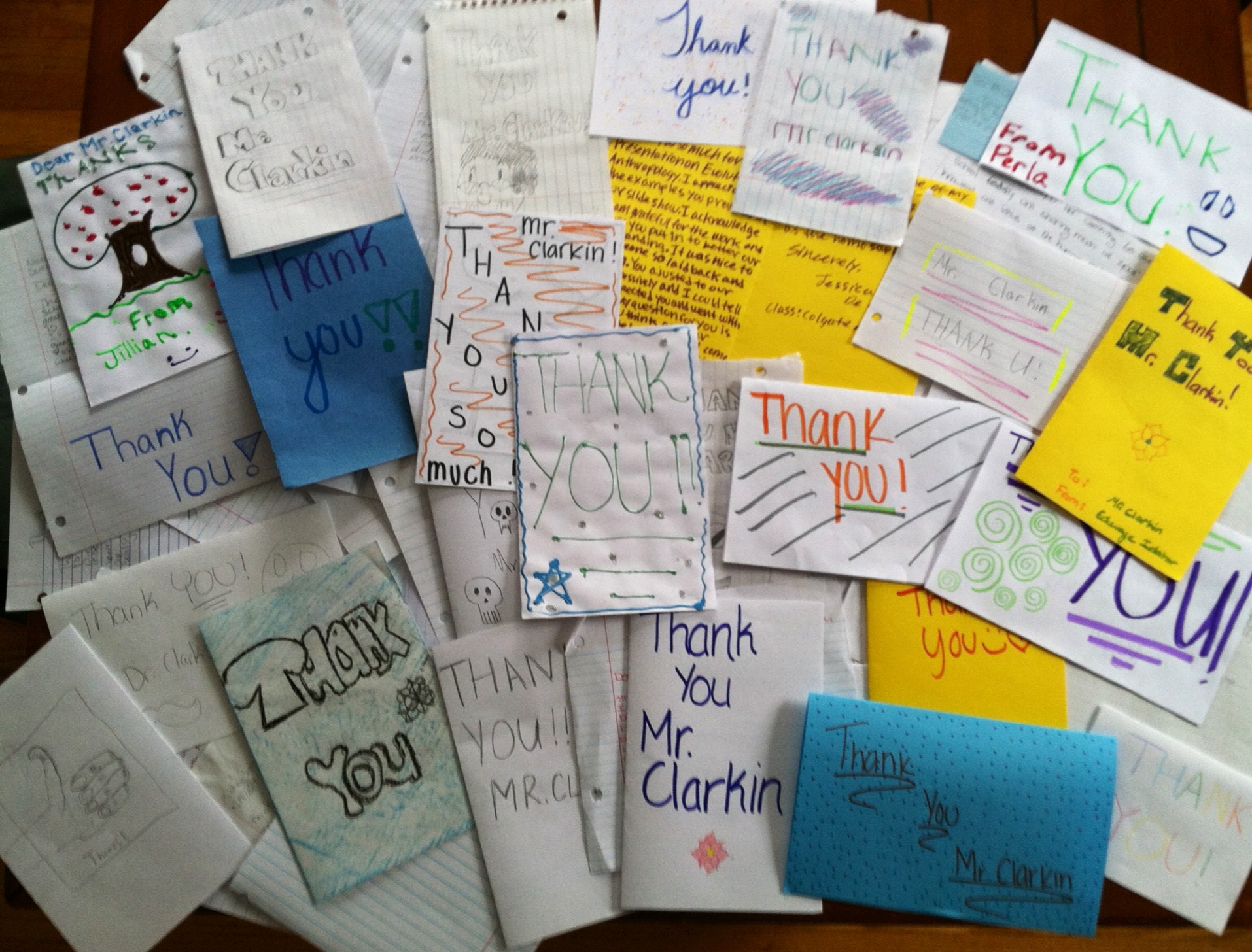
This is the fourth year I’ve visited the 8th graders at the KIPP school in Lynn, Massachusetts to talk about anthropology and evolution for a few hours. Every year, their teacher has them write me thank you notes, about 90 in all over three classes. That alone makes the visit worth it.

KIPP 2014

Related

Public Outreach: Sharing Anthropology Outside the University
Public Outreach 2: KIPP Lynn
More Public Outreach
KIPP Students Rock


Part 15: Humans Are (Blank)-ogamous: Lessons from Models of Sex and Love

Part 15: Humans Are (Blank)-ogamous: Lessons from Models of Sex and Love

The introduction to this series can be found here.

Summary: There are many ways to put a human life together, including for sex and love. Each path has tradeoffs.

____________________________________________________________________

I thought I knew what love was. What did I know?Don Henley, “Boys of Summer”

There are all kinds of love in this world, but never the same love twice. – F. Scott Fitzgerald


“Mom, love is love, whatever you are.” These words of wisdom came from Jackson, the 12 year-old son of actress Maria Bello, after she revealed to him that she had fallen in love with a woman. Bello’s essay, Coming Out as a Modern Family, appeared in last November’s New York Times, where she bravely reflected on her handful of past romantic relationships (mostly with men), her trepidation in revealing her evolving feelings on love, and the variety of meaningful relationships – platonic, familial, romantic – she had in her life.

In the most important sense, which is of course the sense that Jackson meant, love is love, irrespective of one’s sexuality, gender, or ethnicity. Studies from neurobiology reveal that people in the early stages of romantic love show consistent activation in specific brain regions (the ventral tegmental area and caudate) when viewing a photo of one’s partner. This was true for (1) men and women, (2) hetero- and homo-sexuals, and (3) American, British, and Chinese adults (Zeki and Romaya 2010; Xu et al. 2011). Not that Jackson needed it, because a person’s choices in love should be respected regardless of what neurobiology tells us, but he has science on his side.

Continue reading