Of all the things I’ve written on this site, this remains one of the most meaningful to me. (May 29, 2017)
“The weak can never forgive. Forgiveness is the attribute of the strong.” …………………………………………………………………………– Mohandas K. Gandhi
On my desk sits a spoon I bought in a restaurant in northern Laos. It’s lightweight, bigger than a tablespoon, and full of tiny dents that some unknown metalsmith hammered into it. The owner was bemused that in addition to the bowl of pho noodle soup, I also wanted to buy one of her utensils. But I had my reasons.
Earlier on my trip, my guide1 informed me that people in the town of Phonsavanh half-jokingly called these ‘B-52 spoons,’ as they were made of metal recovered from bombs dropped decades ago by U.S. planes during ‘the Secret War.’ To me, the spoon was more than a quirky souvenir. Instead, it represented an attempt by Laotians to take the physical remnants of a tragic period in history and forge them into something more positive, in effect turning swords into plowshares (or bombs into spoons).Continue reading →
Today marks the beginning of the First Meeting of States Parties to the Convention on Cluster Munitions, held in Vientiane, Laos. The meeting’s purpose is to determine how to effectively implement the objectives laid out by the original Convention, which took place in Dublin in May 2008 and became binding to ratifying states in August this year. Those objectives are as follows:
…
The Convention on Cluster Munitions, CCM, prohibits all use, stockpiling, production and transfer of Cluster Munitions. Separate articles in the Convention concern assistance to victims, clearance of contaminated areas and destruction of stockpiles.
…
Thus far, 36 countries have been affected by cluster munitions (ex. Lebanon, Angola, Serbia). However, it is appropriate that Laos is hosting this meeting, as it is one of the most heavily bombed countries in history – a legacy of American bombing during the Second Indochina War. The lingering effects of cluster munitions have been particularly pernicious. Even today, almost four decades after the bombing of Laos ended, there are roughly 250 casualties annually from unexploded ordnance (UXO) leftover from the war. Many of these casualties are children.
..
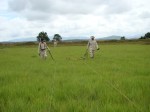
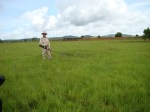
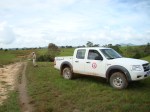
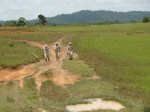
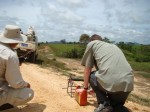
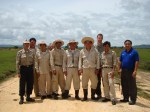
Last year, I saw some of the effects of the war in Laos first-hand in Xieng Khouang province, where craters and injured people are both abundant. My interpreter and guide, Manophet, introduced me to a bomb clearance team outside of the town of Phonsavan. They explained how the process of UXO detection and removal is painstakingly slow, given how widespread an area a single cluster bomb unit can cover and how many tons of ordnance were released over Laos (click here to see what a cluster bomb can do to your neighborhood).
…
The day I visited, the team had located ten ‘bombies,’ and they were kind enough to let me remotely detonate one, an experience far removed from my usual job. It was exciting, but also a chilling reminder of how long such munitions can last, with the potential to indiscriminately maim or kill even decades after a war has officially concluded.
…
As an American, it also struck me how we are obligated to clean up the mess we left behind. After all, the war in Laos is over. Therefore, UXO is not a military problem or a political one. Rather, it is a public health problem – killing family members, causing disability, and disrupting lives. Regardless of where one falls on the political spectrum, it should be uncontroversial to say that children should not be maimed or killed by bombs leftover from a war that ended decades before they were born. Removing the bombs in Laos is simply the right thing to do.
On the surface, it may not be so clear where war, health, and evolution intersect. From the perspective of biological anthropology, many have called for a holistic, transdisciplinary approach to human biology and health which considers the environment as the totality of its evolutionary, ecological, and social components, including social inequality (Little and Haas 1989; Thomas et al. 1989; Wiley 2004).
Girl in Darfur refugee camp (source: Colin Finlay)
…
More than a decade ago, Leatherman and Goodman (1998) suggested that biological anthropologists put more effort toward better understanding what they termed the ‘biology of poverty.’ In this sense, poverty is an ‘environment’ that may induce consistent, but obviously varying, biological responses depending upon local circumstances. Similarly, war can be conceived as a biological environment. At least in the short term from an evolutionary point of view, wartime conditions may be as biologically challenging as some of the classic ecologically extreme environments faced by humans (circumpolar, tropical, high-altitude, desert, etc.) (Clarkin 2010).
Yesterday marked the first visit of a Laotian government official to the United States since 1975. According to the Department of State website, Foreign Minister Thongloun Sisoulith and Secretary Hillary Clinton discussed many issues:
Map of bombing record in Laos (from organization UXO Lao)
Below is a clip of a 1970 CBS exposé of the war in Laos, which had only become known to the American public shortly before it was aired.
…
I had not seen most of this footage before, and find it pretty riveting. At the time this was shown, the war in Laos really was still pretty much a ‘secret war’ because of the 1962 Geneva Accords which declared Laos to be neutral and largely off-limits to foreign interference, specifically foreign troops. Of course, that wasn’t quite the way things played out. There are some really interesting tidbits of history in there that video conveys in a way that merely reading about history cannot, such as:
A recent book, “War and the Health of Nations“, by Zaryab Iqbal (Political Science, Penn State) takes a look at the associations between national health statistics and the presence and duration of war.
…
Chapter 8 explores the topic of forced migration and population health, though with a novel approach. Instead of exploring the ways that forced displacement by war is associated with health in refugees themselves, Iqbal looked at whether an influx of refugees affected overall health statistics in the host country. Utilizing aggregate health data from the World Bank and the number of refugees entering a state in a given year, she tested for associations between the two while accounting for multiple covariates (presence and duration of conflict, GDP, population size, openness to trade, and how democratic/autocratic a country is).
At the population level, childhood growth is often seen as a marker of health and the quality of the environment. When populations get taller in a few generations, this is likely due to some improvement in local conditions (better nutrition, less infection, cleaner water supply, etc.). Conversely, when linear growth declines, it is usually because local conditions (ecological, economic, political) have deteriorated. Two recent working papers illustrate how this pattern applies to war conditions.
War leftovers, decorating a hotel lobby in Phonsavan, northern Laos (July, 2009)
I was impressed by the conviction shown by Congressman Mike Honda (D-CA), when he wrote in today’s Washington Times that “we have a moral obligation to fix this problem” (leftover unexploded ordnance in Laos). He also called for an increase in funds and a sustained commitment to removing leftover cluster bombs dropped by U.S. planes in the 1960s and 70s.
Incidentally, the organization Legacies of War testified before Congress last week, including Rep. Honda, about the extent of the problem of UXO in Laos, and the need for greater funding. As I wrote previously, the scope of the problem is massive and deserves much more attention than it has gotten thus far.
A recent report by the group Physicians for Human Rights described the plight of Rohingya refugees from Myanmar who resettled in Bangladesh. Starvation conditions were said to be widespread among the estimated 200,000 to 400,000 refugees, with 18.2% of children aged 5 years or younger showing signs of acute malnutrition. For comparison, a rate of 10% is considered by humanitarian agencies to be a serious situation, while 15% is considered critical.




















 Patrick F. Clarkin, Ph.D.