For My Daughter

Every so often, some occurrence comes along that throws life into a new orbit. My trajectory was recently shifted by such an event – I fell in love with a girl. She’s much younger than me: not even a week old, in fact. And she happens to have half of my chromosomes, as daughters tend to do. She is healthy, and both she and her mother are doing well. I find myself carrying her around the house, just staring at her face. When she’s awake and looks back at me, which is mostly late at night unfortunately, it’s magical.

Obviously, we knew this day was coming. We’re not ready to plan her entire life out for her just yet (not until she’s at least a month old). But for a while now I’ve been thinking about what it will be like to be a father to a baby girl, and all the possibilities and challenges life has before her. She has two older brothers, who are crazy about her, but there are things that I worry about for their sister that I didn’t have to think about for them, at least not as much. Forgive me for how naïve this is about to sound because I know I’m behind the curve, but I’m trying…

Continue reading

Kindness and Regrets

Be excellent to each other.” – Bill and Ted (20th century philosophers)


From a commencement speech by George Saunders: 

“What I regret most in my life are failures of kindnessThose moments when another human being was there, in front of me, suffering, and I responded…sensibly.  Reservedly.  Mildly.”

Saunders then describes a memory from the seventh grade, when he did not defend the new girl in school who was teased for being different. Forty-two years later, he still thinks of her occasionally, and even though he was not personally cruel toward her, he regrets not going out of his way to extend her kindness. He then questions why kindness is often lacking, and he looks for prescriptions to make it more common.

The speech is a good one, and it stirred up some personal memories of instances when I could have used some kindness from someone. Sometimes it came; others it didn’t. There were also situations that called for me to be the one to extend kindness to someone else who needed it. Sometimes I stepped up, although probably not as consistently as I should have. Fear can be a powerful deterrent. Like Saunders, I regret those missed opportunities.

Of course, the opposite of kindness is cruelty, and I’m often distressed by the latest story of human callousness, where someone is belittled for not conforming to another’s standards. For those of us who are not Rhodes Scholar Olympians (which is to say, nearly everyone), we all fall short of socially constructed ideals in some way. Either we’re not attractive enough, or not stylish, athletic, or smart enough (or too smart). Too red. Too blue. Too promiscuous or too chaste. Too tall. Too short. Too neurally atypical. Or, we’re the ‘wrong’ weight, gender, race, sexuality, ethnicity, social class, or speak the wrong dialect. We can be incredibly creative at finding the holes in the armor to bring someone down.

For such an intensely social species, we often seem to go out of our way to make each other want to leave the group.

Continue reading

A Child’s Wisdom

Today, my son  told me he had figured out how to never make a mistake again. His solution: just never try or do anything anymore. He said it with a smile, but I think he half wishes this was an option. Unfortunately, he seems to have inherited a personality quirk (defect?) from me, which is that we are both incredibly good at self-flagellation when we make mistakes.

To cite a minor example, sometimes I’ll dwell for a couple of days on a student’s question that I couldn’t answer in class. Or if I forget somebody’s name who I am definitely supposed to know, I will swear at myself under my breath far too many times, more than most people would. And those are just minor examples. It can be a problem, one that I wish I hadn’t passed along. Dammit (see?).

To reassure my son, he is actually on the same wavelength as Alain de Botton, one of the better known modern  philosophers out there. And he’s not even 10 yet. Good for him.

de Botton

Continue reading

Tradeoffs, Happiness, & the Biology of Our Cacophonous Selves

You can’t have everything. Where would you put it?” – Steven Wright  (comedian)

 It seemed like a good idea at the time.” – S.A. (neuroscientist, friend)

 .

 .

Lately, I keep seeing a recurrent theme in a number of widely different sources. It’s a concept taught in Economics 101, that of tradeoff and opportunity costs – money or time invested in one object or activity cannot be spent on another. A related concept, foundational to biology, is life history theory (LHT). In his book “Patterns of Human Growth,” the biological anthropologist Barry Bogin defined LHT as:

the study of the strategy an organism uses to allocate its energy toward growth, maintenance, reproduction, raising offspring to independence, and avoiding death. For a mammal, it is the strategy of when to be born, when to be weaned, how many and what types of pre-reproductive stages to pass through, when to reproduce, and when to die.” (1999: 154)

life

you could be a winner at the game of life

Continue reading

Meta Mike Little

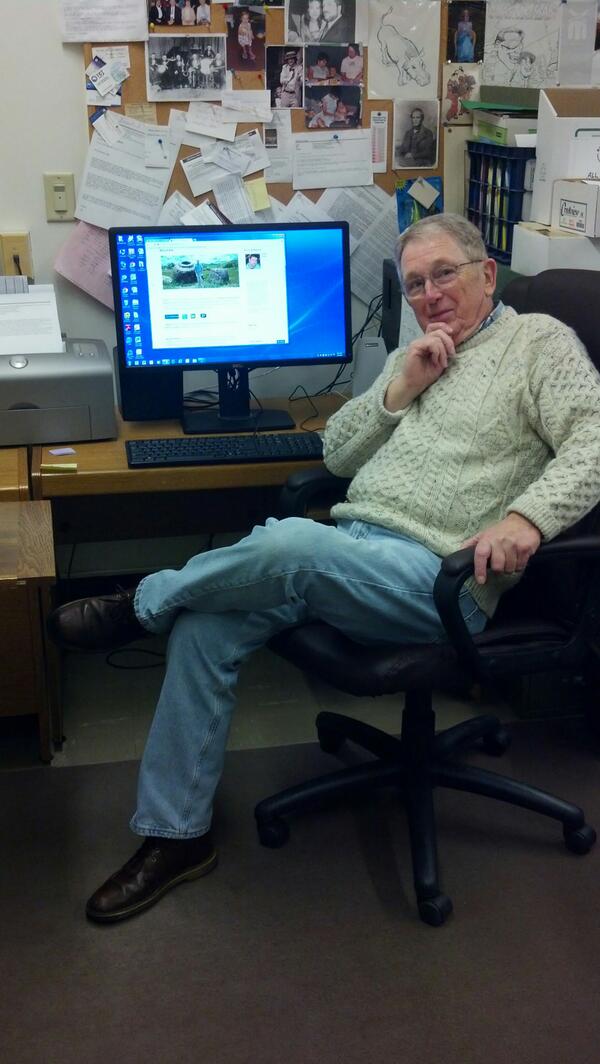
Someone at Binghamton sent me this photo today. It’s my advisor from graduate school, Mike Little, reading this blog. This made me smile.

Mike, if you’re reading this, thanks for everything. I hope seeing this isn’t too meta.

Mike and me.

.


A New Semester

These are the class rules and motivations I gave my students this semester, borrowed from the good people at KIPP (Knowledge is Power Program) and Neil deGrasse Tyson. I thought it would be better to keep things simple and positive, and these sounded a lot better than a list of “don’ts.”  Continue reading

Review 2012

Below is a quick look at the most-read posts that were written in 2012, with a brief summary, in case you’re interested.* Thanks very much to everyone for visiting, and to those who have shared these writings and commented on them.

..

1) Part 6. Humans are (Blank)- ogamous: Many Intimate Relationships. May 17

This was the most viewed post written this year. It looked at the variety of intimate romantic relationships that humans have negotiated into various socially recognized structures. I tried to go beyond looking at humans as naturally monogamous or promiscuous, which I think are overly simplistic arguments, taking a look at how this complexity may have arisen. There’s also a nice graphic, borrowed from David McCandless.

We obviously have a lot of cultural diversity in humanity with substantive differences in worldviews and which behaviors are deemed acceptable, but cultures – and individuals – are tasked with how to balance sex, love, intimacy, and commitment, as well as reproduction and parenting. I think this interplay between individual drives and cultures provides an alternate model of looking at things rather than trying to discern what humans ‘are’ in terms of our sexuality.”   

2) Human Nature, Humility, & Homosexuality. Feb 10

A pointed response to one conservative’s argument about homosexuality being against human nature, and the need for tolerance and the need to avoid making overly confident claims about human behavior. “I would recommend that if we have a choice, then choose humility. Choose tolerance. Choose love.”

Continue reading

Inspiration

I had a burst of inspiration today, and feel pretty good about it. Let’s see if I can convert this into something more tangible. 🙂

..


..

..


Why Academia Should Be More Social

A friend asked me to write something about the benefits of social media like blogging, Twitter, etc. among academics. A few days ago, she posted it on her website, Impassion Media. My approach was that there are many ways to use social media, some of which can be a waste of time, but it can also be productive. I included a few anecdotes in there too.

I’m an academic and an anthropologist, so I’ve tailored my social media use for those fields. Others may have different experiences. Certainly, I may use it for connecting with friends or family, sharing music or humor, or just venting. This isn’t to dismiss the personal – academics are people too! (so I’ve heard) – but there are more substantive benefits… A partial list includes: sharing news on research, professional networking, and engaging with a wider audience through blogging.”

The rest of the post can be found here.

..

The Evolution of the Audacity of Hope

Three passions, simple but overwhelmingly strong, have governed my life: the longing for love, the search for knowledge, and an unbearable pity for the suffering of mankind. – Bertrand Russell

This man beside us also has a hard fight with an unfavouring world, with strong temptations, with doubts and fears, with wounds of the past which have skinned over, but which smart when they are touched… And when this occurs to us we are moved to deal kindly with him, to bid him be of good cheer, to let him understand that we are also fighting a battle. – Ian MacLaren

..

This is the 100th post for this blog, which is hard to believe. I began this site for personal reasons and to share biological anthropology with a wider audience, and didn’t know what to expect. I’ve been pleasantly surprised to watch it grow slowly in readership. I’m grateful for those of you who’ve visited, found some of the things written here worth sharing, and who have made me think with your comments. Thank you.

I’ve not posted here in a while for a couple of reasons: (1) I am on sabbatical and have been focused on other things; (2) I have been thinking for a while that the 100th post should be meaningful and have been waiting for some burst of wisdom to fall from the sky. Wisdom seems to be rather elusive these days, but I’d like to reflect on a few things, including the sabbatical and crossing the tenured threshold, why I’m still in love with anthropology, and why I’m still hopeful about humanity despite all of its faults, and all of the pain out there (in the world in general and among people I know). I’ll try to avoid excessive navel gazing.

. Continue reading