Empathy in Flux, Part 2

Jason De Caro recently shared this video from the Cleveland Clinic. For those who can’t watch it, the video shows various individuals in a hospital setting , with captions describing the most recent, pertinent events in that person’s life (a woman visiting her terminally ill husband, someone learns they’re about to become a parent, etc.)


I thought it was a nice reminder that external appearances are often superficial. All people have a complex history behind them, beyond just the snippets and cross-sections that we observe, particularly when meeting someone for the first time. In another post, titled “Empathy in Flux,” I wrote that single slices of a person’s life are never enough to fully understand the complexity of a person:

as Forrest Gump famously put it: “stupid is as stupid does.” I think this is an often misunderstood piece of folk wisdom. My interpretation of this is that one can evaluate actions without leaping to evaluations of states of being. Certainly one can do stupid things without “being” stupid. To believe another person “is” stupid (or any personality trait you can imagine) is to claim one has found the signal among the noise, while ignoring a LOT of complexity, the deviation around the mean. In short, we have just a cross-section in the totality of that person’s life. Even Hitler laughed. Even Gandhi had periods of depression. Certainly, we have more than a snapshot of these particular individuals’ lives, but we don’t have that for everyone we meet. How different would our impression of others be if we had that longitudinal data in front of us? Of course, for most people the amplitude of one’s personality does not fluctuate that widely. Most people are consistent in either being kind, or funny, or complete assholes. But context and variation are essential. 

Like all reminders to be mindful, the video is welcome (and necessary).

.
 

Bombing of Laos, Animated

The organization Legacies of War shared this animated video on the impacts of U.S. bombing of Laos during the Vietnam War. I thought the filmmaker, Corey Sheldon, put together a very attractive and informative video, although the history is perhaps understandably simplified. Today, the remnants of unexploded bombs are still a problem in Laos, decades after the war has ended, so I think projects like this one are helpful in raising awareness, particularly in the United States.  <div style=”text-align:center”>

</div>

Related posts

The Lingering Effects of the War in Laos 

Laos: The Not So Secret War 

.

Mythic War

From Chris Hedges:

“Lawrence LeShan in The Psychology of War differentiates between “mythic reality” and “sensory reality” in wartime. In sensory reality we see events for what they are. Most of those who are thrust into combat soon find it impossible to maintain the mythic perception of war. They would not survive if they did. Wars that lose their mythic stature for the public, such as Korea or Vietnam, are doomed to failure, for war is exposed for what it is– organized murder.

But in mythic war we imbue events with meanings they do not have. We see defeats as signposts on the road to ultimate victory. We demonize the enemy so that our opponent is no longer human. We view ourselves, our people, as the embodiment of absolute goodness. Our enemies invert our view of the world to justify their own cruelty. In most mythic wars this is the case. Each side reduces the other to objects – eventually in the form of corpses.

for the lie in war is almost always the lie of omission. The blunders and senseless slaughter by our generals, the execution of prisoners and innocents, and the horror of wounds are rarely disclosed, at least during a mythic war, to the public. Only when the myth is punctured, as it eventually was in Vietnam, does the press begin to report in a sensory rather than a mythic manner. But even then it is it reacting to a public that has changed its perception of war.” 


― Chris Hedges (2002) War Is a Force That Gives Us Meaning (p. 21-22)

.

Heck Yeah, Humans!

Here’s a  reprieve from the bombardment of bad news and encroaching cynicism. Thank you, Russians and your dash-cams.

.

Related: Optimism and Human Nature

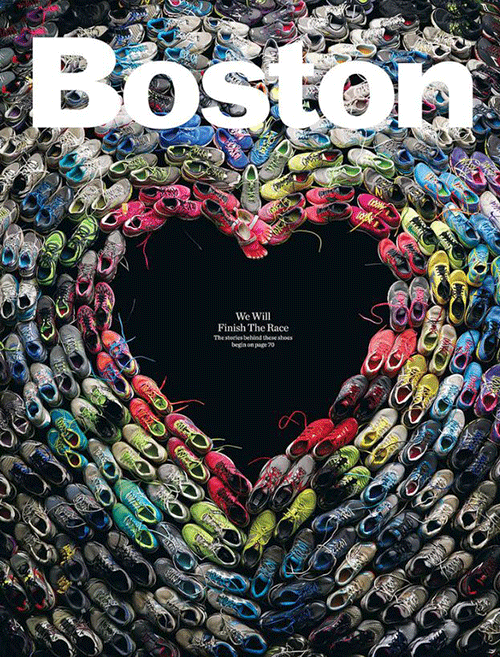
Forgiveness in Boston

Boston-Magazine Shoes http://www.bostonmagazine.com/news/blog/2013/04/25/behind-our-may-boston-marathon-cover/

Cover of ‘Boston Magazine,’ by Mitch Feinberg

Less than a week after the Boston Marathon bombings, which left 3 people dead and over 280 injured, Cardinal Sean O’Malley emphasized the importance of forgiveness during Mass at the Cathedral of the Holy Cross. According to the Boston Globe, Cardinal O’Malley gave the congregation  two reasons to consider forgiveness. The first was  to avoid the “eye for an eye, tooth for a tooth mentality.” In that way, forgiveness offered a potential means to avoid further hostilities between groups. In fact, local tensions seemed to be simmeringO’Malley was likely cognizant of this, hoping to help defuse things before they progressed any further.  

Continue reading

Nature, Not Always “Red in Tooth and Claw”

In “River Out of Eden,” Richard Dawkins wrote this passage on the cruelties of nature:

 “The total amount of suffering per year in the natural world is beyond all decent contemplation. During the minute that it takes me to compose this sentence, thousands of animals are being eaten alive, many others are running for their lives, whimpering with fear, others are slowly being devoured from within by rasping parasites, thousands of all kinds are dying of starvation, thirst, and disease. It must be so. If there ever is a time of plenty, this very fact will automatically lead to an increase in the population until the natural state of starvation and misery is restored. In a universe of electrons and selfish genes, blind physical forces and genetic replication, some people are going to get hurt, other people are going to get lucky, and you won’t find any rhyme or reason in it, nor any justice. The universe that we observe has precisely the properties we should expect if there is, at bottom, no design, no purpose, no evil, no good, nothing but pitiless indifference.” (Dawkins 2008: 131-2)


I think this view of nature is one of the primary reasons that many people run away from the idea of evolution.  For some, the notion of an indifferent nature, where organisms can be reduced merely to genetic ‘copy me’ programs  with the goals of survival and reproduction, is too bleak. Eugenie Scott, Director of the National Center for Science Education, has written that for many non-biologists the notion that evolution is an unguided, mechanistic process implies that “life has no meaning.” Microbiologist Kenneth Miller, a staunch defender of evolution, has relayed that in his experience one of the main concerns of many anti-evolutionists is not with the science, but with the implications of evolution, which is perceived as threatening to moral order. For example, Miller referred to this statement from Rick Santorum, the former Presidential candidate and Senator from Pennsylvania:

Continue reading

Review 2012

Below is a quick look at the most-read posts that were written in 2012, with a brief summary, in case you’re interested.* Thanks very much to everyone for visiting, and to those who have shared these writings and commented on them.

..

1) Part 6. Humans are (Blank)- ogamous: Many Intimate Relationships. May 17

This was the most viewed post written this year. It looked at the variety of intimate romantic relationships that humans have negotiated into various socially recognized structures. I tried to go beyond looking at humans as naturally monogamous or promiscuous, which I think are overly simplistic arguments, taking a look at how this complexity may have arisen. There’s also a nice graphic, borrowed from David McCandless.

We obviously have a lot of cultural diversity in humanity with substantive differences in worldviews and which behaviors are deemed acceptable, but cultures – and individuals – are tasked with how to balance sex, love, intimacy, and commitment, as well as reproduction and parenting. I think this interplay between individual drives and cultures provides an alternate model of looking at things rather than trying to discern what humans ‘are’ in terms of our sexuality.”   

2) Human Nature, Humility, & Homosexuality. Feb 10

A pointed response to one conservative’s argument about homosexuality being against human nature, and the need for tolerance and the need to avoid making overly confident claims about human behavior. “I would recommend that if we have a choice, then choose humility. Choose tolerance. Choose love.”

Continue reading

The Christmas Truce (Yet Again)

A couple of years ago around this time, I wrote a post titled Lessons from the Christmas Truce of 1914,” which is by far the most read thing on on this site.  Last year I had a lesser viewed follow-up about a man named Julio Diaz, a New Yorker who responded to a teenage mugger with compassion, which led to a conversation at a diner and the teen voluntarily handing over his weapon. 

..

Together, the two posts address some attributes we have as a species that facilitate cooperation,  even in times that are enormously challenging. These include, but are not limited to: empathy, the benefits of mutualism, and trust. We can find certainly find many counterexamples lately, with people inflicting great pain and suffering on each other. In recent memory, these include the horrific shooting deaths in Newtown, Connecticut  or the use of cluster bombs against civilians in Syria. This makes examples of cooperation all the more necessary.

..

To continue with this late December tradition, here is the story of a German fighter pilot from World War II named Franz Stigler and an American bomber pilot named Charles Brown:

On Dec. 20, 1943, a young American fighter pilot named Charlie Brown was on his first World War II mission. Flying in the German skies, Brown’s B-17 bomber was shot and badly damaged. As Brown and his men desperately tried to escape enemy territory back to England, a German fighter plane pulled up to their tail. It seemed certain death. Instead of shooting the plane down, however, the German pilot, Franz Stigler, escorted the Americans to safety.  (source)

Continue reading

I Should Like to Say Two Things

With another contentious election now behind us, I’ve been thinking about this famous, lengthy quote from Bertrand Russell. In an interview from 1959, he spoke of the need for people to find common ground and to make an honest effort at seeking truth, even when we don’t like what the truth is.

I should like to say two things, one intellectual and one moral.

The intellectual thing I should want to say to them is this: When you are studying any matter, or considering any philosophy, ask yourself only what are the facts and what is the truth that the facts bear out. Never let yourself be diverted either by what you wish to believe, or by what you think would have beneficent social effects if it were believed. But look only, and solely, at what are the facts. That is the intellectual thing that I should wish to say.

The moral thing I should wish to say to them is very simple. I should say: Love is wise. Hatred is foolish. In this world which is getting more and more closely interconnected, we have to learn to tolerate each other. We have to learn to put up with the fact that some people say things that we don’t like. We can only live together in that way — and if we are to live together and not die together, we must learn a kind of charity and a kind of tolerance, which is absolutely vital to the continuation of human life on this planet.

Continue reading

Egalitarianism & Arrogance

When men are most sure and arrogant, they are commonly the most mistaken, and have then given views to passion, without that proper deliberation and suspense which can alone secure them from the grossest absurdities.”                            – David Hume


Person 1: “There is no ‘I’ in ‘team.’ ”

Person 2: “True, but there is an ‘M’ and an ‘E.’ ” 

On occasion, I have been arrogant at times in my life. To be fair to myself, I believe such episodes have been rare, and most people who know me would probably describe me as introverted, possibly even timid. More than once, I have been told that I am “too nice” and overly conciliatory. During my pre-tenure review, one committee member told me that my autobiographical narrative was too modest, and that “in academia you need to toot your own horn because nobody else is going to do it for you.” That’s probably true in most fields, but it often makes me uneasy. And if you spent some time in the cacophony in my head, you’d see there is plenty of self-doubt and insecurity in here (you’re better off not doing that). Still, like everyone else, I am complex, and have had enough instances of arrogance that they irritate me and force me to consider from where they originate.

I bring this up now because I’ve been reading about hunter-gatherer societies, and was reminded of this famous passage from the anthropologist Richard Lee (1979) on egalitarianism in the !Kung of Namibia and Botswana.

Continue reading