The Branches of Humanity

I think it helps to remember that all humans share common ancestry. While there are certainly cultural and biological differences around the globe today, these are the tip of the iceberg, the distant branches of the tree. Under the surface, at the roots, the distribution of people across the globe owes itself to a long, gradual process of migration — or several migrations — during which time some differences arose (along with the interbreeding with neighboring groups that maintained similarities). 

The animation below illustrates some of the major migrations of people across the world over the past 200,000 years, reminding us of our roots and shared connections. Some of this is already out of date. For example, a recent study suggested that modern humans may have reached China by 100,000 years ago, much earlier than suggested in the video. But the point still stands — no matter where they live today, all humans can trace their lineage back to the same place.

The Sex Lives of Others

“Although anthropologists have identified few, if any, true human universals, taboos are widespread against exposure of the genitals, public displays of sexual behavior, and multiple consecutive partners. Having sex willingly in the presence of observers or with multiple participants crosses a line of social propriety in many societies. Where these lines are drawn is, of course, highly variable.”          

– Katherine Frank, Plays Well in Groups: A Journey Through the World of Group Sex (2013: 3)

“Humans aren’t the only sex deviants in the animal kingdom. But we are the only ones to stigmatize each other as disgusting perverts.”

– Jesse Bering, Perv: The Sexual Deviant in All of Us: (2013: 216).


Apes don’t have bedrooms.

This is relevant because privacy is sometimes hard to come by in the life of an ape, including for intimate sexual behavior. But for humans it’s different. Sexual privacy is important, yet privacy is never really absolute.

One of the more puzzling questions around human sexuality is why we invest so much energy into influencing the sexual and romantic lives of other people. Why does it matter to us whether celebrities get divorced, or gay people marry, or whether the sexual behavior of strangers somehow falls outside specific social norms?

This isn’t necessarily the case for our primate cousins. Certainly, monkeys and apes compete for mates and they keep track of each others’ social relationships. What they do not do is moralize about proper sexual practices. For chimpanzees and bonobos (outside of the occasional private tryst away from the group to avoid interference from a dominant male), sex usually takes place in view of fellow group members, with little fanfare. Among bonobos, sex is so common that it is almost mundane.

In one study, Zanna Clay and colleagues observed a group of fifty adult bonobos for about a thousand hours in a year (Clay et al 2011). In that time, they recorded 1,100 female–male copulations and 674 female–female genital contacts. Notably, females often made ‘copulation calls’ when they were with a partner of higher rank, regardless of whether their partner was male or female. Clay suggested that these calls were part of a female’s social strategy, announcing to other group members that they had powerful friends (“Hey, see who likes me!?”).

However, while apes jockey for social position when it comes to relationships, we can take this to another level. Not only do we try to improve our own prospects by climbing the social ladder, but we can also get quite judgmental about others’ erotic lives.

Continue reading

“The Fundamental Connection That We All Share”

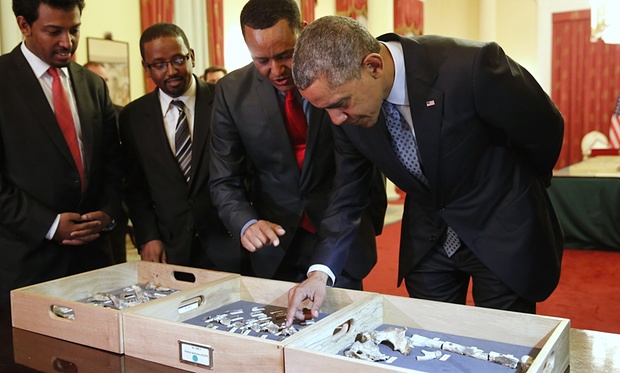
On his visit to Ethiopia, U.S. President Barack Obama viewed the fossil remains of three famous human ancestors. These included two belonging to the 3 to 3.8 million-year old hominin species Australopithecus afarensis, “Lucy” and “Selam”), as well as “Ardi” from an older species Ardipithecus ramidus. (Click here for a nice overview of our hominin family tree). Later, he said this

“When you see our ancestor, 3.5 million years old, we are reminded that Ethiopians, Americans, all the people of the world are part of the same human family, the same chain… And as one of the professors (Zeresenay Alemseged) who was describing the artifacts correctly pointed out, so much of the hardship and conflict and sadness and violence that occurs around the world is because we forget that fact.  We look at superficial differences as opposed to seeing the fundamental connection that we all share.

I think Obama got it right, which isn’t surprising, since his mother was an anthropologist. Humans everywhere belong to the same species and share common ancestry. We have our differences — some trivial, some significant to us — but our bedrock should be that shared connection. That may be an ideological approach, but the nice thing is that it’s also scientifically accurate. 

Pesident Obama touches the fossilized vertebra of Lucy, an early human ancestor in Ethiopia on Monday. Photograph: Jonathan Ernst/Reuters

President Obama touches the fossilized vertebra of Lucy, an early human ancestor in Ethiopia on Monday. Photograph: Jonathan Ernst/Reuters

You Are My Cousin

There’s so many different worlds
So many different suns
And we have just one world
But we live in different ones

         — Mark Knopfler, Brothers in Arms

I had the above T-shirt custom-made a couple of weeks ago, which reads “you are my cousin” in several languages. I can’t say for certain whether all of the translations are 100% accurate, but I tried to include a diverse range of languages, including the most commonly spoken ones (and Hmong; I just had to include Hmong). I’ve yet to wear it in public, but I am curious whether people will ask me about it. My hope is that it will get people to think a little about human diversity, similarity, difference, and how we are all related.

Of course, I’m playing fast and loose with terminology here, using ‘cousin’ in a very broad evolutionary sense. From an evolutionary perspective, genetic ties (or ‘blood’) are considered important since they indicate degree of shared genetic material. However, not every society sees family relations in the same way, which is a testament to the power of culture.

Continue reading

More Outreach: A Return to KIPP, Year Five

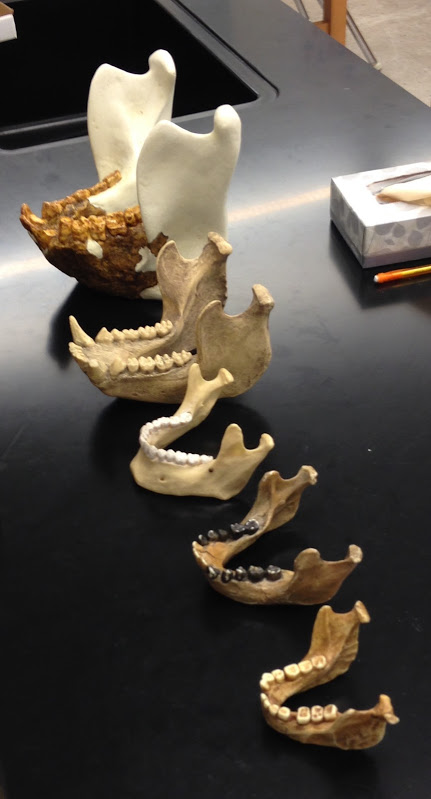
mandibles

I brought some friends to show variation in the mandibles of some apes and hominins.

This is the fifth (and likely final) year that I’ve visited the 8th graders at the KIPP school in Lynn, Massachusetts. Each Spring I visit for about three hours to talk about anthropology, evolution, and what life in college is like. This coincides with the time in the school year they are discussing evolution in their science classes.

In my most recent visit last week, the theme of the day was how all living things are biologically related, though we focused mostly on humans and other primates. In a way, all humans are ‘cousins’, as is everything that lives. I also brought some fossil casts with me to enhance the presentation, including a new addition to our lab at UMass Boston — that of a Gigantopithecus. Of course, it was a big hit. Who can resist the concept of Gigantopithecus?  

When I started doing this, I asked around if any teachers in the area wanted me to come speak with their students. Only one teacher responded, and she kept inviting me back each year. This time she told me that she’s moving on to another position, so it will likely be my last year visiting KIPP unless something changes. I may have to find another way to share anthropology with middle schoolers.

Continue reading

Six Million Years of Hominin Evolution in Four Minutes

From the Natural History Museum in Vienna, Austria, this video shows some of the major hominin fossils discovered so far. It’ seems to have been recorded by a tourist, so the quality isn’t the best. However, it’s really well done, and the nice part is that it nicely illustrates these species’ geographic and temporal distributions, which can be hard to find elsewhere. 

Sex Really Is Dangerous (and Other Adjectives)

..

I maintain that sex is regarded as dangerous by the savage, that it is tabooed and ritualized, surrounded by moral and legal norms – not because of any superstition of primitive man, or emotional view of or instinct about strangeness, but for the simple reason that sex really is dangerous.” – Bronislaw Malinowski, anthropologist (1928)

Young or old, don’t delude yourself. You don’t have sex. Sex has you. Buckle up.” – Dan Savage, author, giver of advice, Twitter friend (2013: 52)

“According to Irish folk belief, there are two ways of achieving certain salvation. The first is through a red martyrdom, or dying for one’s faith in the tradition of the early Christians and the great missionary saints. The second path to sainthood, and the one chosen by most ordinary people, is the white martyrdom (ban-martra), a slow ‘death to self’ through acts of self-denial – fasting, penance – and, above all, a life characterized by sexual purity.” – Nancy Scheper-Hughes, anthropologist (2001: 206)

 “You can’t just let nature run wild.” – Walter Hickel, former Governor of Alaska (1992)

______________________________________________

Quote #1 suggests that sex is potentially dangerous for all people, regardless of cultural background. Note that Malinowski’s use of the word ‘savage’ was acceptable at the time. Today, it obviously isn’t. (#2) However, despite that danger, sex is powerful and has a hold over people. (#3) They can assert control over sexual impulses, but to suppress them entirely is difficult enough to be considered equivalent to martyrdom. (#4) All societies need regulation, including for sexuality. (I took some license with this last quote, one of my favorites. The actual context was that Hickel was defending the state’s controversial aerial wolf control program, apparently said without irony). 

______________________________________________

The young wife, Isakapu, put on her best jewelry and climbed to the top of a coconut tree near her village. From there she shouted down to her husband, Kabwaynaka, and to any other witnesses below that his accusations of adultery against her were false, and that she resented that he had beaten and insulted her out of jealousy a few days earlier. Kabwaynaka climbed up after her to bring her down, but before he could reach the top she jumped, throwing herself to her own death (Malinowski 1929: 120).

In Bronislaw Malinowski’s classic ethnography The Sexual Lives of Savages, suicide in the Trobriand Islands was an acceptable means of escape from the shame of breaking various sexual taboos (even if the accusations were false). This was the case not only for adultery, but also for bestiality, or for having sex within the clan. Consuming the poisonous gallbladder of a pufferfish was one method for taking one’s own life, but the option chosen by Isakapu, jumping from a tree (known as lo’u), was also common at the time. Malinowski wrote that while the sexual lives of Trobrianders might seem “easy and carnal” to an outsider, in reality they were often marked by “strong passions and complex sentiments” and sometimes filled with strife (p. 119-21). 

A Harvest Scene (Malinowski 1929, plate 57).

A Harvest Scene in the Trobriands (Malinowski 1929, plate 57).

A look at the ethnographic record reveals that strong and complex emotions surrounding sex are not unique to the Trobianders, or to any single culture. Some historical narratives of human sexuality have wondered whether non-Western cultures, or perhaps our distant ancestors, have had a less stressful time with this part of life, placing the blame for any modern sexual malaise at the feet of various culprits. These include (1) religion, particularly the monotheistic Abrahamic faiths (Ray 2012); or (2) capitalism and ‘the Protestant ethic,’ with its emphasis on guilt, self-control, and the frustration of delayed marriage before sufficient resources could be accumulated (Albee 1977); or (3) agriculture, with its emphasis on fixed settlements, the accumulation of private property, and a more intense guarding of paternity and property rights (Ryan and Jethá 2010). Continue reading

Sapiosexuality & Our Behavioral Complexity

You know, animals have sex. It’s biology, it’s natural instinct. We are the only ones who have an erotic life, which means that it’s sexuality transformed by the human imagination.”  — Esther Perel

One of the reasons some cultural elitists – political pundits, novelists, intellectuals – tend to be so unsettled by the Internet is that it has revealed how oceanically broad are the interests of the public in general. Before the Internet, with no way of observing the obsessions of the masses, it was a lot easier to pretend that these obsessions simply didn’t exist; that the nation was “united” around caring about the same small number of movies, weekly magazines, novels, political issues, or personalities. This was probably always a self-flattering illusion for the folks who ran things. The Internet destroyed it. When you gaze …upon the Pacific of strangeness online, you confront the astonishing diversity of human passion.”  — Clive Thompson (2013) Smarter Than You Think: How Technology is Changing Our Minds for the Better

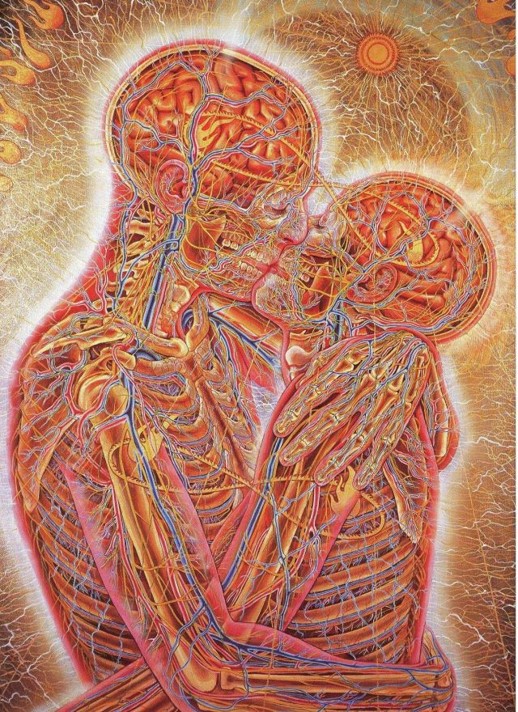
Kissing, by Alex Grey.

Kissing, by Alex Grey. (alexgrey.com)

                                                                                 ~~~~~~~

Please bear with me as I try to connect two not very obviously connected ideas: romantic love and our species’ behavioral flexibility. I don’t have it all worked out. Perhaps I’m going down the wrong path altogether.

I started thinking about these things after several friends on social media shared this Mandy Len Catron essay: “To Fall in Love With Anyone, Do This”. Catron describes a time that she and a male acquaintance intentionally tried to induce feelings of romantic love. To do this, they followed two steps, borrowed from a study done by the psychologist Arthur Aron. First, they asked each other a series of 36 increasingly intimate questions. Next, they stared into each other’s eyes for four uninterrupted minutes.

My first reaction when I went through the questions was that I can see how they could elicit feelings of intimacy under the right circumstances and with the right person. To work through all 36 of them would take some time, as they are not typical of everyday conversation. Time itself is could be a factor in bonding. To answer each question would require some thought, as they do not have prepared, canned responses. Some examples from Aron’s list:

  • Name three things you and your partner appear to have in common.
  • Take four minutes and tell your partner your life story in as much detail as possible.
  • Is there something that you’ve dreamed of doing for a long time? Why haven’t you done it?
  • What is your most treasured memory? Continue reading

The Kindness of Strangers

In one of my classes, we play a game known as the Prisoner’s Dilemma. It’s a fun exercise, where students earn ‘points’ by choosing either to cooperate with, or defect on, a partner. We do a few different versions of the game, sometimes with randomly assigned partners for a single round, sometimes with the same partner for multiple rounds, and with different point structures. We also use a deck of playing cards, where students choose a red card to signify defection or a black card for cooperation. All interactions are face-to-face, in real time, and as an incentive there is a prize for the two people who receive the most points.

The main rule of the game is that the number of points one earns depends not only on their own choices, but also the choice their partner makes. The game was originally named after the dilemma that two partners in crime face should they be caught. Here is Eric Johnson’s succinct explanation:

In the game, two people who committed a crime are arrested and each is placed in solitary confinement for interrogation. If one betrays the other, the first goes free while the second is sentenced to three years in prison. If they both betray one another, they each receive two years. But if they both keep silent, they receive the minimum penalty of one year each. Under this scenario, the best individual strategy would be to betray the other. 

In our classroom exercise, we invert the scenario and give positive rewards for cooperating (points), since I’m not authorized to give out negative penalties for defecting like years in prison (not that I’d want to do that, anyway). 

Scenario

You get

Partner gets

You both cooperate w/each other 

3 pts

3 pts

You cooperate, but partner defects 

0 pts

5 pts

You defect, partner cooperates

5 pts

0 pts

Both defect 

1 pt

1 pt

.

.

Continue reading

A Chain of Ancestors

One of the better examples I’ve yet found that conveys the concept of evolution comes from the 2002 NOVA documentary “Search for the First Human.” The main focus of the video is the species Orrorin tugenensis and it’s possible place in our family tree six million years ago. However, two particular segments stand out to me, and I think do a pretty good job of conveying the idea of evolution to students.

Continue reading