“One planet, one experiment.” ………………..— Edward O. Wilson. 1992. The Diversity of Life.
…
Hadzabe men (wikimedia commons)
The BBC has compiled what looks to be an absolutely visually stunning television series, titled ‘Human Planet.’ The footage is said to contain video from 80 different locations, highlighting the relationship of humans to various ecological conditions.1 The description from the website:
Uniquely in the animal kingdom, humans have managed to adapt and thrive in every environment on Earth. Each episode takes you to the extremes of our planet: the arctic, mountains, oceans, jungles, grasslands, deserts, rivers and even the urban jungle. Here you will meet people who survive by building complex, exciting and often mutually beneficial relationships with their animal neighbours and the hostile elements of the natural world.”
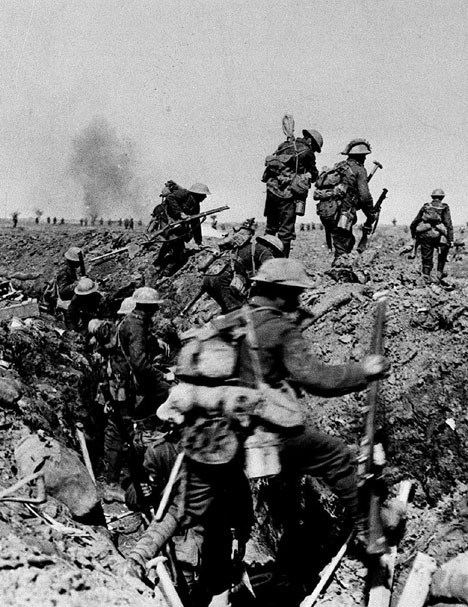
As Christmas approaches, it seems like the perfect time to reflect on an unlikely event from military history. During the First World War, a spontaneous, temporary truce was brokered between German, French, and Scottish officers on Christmas Eve, 1914. On that night and on Christmas Day along the trenches in Flanders, soldiers who recently had been shooting at each other used the ceasefire to bury their dead, then shared food and drink with their ‘enemies,’ played soccer, and even exchanged gifts and addresses in order to write each other after the war ended.
…
The details leading up to the ceasefire are a bit murky, but eyewitnesses reported that German and Scottish troops took turns festively singing carols in their own trenches. A few brave officers then seized the spirit of the moment to risk their safety, leave their trenches, and negotiate a respite from the brutality. The remaining soldiers then followed, leading to the amazing scene.
This year was the first for this website. In looking at the blog’s statistics, it’s interesting to see which posts were the most-read. I’m listing the top ten posts with a brief summary, in case you’re interested. Thanks very much to everyone for visiting.
This was the most-read post of the year, and it was a very personal one. I wrote about the tenth anniversary of the death of my brother Kevin, and how I’ve used anthropology and evolutionary biology to maintain perspective on the beauty of life.
If past injustices are not addressed, they can fester for decades or centuries. However, people seem to crave forgiveness, justice, and reconciliation. [Armenia, the Soviet Union and Poland, the former Yugoslavia, Tiger Woods, Joshua Blahyi (‘General Butt Naked’), and Gandhi.]
A couple of reminders from John F. Kennedy and Carl Sagan that we are, all of us, in this together. We are all connected, share commonalities, and come from one big family, after all.
XXX
“For in the final analysis, our most basic common link is that we all inhabit this small planet. We all breathe the same air. We all cherish our children’s future. And we are all mortal.” – John F. Kennedy (June 10, 1963)
‘Beauty is truth, truth beauty, – that is all Ye know on earth and all ye need to know.’ – John Keats
…
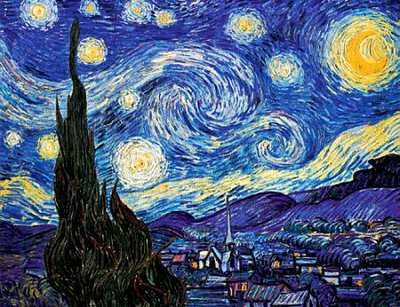
Van Gogh's Starry Night
In 2004, Kevin Kniffin (a former classmate of mine at Binghamton) and David Sloan Wilson, published an article in the journal Evolution and Human Behavior revealing their results from three different studies on perceptions of beauty. Among their findings was that, for people who knew each other, ratings of physical attractiveness were strongly influenced by the personality traits of those persons who were being rated. In other words, when rating potential mates, ‘inner beauty’ augmented perceptions of external appearance and overall attractiveness. The reason behind this likely has Darwinian roots. According to Wilson:
…
“The fitness value of potential social partners depends at least as much on non-physical traits — whether they are cooperative, dependable, brave, hardworking, intelligent and so on — as physical factors, such as smooth skin and symmetrical features.”
Today marks the beginning of the First Meeting of States Parties to the Convention on Cluster Munitions, held in Vientiane, Laos. The meeting’s purpose is to determine how to effectively implement the objectives laid out by the original Convention, which took place in Dublin in May 2008 and became binding to ratifying states in August this year. Those objectives are as follows:
…
The Convention on Cluster Munitions, CCM, prohibits all use, stockpiling, production and transfer of Cluster Munitions. Separate articles in the Convention concern assistance to victims, clearance of contaminated areas and destruction of stockpiles.
…
Thus far, 36 countries have been affected by cluster munitions (ex. Lebanon, Angola, Serbia). However, it is appropriate that Laos is hosting this meeting, as it is one of the most heavily bombed countries in history – a legacy of American bombing during the Second Indochina War. The lingering effects of cluster munitions have been particularly pernicious. Even today, almost four decades after the bombing of Laos ended, there are roughly 250 casualties annually from unexploded ordnance (UXO) leftover from the war. Many of these casualties are children.
..
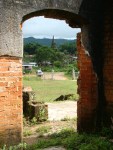
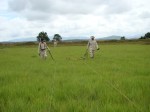
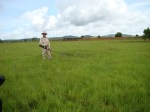
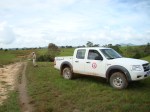
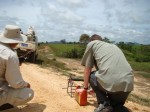
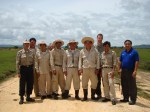
Last year, I saw some of the effects of the war in Laos first-hand in Xieng Khouang province, where craters and injured people are both abundant. My interpreter and guide, Manophet, introduced me to a bomb clearance team outside of the town of Phonsavan. They explained how the process of UXO detection and removal is painstakingly slow, given how widespread an area a single cluster bomb unit can cover and how many tons of ordnance were released over Laos (click here to see what a cluster bomb can do to your neighborhood).
…
The day I visited, the team had located ten ‘bombies,’ and they were kind enough to let me remotely detonate one, an experience far removed from my usual job. It was exciting, but also a chilling reminder of how long such munitions can last, with the potential to indiscriminately maim or kill even decades after a war has officially concluded.
…
As an American, it also struck me how we are obligated to clean up the mess we left behind. After all, the war in Laos is over. Therefore, UXO is not a military problem or a political one. Rather, it is a public health problem – killing family members, causing disability, and disrupting lives. Regardless of where one falls on the political spectrum, it should be uncontroversial to say that children should not be maimed or killed by bombs leftover from a war that ended decades before they were born. Removing the bombs in Laos is simply the right thing to do.
The journal Economics and Human Biology has an obituary (in press) describing the life of James M. Tanner, and his singular contributions to the development of the study of human growth. In his memorial, Roderick Floud quotes David Barker as saying “Jim was the God” of growth studies.
…
I had missed news of Tanner’s passing, which occurred in August, and was sad to learn of it. His work has been invaluable to many people, including my own teaching and research, from formulating growth charts to a comparative look at how people grow in different parts of the world. But it’s important to reflect not just on his contributions to science, but also the person behind them. One gets a sense of his compassion from the way he referred to childhood growth as a mirror for “the material and moral condition” of a society (1986: 3). Floud quotes an oft-cited passage by Tanner:
…
A child’s growth rate reflects, better than any other single index, his state of health and nutrition, and often indeed his psychological situation also. Similarly, the average value of children’s heights and weights reflect accurately the state of a nation’s public health and the average nutritional status of its citizens. . . . Thus a well- designed growth study is a powerful tool with which to monitor the health of a population, or to pinpoint subgroups of a population whose share in economic or social benefits is less than it might be.”
…
Select Works
Eveleth, Phyllis B. and Tanner, James M. 1990. Worldwide Variation in Human Growth (second edition). Cambridge: Cambridge University Press.
Tanner, James M. 1986. Growth as a mirror for the conditions of society: secular trends and class distinctions. In Human Growth: A Multidisciplinary Review. Arto Demirjian and Micheline Brault Dubuc, eds. Pp. 3-34. London: Taylor and Francis.
Tanner, James M. 1990. Fetus into Man: Physical Growth from Conception to Maturity. Cambridge, MA: Harvard University Press.
“What I see in Nature is a magnificent structure that we can comprehend only very imperfectly, and that must fill a thinking person with a feeling of humility.”
……………………………………………………………………………………. – Albert Einstein
…
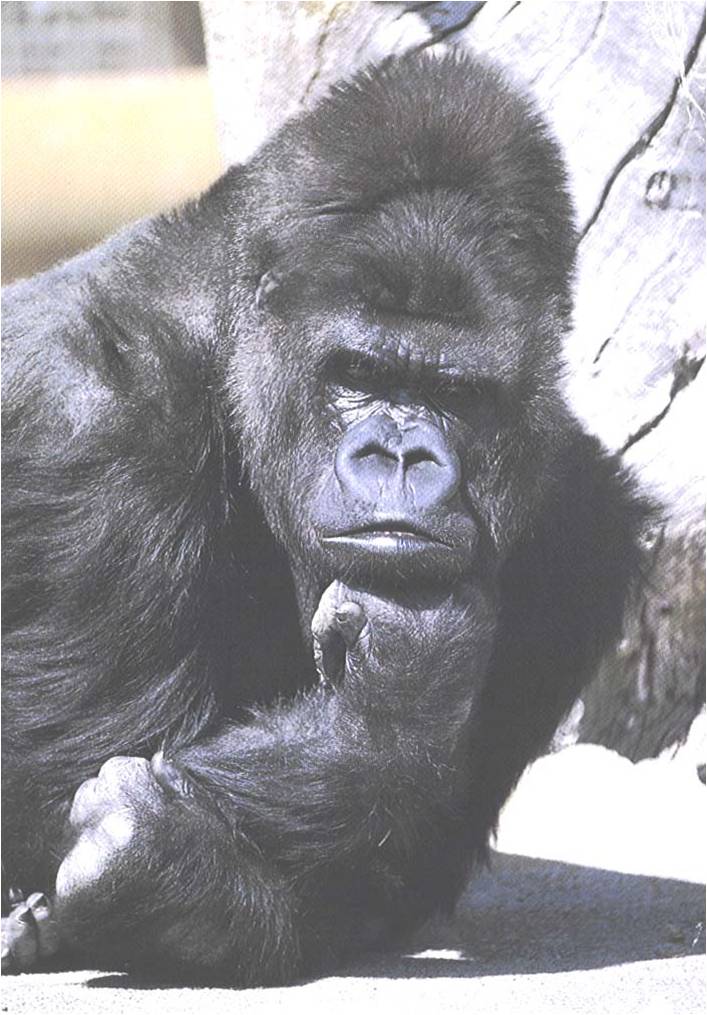
Another irrational ape (imitating Rodin’s ‘The Thinker’)
Jonah Lehrer has written another great piece about our irrationality in decision making, and our emotional responses to avoiding loss. He writes:
…
From the perspective of economics, there is no good reason to weight gains and losses so differently. Opportunity costs (foregone gains) should be treated just like “out-of-pocket costs” (losses). But they aren’t – losses carry a particular emotional sting.”
…
Others have noted the importance of emotion involved in decision making, and how it affects our ability to intuit how our choices will make us feel. When someone suffers damage to the prefrontal cortex of their brain, both their emotions and decision-making abilities are impaired (Bechara et al 1997). What this suggests is that emotions and reason are linked, rather than oppositional. They inform each other. This all fits in with Dan Ariely’s view of humans as “predictably irrational.”
I love baseball, having played from Little League through high school. The game taught me many lessons about athletics, but also about life. As a New Englander, I grew up a Red Sox fan, which was sometimes painful (the infamous Bill Buckner game of the 1986 World Series fell on my 12th birthday). However, the 2004 championship was pure elation, and made up for everything. After the Red Sox came back from a 0-3 deficit to beat the Yankees in the ALCS (the semi-finals, for you non-baseball fans), my father, brother, uncles, cousins, and I took photos in front of the television, as if we were documenting history. I even made sure my infant son was in the photos, to prove to him when he got older that he was there. Ridiculous, right?
My university, UMass Boston, sits on a beautiful spot. Fortunately for us, we get to share a peninsula in Dorchester with the Massachusetts Archives and the John F. Kennedy Presidential Library. Taking advantage of our school’s location, I’ve made a few trips over to the JFK Library, a very attractive building designed by I.M. Pei.


























 Patrick F. Clarkin, Ph.D.