Genocidal Altruists: Are We ‘Naturally’ Violent? Altruistic? Both?

This was from several months ago, but I wanted to bring it back again.

Patrick Clarkin's avatarPatrick F. Clarkin, Ph.D.

“We know that we are apes, but we cannot be classified simplistically as ‘naked apes’ or ‘killer apes’ or ‘moral apes.’…Our past is complicated; so is our present, and so will be our future.” – Paul Ehrlich (2000: 331)

“When we are bad, we are worse than any primate that I know. And when we are good, we are actually better and more altruistic than any primate that I know. ” –Frans de Waal

…..

The Eagles headed back to their cabin feeling dejected after losing a tug-of-war contest to their rivals, the Rattlers. Along the way, one of the boys noticed the Rattlers had forgotten their flag on the baseball field, leaving it unprotected. Craig and Mason soon seized it, but struggled to tear it to pieces. McGraw then presented some matches and suggested they burn it instead. The group then hung the flag’s charred remains from the…

View original post 2,083 more words

Being Wrong, Part 2

A (more humorous) follow-up from Part 1.

Of course, the wisdom of admitting a mistake is compromised if one keeps making them over and over again.

“Love Will Win”


Refugeee Love

A young refugee couple kiss in a tent in Keleti station in Budapest, Hungary. Photograph: Istvan Zsiros. Source

From the article in The Guardian:

 “I hope every refugee finds a their place in the world, finds peace as quickly as possible,” (photographer) Istvan Zsiros says. “That everyone is happy. It’s a very difficult situation, a very complex situation.”

And he hopes his photograph might change the way people see the situation: “Love,” he says, quoting the movie Interstellar, “is the one thing we’re capable of perceiving that transcends time and space.” And, perhaps, borders.”

Being Wrong

It gives me hope when people can admit they were wrong. There’s something redeeming about admitting that one’s judgment is fallible rather than refusing to admit error for the sake of ego.

As an example, this clip from Errol Morris’ film “The Fog of War” features Robert McNamara discussing the events of the Gulf of Tonkin incident. In it, McNamara revealed that the U.S. likely misread sonar signals that supposedly indicated an increase in Vietnamese aggression. This misinterpretation helped escalate the war, causing irreparable harm to many. The key exchange:

Continue reading

Some Lessons on War and Forced Displacement

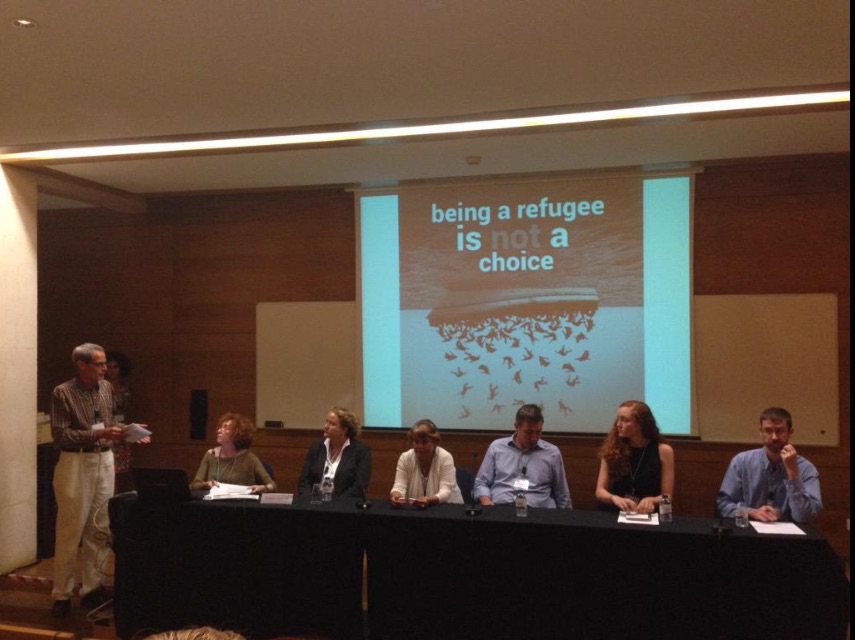
Lessons from our SSHB conference on The Human Biology of Poverty, held in Lisbon earlier this month. Thanks to Ines Varela Silva for putting together a great conference in a beautiful country.

This is not a complete list, but a copy and paste of some of the highlights from our session: 

Presentations

  • War and forced displacement: Embodiment of conflict-related experiences (Patrick Clarkin)
  • Female minor refugees: Are they underprivileged by forensic age estimation? (Bianca Gelbrich)
  • War and its effect on the changes in lifestyles: a case of Croatia (Sasa Missoni)
  • Secular trends of somatic development in Abkhazian children and adolescents for the last decades (Elena Godina)
  • Do stress biomarkers track poverty, stress, and trauma? Evaluating war-affected youth (Amelia Sancilio)
  • Refugees in Portugal: What do we know? (Cristina Santinho and Ines Varela-Silva)
  • Poster: Maya Guatemalan children in refugee camps in Mexico. How bad is their growth status? (Aya Ueno, Barry Bogin, Faith Warner and Ines Varela-Silva)

Summary of the session

Below are some reasons why our research is important and how it is relevant  for the public in general.

Continue reading

The Beacon in the Terrifying Darkness

“Life is tragic simply because the earth turns and the sun inexorably rises and sets, and one day, for each of us, the sun will go down for the last, last time. Perhaps the whole root of our trouble, the human trouble, is that we will sacrifice all the beauty of our lives, will imprison ourselves in totems, taboos, crosses, blood sacrifices, steeples, mosques, races, armies, flags, nations, in order to deny the fact of death, the only fact we have. It seems to me that one ought to rejoice in the fact of death–ought to decide, indeed, to earn one’s death by confronting with passion the conundrum of life. One is responsible for life: It is the small beacon in that terrifying darkness from which we come and to which we shall return.”

― James Baldwin, The Fire Next Time

Human Biology of Poverty Symposium

We just finished a symposium on “the human biology of poverty,” held at ISCTE-IUL in Lisbon, and sponsored by the The Society for the Study of Human Biology. It really was a great meeting, full of important research on the effects of various forms of deprivation on biology and health in different populations. The complete program can be found here.

image image image


“We Are People, Human Beings” (The War in Yemen)

photo-essay of the of how war is affecting people in Yemen. Doctors Without Borders has called it a “war on civilians.”

And here is a statement from one man:

“Our nation was a poor nation even before this crisis and before this war. Can you imagine now after 14 countries in a coalition surprisingly declared war and huge airstrikes against us while we were safe in our homes? We did not expect such an action to take place, and were not prepared. We cannot prepare for that. We immediately fled to fields, to mountains, and to deserted old villages and buildings. We lived there for a while with wild animals and monkeys! We were terrified, fighting with the animals, suffering diseases and lack of food, lack of everything, lack of safety and protection.

My boy is 18 months old. Whenever he hears warplanes he shouts “Papa, Papa!” Terrified. He is traumatized. He was fat, and now…

We are human beings. We are people, human beings.”

The Sex Lives of Others

“Although anthropologists have identified few, if any, true human universals, taboos are widespread against exposure of the genitals, public displays of sexual behavior, and multiple consecutive partners. Having sex willingly in the presence of observers or with multiple participants crosses a line of social propriety in many societies. Where these lines are drawn is, of course, highly variable.”          

– Katherine Frank, Plays Well in Groups: A Journey Through the World of Group Sex (2013: 3)

“Humans aren’t the only sex deviants in the animal kingdom. But we are the only ones to stigmatize each other as disgusting perverts.”

– Jesse Bering, Perv: The Sexual Deviant in All of Us: (2013: 216).


Apes don’t have bedrooms.

This is relevant because privacy is sometimes hard to come by in the life of an ape, including for intimate sexual behavior. But for humans it’s different. Sexual privacy is important, yet privacy is never really absolute.

One of the more puzzling questions around human sexuality is why we invest so much energy into influencing the sexual and romantic lives of other people. Why does it matter to us whether celebrities get divorced, or gay people marry, or whether the sexual behavior of strangers somehow falls outside specific social norms?

This isn’t necessarily the case for our primate cousins. Certainly, monkeys and apes compete for mates and they keep track of each others’ social relationships. What they do not do is moralize about proper sexual practices. For chimpanzees and bonobos (outside of the occasional private tryst away from the group to avoid interference from a dominant male), sex usually takes place in view of fellow group members, with little fanfare. Among bonobos, sex is so common that it is almost mundane.

In one study, Zanna Clay and colleagues observed a group of fifty adult bonobos for about a thousand hours in a year (Clay et al 2011). In that time, they recorded 1,100 female–male copulations and 674 female–female genital contacts. Notably, females often made ‘copulation calls’ when they were with a partner of higher rank, regardless of whether their partner was male or female. Clay suggested that these calls were part of a female’s social strategy, announcing to other group members that they had powerful friends (“Hey, see who likes me!?”).

However, while apes jockey for social position when it comes to relationships, we can take this to another level. Not only do we try to improve our own prospects by climbing the social ladder, but we can also get quite judgmental about others’ erotic lives.

Continue reading

Developmental Plasticity and the “Hard-Wired” Problem

From last summer, this quickly became one of the most-read posts on this site.

Patrick Clarkin's avatarPatrick F. Clarkin, Ph.D.

“Development is the missing link between genotype and phenotype, a place too often occupied by metaphors in the past … But a strong emphasis on the genome means that environmental influence is systematically ignored. If you begin with DNA and view development as “hard-wired,” you overlook the flexible phenotype and the causes of its variation that are the mainsprings of adaptive evolution.” (Mary Jane West-Eberhard, 2003: 89-90)

“Genes, unlike gods, are conditional. They are exquisitely good at simple if-then logic: if in a certain environment, then develop in a certain way… So here is the first moral of the tale: Don’t be frightened of genes. They are not gods; they are cogs. (Matt Ridley, 2003: 250)

Plasticity: actor Christian Bale at two points in time. Same genes, different phenotypes.Plasticity: actor Christian Bale at two points in time. Same genes, different phenotypes.

In his book The Triple Helix, Richard Lewontin told the story of the molecular biologist and Nobel laureate Sydney…

View original post 4,197 more words