Wrapping up the (Blank)-ogamous Series

“We have both a moral and ethical responsibility to protect all children and adolescents in our community. We cannot withhold information from children, adolescents, or adults, live in silence about this taboo subject and expect everything to turn out all right. We have tried ignorance and it does not work.”

– Joycelyn Elders, former Surgeon General, writing about human sexuality (2010: 249)

A few years ago, I began the “Humans are (Blank)-ogamous” series. I originally intended it to be only a few posts that would explore the roles that evolution and culture play in human sexual behavior. The inspiration for it was that several theorists over time had proposed that humans had evolved to be a number of things – monogamous, polygynous, serially monogamous, promiscuous, etc. I wondered how people could look at the same species and reach such different conclusions. Perhaps if I could read enough I might be able to find “the answer.”

From there, the series grew, blossoming into 20+ posts, citing over 200+ references (yes, I counted). I probably could have gotten at least a Master’s Thesis out of this. Anyway, those posts easily have been among the most read things on this site. That’s not because they are particularly brilliant. Rather, I think it’s because people are hungry for credible information and – despite how important the topic of human sexuality is – that can be hard to come by. Having those three magic letters “Ph.D.” after one’s name can help with internet search engine results, but a Ph.D. is no guarantee of being right. Far from it. All that means is that I went to school for a long time. I’m still in school, actually, so there’s always more to learn…

The series has been pretty well received by a number of people I admire, which feels pretty good I have to admit. They’ve been shared on social media, and some posts were even included on different university syllabi. In fact, I taught my own class on the subject last semester, and I think it went very well. When I re-read some of the earlier posts, there isn’t too much that I regret, (which is a good sign – sometimes when I reading my old stuff I sound like Sideshow Bob stepping on a rake).  

With all that said, I think I think I’d like to wrap this up by taking the utilitarian approach. If I’m confident about anything that I wrote, and willing to put my money where my mouth is, then what would I emphasize to my students, friends, or (most importantly) to my own children?  I’ll keep some of the lessons I’ve learned private, but here are a few:

Continue reading

Simple Acts of Kindness and Love

Forgive my dorkiness. This is close to my heart. 

“Saruman believes it is only great power that can hold evil in check. But that is not what I have found. I found it is the small things– everyday deeds of ordinary folk — that keep the darkness at bay. Simple acts of kindness and love.”

The Lessons of Hiroshima

A friend of mine, Hugh Gusterson, wrote this imaginary speech that President Obama might consider delivering if he should decide to visit Hiroshima. Hugh is a very thoughtful person and I thought he did an excellent job here. It doesn’t look like his essay was shared very widely, so I thought I would repost it here…

_______

“The White House is reportedly trying to decide whether President Obama should visit Hiroshima before he leaves office. He should go. And, since he is a very busy man, I’ve written his speech for him:”

Continue reading

Alcohol, Coffee & Sex: Keeping the Revolution at Bay

To alcohol… the cause of, and solution to, all of life’s problems.” – Homer J. Simpson


I read this essay by Adam Cole on NPR yesterday, titled: “Drink Coffee? Off With Your Head!” Cole explained that in the past some societies viewed the widespread acceptance of coffee drinking as a threat to social order. This was true of England and the Ottoman Empire during the 17th century, as well as in 18th century Prussia.  

The threats came in different forms – in terms of health, spirituality, and political upheaval. Cole reiterated that sometimes coffee was blamed for draining a person’s vigor, at other times painted as “poison for the bodies and souls.” And it was also seen as a sort of lubricant for revolution, since it was consumed in coffee houses where people could discuss a range of subjects, including possibly getting rid of the current social and political status quo.

Continue reading

The Ecosphere of Kindness

From Andrew Solomon:

“And there are people who think that the existence of my family somehow undermines or weakens or damages their family. And there are people who think that families like mine shouldn’t be allowed to exist. And I don’t accept subtractive models of love, only additive ones. And I believe that in the same way that we need species diversity to ensure that the planet can go on, so we need this diversity of affection and diversity of family in order to strengthen the ecosphere of kindness.”

Compassion at the Crossroads

Robert Kennedy, on the night of Martin Luther King’s assassination:

“What we need in the United States is not division; what we need in the United States is not hatred; what we need in the United States is not violence and lawlessness, but is love and wisdom, and compassion toward one another, and a feeling of justice toward those who still suffer within our country, whether they be white or whether they be black.”

I know posting this won’t matter much. A few people will watch the video below (thank you). Fewer will care. It’s not very anthropological, or analytical. I have little to add to it. Some, in the Jonathan Haidt school of thought, could take umbrage that citing RFK and MLK is just more evidence of the liberalism of academics.

It just feels like a time when social divisions continue to grow. Injecting a little bit of compassion into the blogosphere simply feels right.   

Growth of Recently Arrived Refugee Children in the U.S.

A recent paper in the journal PLoS One examined growth patterns of 982 refugee children (age 0-10 yrs) from 35 countries who were resettled in the state of Washington (Dawson-Hahn et al 2016). Using height and weight measured at the time of their overseas health examination, the authors calculated rates of stunting (low height-for-age), wasting (low weight-for-height), and overweight/obesity as markers of a child’s nutritional status. These statistics were also compared to low-income children in Washington.

To me, the most important part of the results was that rates of substandard growth were quite high among refugees. Overall, refugee children aged 0-5 years old were more likely to be wasted and stunted, and less likely to be obese in comparison to low-income children in Washington.

blog1

Figure 1 from Dawson-Hahn et al


Continue reading

The Best Student I Ever Had Was a Refugee

I have had many memorable students over the years. Since 2003, the class I’ve taught most frequently at my university – nearly every semester – has been one of our staple courses, “Introduction to Biological Anthropology.” In all, I estimate that I’ve had nearly a thousand students enrolled in that one course.

Out of those thousand students, the single best one (the one who received the highest grade) was a Sudanese refugee named ‘John’ (a pseudonym). He got every exam question right, mastered every essay and assignment, and also received every available extra credit point. That was nine years ago.

Continue reading

Syria, After the War

Conscience cannot stand much violence. Once thoroughly broken down, who is he that can repair the damage?” – Frederick Douglass, “My Bondage and My Freedom” (1855, Chapter XI)

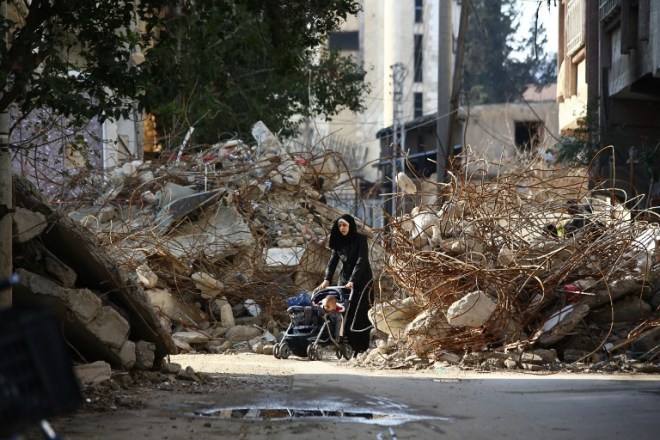
The war in Syria has to end, eventually. However, the tragic reality is that the damage is likely to last for decades.

TOPSHOTS-SYRIA-CONFLICT-DAILY LIFE

Woman and child in Douma, Syria in Dec 2014. (AFP Photo/ Abd Doumany)

Yesterday, The New York Times reported that in the past few days “tens of thousands of civilians” have fled the city of Aleppo as the Syrian military, aided by Russian jets, have tried to reclaim the area. This is only the latest wave of civilians being forcibly displaced by the war. Altogether, the UN estimates that more than half of Syrians have been displaced from their homes at least once. Some of these have crossed into other countries, while the rest remain internally displaced.

Continue reading

Trump-ed Up Genes

“Wherever you go, there you are.”

I try to keep my ears open to how public figures speak about science and anthropology. It’s always interesting to learn how different people, particularly influential people, perceive these subjects. For example, in his 2009 acceptance speech for the Nobel Peace Prize Barack Obama said that “War, in one form or another, appeared with the first man.” That’s an empirical claim, but I don’t think the archaeological evidence is on his side.  

However, Obama’s statement offered a tantalizing window into the way he might see war – that it is simply an unavoidable outcome of human nature, implying that we may be stuck with it indefinitely. I don’t know for a fact that he actually thought that way; that’s me trying to read between the lines. And I’m not saying that such a view is wrong; I don’t think war will be eradicated anytime soon either. But I don’t think we should reduce something as complex as the large-scale arming and mobilization of military forces simply to some fuzzy notion of an aggressive human nature.     

This brings me to Donald Trump. More than once, I’ve noticed that he likes to say that he’s a “big believer” in the “gene thing” as an explanation for whatever success he has had in life (see here and here). A quick Google search shows that he’s done this for years, and that he has credited several of his ‘superior’ traits to his genes or some generic notion of heredity, a pattern I find interesting. Some examples:

Continue reading