“Is Destroying Water Left for Migrants a Crime?”

I recently saw the video below featuring the humanitarian organization No More Deaths, under the title “Is Giving Water to Migrants a Crime?” However, an alternative title could have been “Is Destroying Water Left for Migrants a Crime?”  In the video, we see U.S. Border Agents in southern Arizona destroying water left by volunteers for migrants crossing via Mexico. We also learn that one of the group’s volunteers was arrested for “harboring two undocumented immigrants and giving them food, water and clean clothes.”

The area is home to the Sonoran Desert and is notorious for migrants dying from the heat and dehydration, from hypothermia (in winter), and from injuries and getting lost during the exhausting journey.  Between 1999 and 2013, an estimated 2,400 people died in the area, according to the organization Human Borders. Certainly, more have died since. According to Betzi Younglas, a volunteer with the organization, “When the US began walling off the border cities and erecting a barrier right across Texas, they thought the danger of coming through here would deter the migrants. But they underestimated their desperation.”
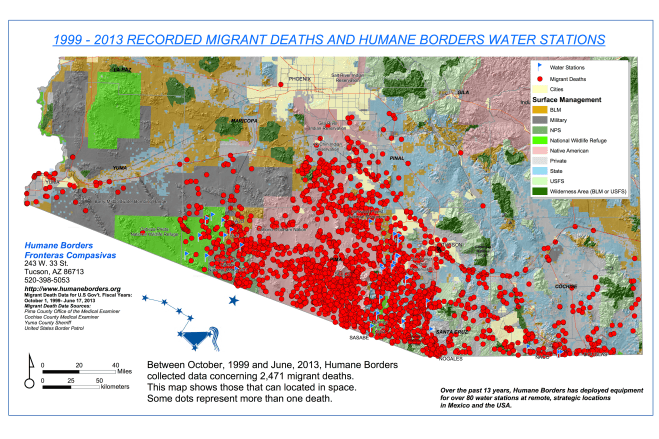
131204_humane_borders

Therefore, groups like “No More Deaths” are literally saving lives. Leaving aside the nuances of the debates about undocumented immigration, most (reasonable) people would agree that crossing an international border without proper paperwork should not be a death sentence (though here is an unreasonable example).

It occurred to me that border agents who damage food and water supplies left for migrants is something that would not be tolerated in war time. In 2016, referring to the war in Syria, U.N. Secretary General Ban Ki-Moon bluntly stated “Let me be clear: The use of starvation as a weapon of war is a war crime.” Of course, this applies to the deliberate deprivation of drinking water as well. According to Leslie Alan Horvitz and Christopher Catherwood’s book “The Encyclopedia of War Crimes and Genocide” (2014: 406-7):

Continue reading

The Dreams of Refugees

Do yourself a favor and watch this 6 minute short film on refugee children. You won’t regret it. 

R.I.P. Dolores O’Riordan

“You’ll always be special to me.”

Yesterday, it was reported that singer Dolores O’Riordan passed away unexpectedly at age 46. This one was a gut punch to me. I must have played The Cranberries‘ CD’s hundreds of times in college and graduate school, and I often had their songs on my playlist while traveling, including on a long, memorable bus ride through the mountains of Laos. Her voice and lyrics will be with me for a long time.

Somewhere between Phonsavan and Luang Prabang in northern Laos, 2009. I’ll long remember the breathtaking scenery, paired with the Cranberries’ music.

Continue reading

8th Anniversary at a Crossroads

“The purpose of anthropology is to make the world safe for human differences.” – Ruth Benedict

“Imagine what seven billion people could accomplish if we all loved and respected each other.” – Anthony Douglas Williams


I just received notice from WordPress that it is the 8th anniversary for this site. To be honest, I have not been feeling too great about this site lately. Readership is down noticeably, and it has been harder to get the attention of my targeted audiences. I’ve even contemplated folding the tent.

Surely, part of that is me, as I’ve found it hard to maintain the volume of essays compared to prior years. Perhaps it’s merely the nature of today’s Internet. Eight years ago, there were fewer personal blogs and sites to compete for readers’ attention, and people seem to prefer shorter, more digestible, essays before moving on to the next item on their list. I understand. Time is finite, and we have things to do. 

Continue reading

The Fog of Warnings

Earlier today there was a report that people in Hawaii received a warning that a missile was incoming. This turned out to be a false alarm, but for approximately twenty minutes many people believed a missile attack, possibly a nuclear one from North Korea, was imminent. 

6ebwf2ejdm6kpat5dqv3uwo6ai

As with everything these days, the discussion online seemed to revolve around who was to blame. It appears that someone pushed the wrong button, causing anxiety and fear for many people. It could have been worse, had the wrong people panicked.

I immediately thought of Robert McNamara’s recollection of the Cuban Missile Crisis from the documentary “The Fog of War,” and the lessons he learned from that episode. 

Continue reading

Children in Conflict

“If a bomb is deliberately dropped on a house or a vehicle on the grounds that a “suspected terrorist” is inside (note the frequent use of the word suspected as evidence of the uncertainty surrounding targets), the resulting deaths of women and children may not be intentional. But neither are they accidental. The proper description is “inevitable.” 

-Howard Zinn, “War is not a solution for terrorism” The Boston Globe 2, 2006

Screen captures featuring headlines concerned with civilian victims of war.

UNICEF recently released a list of some of the most dangerous places for children to live. In various wars around the world, children have been killed, abducted, injured, raped, lost family members, and been forced into military service (“child soldiers”). In addition to the direct targeting of civilians, including children, war also creates indirect adversities including psychological stress, infections, and malnutrition. For example, in the ongoing conflict in Yemen, one million people have contracted the deadly diarrheal disease cholera, 600,000 of whom are children.

Continue reading

Putnam, Past, and Present

If you live in southern New England as I do, it can be hard to avoid the name Putnam. Putnam Cottage, Putnam Memorial State Park, Putnam Monument (Brooklyn), Putnam Monument (Hartford), Putnam Street and Putnam Pike in Rhode Island, Putnam House, Putnam County (several), Putnam Farm, Put’s Hill, Putnam Pond.  My cousins grew up right near the town of Putnam Connecticut. There’s even a beer named after Putnam, brewed in Connecticut of course, and described as “full of flavor and unabashed amazingness.”

Traveling through the area, there are road signs for all of these memorials, dedicated the Revolutionary War general Israel Putnam, who was called “the provincial army’s most beloved officer” by historian Nathaniel Philbrick. Putnam was born in Massachusetts and lived most of his life in Connecticut, so it makes sense that any monuments of him would be found in this region. It’s interesting to note that many of these tributes were established years, decades, or even nearly two centuries after Putnam’s death in 1790. The town of Putnam, Connecticut was named in 1855. His monuments in Hartford and Brooklyn were dedicated in 1874 and 1888, respectively; the state Park was created in 1887, and his statue there was made in 1969.

p1170508

Israel Putnam Monument in Brooklyn, Connecticut. Source.

The anthropologist Marshall Sahlins (1976) once told a story of a sociologist who studied equestrian statues in New York, noting the relationship between the number of feet the horse had in the air and the status of the rider. One foot in the air connoted something different than two feet or none. One observer argued that the study was complicated by the fact that people didn’t ride horses anymore. Because horses were largely obsolete, societies were less restrained in how they could consider and present them. To which another observer replied, “It’s true that people don’t ride horses anymore, but they still build statues.” Continue reading