Did Pairbonds Evolve to Be Asymmetrical?

“I know you belong to somebody new, but tonight you belong to me.” Rose and David 

“I wanted love, I needed love. Most of all, most of all.” Auerbach and Carney (1)

.

Several researchers have attempted to reconstruct the very difficult problem of why pairbonding may have evolved in humans (I wrote about this here, but a decent guess is that this began around 2 million years ago. Maybe). Those reconstructions often come with an addendum, which predict that pair-bonds would not be completely symmetrical. Instead, either males or females would have more of an incentive to initiate or maintain a long-term bond, and this would depend on the reasons that pairbonding evolved in the first place.

For example, here is David Buss, explaining why males are more likely to fall in love first:

“Because love is an emotion tethered to long-term mating; because fecundity and reproductive value is so critical to men in selecting a long-term mate; and because physical appearance provides an abundance of cues to a woman’s fecundity and reproductive value, we can predict that men will experience “love at first sight” more often than women. The empirical evidence supports this prediction.” (Buss, 2006: 69)
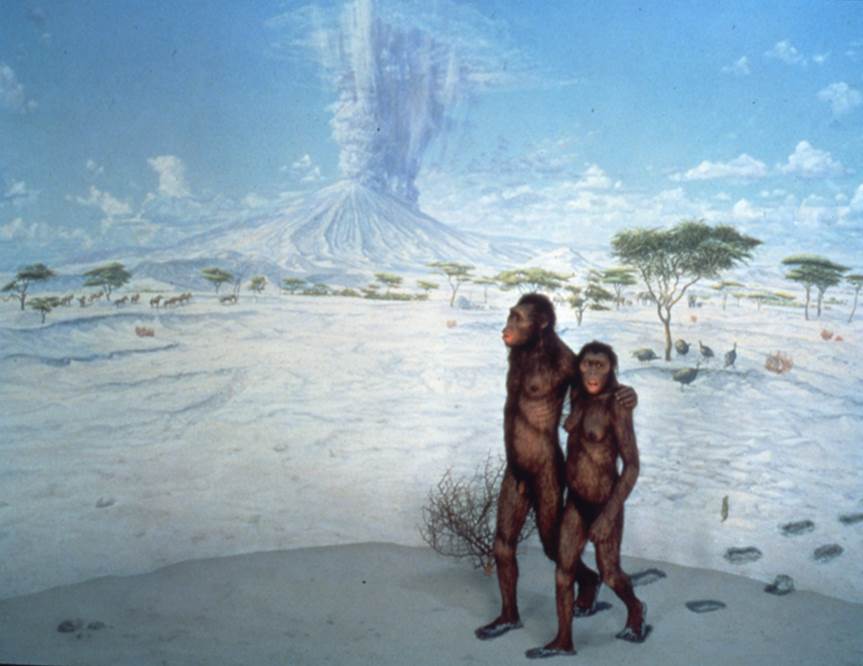
Australopithecus afarensis ("Lucy"), out with her date. Source.

Australopithecus afarensis (“Lucy”), out with her date around 3.6 mya. This portrayal of an early pairbond is speculative, but it ‘s probably not accurate. Source: AMNH.


Continue reading

Kindness and Regrets

Be excellent to each other.” – Bill and Ted (20th century philosophers)


From a commencement speech by George Saunders: 

“What I regret most in my life are failures of kindnessThose moments when another human being was there, in front of me, suffering, and I responded…sensibly.  Reservedly.  Mildly.”

Saunders then describes a memory from the seventh grade, when he did not defend the new girl in school who was teased for being different. Forty-two years later, he still thinks of her occasionally, and even though he was not personally cruel toward her, he regrets not going out of his way to extend her kindness. He then questions why kindness is often lacking, and he looks for prescriptions to make it more common.

The speech is a good one, and it stirred up some personal memories of instances when I could have used some kindness from someone. Sometimes it came; others it didn’t. There were also situations that called for me to be the one to extend kindness to someone else who needed it. Sometimes I stepped up, although probably not as consistently as I should have. Fear can be a powerful deterrent. Like Saunders, I regret those missed opportunities.

Of course, the opposite of kindness is cruelty, and I’m often distressed by the latest story of human callousness, where someone is belittled for not conforming to another’s standards. For those of us who are not Rhodes Scholar Olympians (which is to say, nearly everyone), we all fall short of socially constructed ideals in some way. Either we’re not attractive enough, or not stylish, athletic, or smart enough (or too smart). Too red. Too blue. Too promiscuous or too chaste. Too tall. Too short. Too neurally atypical. Or, we’re the ‘wrong’ weight, gender, race, sexuality, ethnicity, social class, or speak the wrong dialect. We can be incredibly creative at finding the holes in the armor to bring someone down.

For such an intensely social species, we often seem to go out of our way to make each other want to leave the group.

Continue reading

A Child’s Wisdom

Today, my son  told me he had figured out how to never make a mistake again. His solution: just never try or do anything anymore. He said it with a smile, but I think he half wishes this was an option. Unfortunately, he seems to have inherited a personality quirk (defect?) from me, which is that we are both incredibly good at self-flagellation when we make mistakes.

To cite a minor example, sometimes I’ll dwell for a couple of days on a student’s question that I couldn’t answer in class. Or if I forget somebody’s name who I am definitely supposed to know, I will swear at myself under my breath far too many times, more than most people would. And those are just minor examples. It can be a problem, one that I wish I hadn’t passed along. Dammit (see?).

To reassure my son, he is actually on the same wavelength as Alain de Botton, one of the better known modern  philosophers out there. And he’s not even 10 yet. Good for him.

de Botton

Continue reading

KIPP Students Rock!

…as does their teacher, Ms. Bertrand. 

I just got a nice package in the mail today, full of seventy or so “thank you” notes for my visit to the three 8th grade classes at KIPP Lynn last week. I appreciate it, guys.

What really makes me smile are the notes that mention how students had their curiosity piqued or that they explored some idea further on their own.  That alone is worth the visit. Learning isn’t limited to school. It never stops, and the world is yours to explore.

Continue reading

More Public Outreach

For the third consecutive year, I went back to the Knowledge is Power Program (KIPP) school in Lynn, Massachusetts to share a little biological anthropology with some 8th graders again. They have a beautiful new building, and I’m even more impressed by their students. The first class starts at 7:25am, and they were really bright young minds who asked lots of questions.  I was a little burnt out by the third class, but the students really kept me on my toes. The three hours actually flew by.

Their teacher, Ms. Bertrand, even had the class present me with an Honor Roll t-shirt. Do I have any ganas? Yup.

Related: Public Outreach 3: Sharing Anthropology with 8th Graders.

Tradeoffs, Happiness, & the Biology of Our Cacophonous Selves

You can’t have everything. Where would you put it?” – Steven Wright  (comedian)

 It seemed like a good idea at the time.” – S.A. (neuroscientist, friend)

 .

 .

Lately, I keep seeing a recurrent theme in a number of widely different sources. It’s a concept taught in Economics 101, that of tradeoff and opportunity costs – money or time invested in one object or activity cannot be spent on another. A related concept, foundational to biology, is life history theory (LHT). In his book “Patterns of Human Growth,” the biological anthropologist Barry Bogin defined LHT as:

the study of the strategy an organism uses to allocate its energy toward growth, maintenance, reproduction, raising offspring to independence, and avoiding death. For a mammal, it is the strategy of when to be born, when to be weaned, how many and what types of pre-reproductive stages to pass through, when to reproduce, and when to die.” (1999: 154)

life

you could be a winner at the game of life

Continue reading

Part 9. Humans are (Blank)-ogamous: Love Is an Evolutionary Compromise

This is part 9 of a series on the evolution of human mating behavior, comparing evidence for promiscuity and pair-bonding in our species. Please see the introduction here.

____________________________________________________________________

I want love to roll me over slowly,
Stick a knife inside me, and twist it all around.
I want love to grab my fingers gently,
Slam them in a doorway, put my face into the ground. – Jack White (Love Interruption[1]  

“Everything is a double-edged sword… Even single-edged swords are a double-edged sword. Because you can cut something with it, but the other edge is kind of flat and it doesn’t cut very well.” – Louis CK (comedian)

.

.

Yesterday’s post looked at the neurobiology of romantic love, asking whether evolutionary perspectives are sufficient to explain this highly significant part of what it means to be human. It also raised the question as to why love seems to be a painful experience for so many people.

Before going further, it’s important to remember that while humans are undoubtedly evolved, biological organisms, we are also animals with complex behavior, language, and culture. Others have said this better than I can. To Jon Marks (2010), we are “biocultural ex-apes,” while Agustin Fuentes wrote that “human behavior is almost always ‘naturenurtural’ ” (2012:16). Just as human modification of the environment can affect natural selection (Hawks et al 2007; Laland et al. 2010), so can culture profoundly influence the way we interpret powerful emotional impulses, including those related to desire and love.

Continue reading

The Christmas Truce (Yet Again)

A couple of years ago around this time, I wrote a post titled Lessons from the Christmas Truce of 1914,” which is by far the most read thing on on this site.  Last year I had a lesser viewed follow-up about a man named Julio Diaz, a New Yorker who responded to a teenage mugger with compassion, which led to a conversation at a diner and the teen voluntarily handing over his weapon. 

..

Together, the two posts address some attributes we have as a species that facilitate cooperation,  even in times that are enormously challenging. These include, but are not limited to: empathy, the benefits of mutualism, and trust. We can find certainly find many counterexamples lately, with people inflicting great pain and suffering on each other. In recent memory, these include the horrific shooting deaths in Newtown, Connecticut  or the use of cluster bombs against civilians in Syria. This makes examples of cooperation all the more necessary.

..

To continue with this late December tradition, here is the story of a German fighter pilot from World War II named Franz Stigler and an American bomber pilot named Charles Brown:

On Dec. 20, 1943, a young American fighter pilot named Charlie Brown was on his first World War II mission. Flying in the German skies, Brown’s B-17 bomber was shot and badly damaged. As Brown and his men desperately tried to escape enemy territory back to England, a German fighter plane pulled up to their tail. It seemed certain death. Instead of shooting the plane down, however, the German pilot, Franz Stigler, escorted the Americans to safety.  (source)

Continue reading

Adversity, Resilience, & Adaptation

Note: this post was inspired by the recent conversation I had with Soo Na Pak about grief and resilience.

_______________________________________________________________ 

..

Now the music’s gone, but they carry on
For their spirit’s been bruised, never broken.
They will not forget, but their hearts are set
on tomorrow and peace once again.

Phil Coulter, The Town I Loved So Well1

..

..

When I was a boy and got hurt – falling off my bike, getting hit by a baseball in the ribs, a bruised ego – my father would say to me “you’ll have a lot more of those in your life, kid.” It really wasn’t the response I was looking for at the time, which I suppose was for sympathy. My guess is that he thought a bit of cold, hard reality would do me some good. I don’t know which parental approach is the correct one, but he was undoubtedly right that adversity and getting hurt never really stop, no matter how old we are. But after being knocked down, we do our best to get up again.

My dad and I, during the great scissors shortage of 1977.

Unfortunately, we sometimes face challenging circumstances which greatly exceed falling off a bicycle – the death or loss of our loved ones, poverty, discrimination, debilitating disease or psychological trauma, famine, slavery, war, etc. Sometimes these things are chronic or even fatal, and should we be lucky enough to make it through to the other side of the tunnel, the pain can feel almost unbearable in the interim.

Continue reading

Public Outreach 3: Sharing Anthropology with 8th Graders

My 8th grade class. It’s relevant.

Last week, I spoke with three 8th-grade science classes at the KIPP (Knowledge is Power Program) Academy in Lynn, Massachusetts. It’s my third visit in two years, and I’ve found my time there to be very well-spent. KIPP is a neat place. The teachers are passionate and believe in their students, who in turn are highly enthusiastic and engaged. On its website, the program mentions that its objective is to help students in under-served communities around the United States “climb the mountain to and through college.” This is accomplished through effective teachers, a lengthened school day and week, and by instilling “a strong culture of achievement.”

One very admirable aspect to their philosophy is that “demographics do not define destiny.” More than 87 percent of KIPP students nationally come from low-income families, but the school feels that this can be overcome through hard work, and they have the data to back this up. “There are no shortcuts,” is one of their school mottos. Good for them.

.

Some of the fossil casts I brought with me. Except the one on the left. That’s a boy (my son, actually).

..

Continue reading