Peace with the ‘Enemy’

NBC News has been running a compelling series on the return of American Col. Jack Jacobs to Vietnam, where he was wounded forty years ago. I recommend this insightful essay by Col. Jacobs, a Medal of Honor recipient and former West Point faculty. It describes his meeting with the former commander that ambushed his battalion, as well as his general reflections on the ‘enemy.’

But the enemy is an amoebic mass, a single-minded monolithic inhuman force. Killed in action, they are only a logistical problem, and you get a feeling of them as individuals only when you capture them, scared, wounded and shivering. They are no longer part of the enemy organism, and it is only then they come to life as people.”

Continue reading

On Parenthood

It’s hard to believe that my older son was born almost eight years ago. Sometimes I remind him that at one point he was only a little longer than my forearm, and that I could hold him in one hand. He’s a little taller than that now.

A duet

Continue reading

Student Research on War, Health, and Biology

With grades submitted earlier this week, the Spring 2011 semester is officially in the books. In my ANTH 324 class, “A Biocultural Approach to War,” students were required to write a literature review paper on the ways that war impacts human biology and health.

In my opinion, research papers are valuable in upper level undergraduate classes because they give students the freedom to pick a topic of their choice, within the boundaries of class goals. While it seems self-evident that war’s effects on biology are negative, this relationship is not always straightforward for every possible outcome variable. Thus, it is necessary to explore the evidence thoroughly.   

Continue reading

The Sex Ratio at Birth Following Periods of Conflict

Note: this paper was written by UMass Boston undergraduate student Johnny Xu for my Spring 2011 class ANTH 324: “A Biocultural Approach to War.” I asked his permission to post it here. 

..

Birth Sex Ratio and Infant Mortality: Adaptations or By-products?

..

1. Introduction

            The purpose of this paper is to provide manifold reasons attempting to explain why the birth sex ratio following war periods tend to rise in favor of males and what this implies in correlation with infant mortality; and, most of all, to answer the following question: is the combination of these findings proposing that this is an adaptive response of the parent to produce the sex with higher survival prospects in the given environment, or is this simply the by-product of environmental forces?


Continue reading

Peace with the Past: The Arrest of Mladic

Thursday’s arrest of Ratko Mladic, who had avoided capture for 15 years, acts as a reminder that the need for justice has a long reach. The Serbian General is believed to be responsible for being the architect of, among other things, the siege of Sarajevo and the massacre at Srebrenica. Tellingly, Mladic will be handed over for trial for war crimes to The Hague by the Serbian government, a sign that times can change and that nationalism does not always precede doing the right thing. President Boris Tadic stated: “I think today we finished a difficult period in our recent history.” 

A woman visits the grave of her son, killed in Srebrenica (NY Times)

Continue reading

Public Outreach 2: KIPP Lynn

With classes and exams completed at UMass Boston, I finally feel like I have a little bit of breathing room.

..

Today, I visited KIPP Lynn for the second time, giving a presentation on evolution and cooperation for three 8th grade classes. It was necessarily condensed talk, but the students in all three classes were really engaged with terrific comments and questions. It’s been a while since I was in the 8th grade, and it’s hard to remember what that age was like, intellectually. Nonetheless, I thought they were really impressive kids, with bright futures ahead of them. 

..

Now to finish up some grading…

..

Related post: Public Outreach: Sharing Anthropology Outside the University (Apr 17, 2011) 

Life is Still Beautiful

I wrote this last year, as a memorial to my brother Kevin. It means as much to me today as when I first wrote it.

https://kevishere.wordpress.com/2010/05/15/life-is-beautiful/

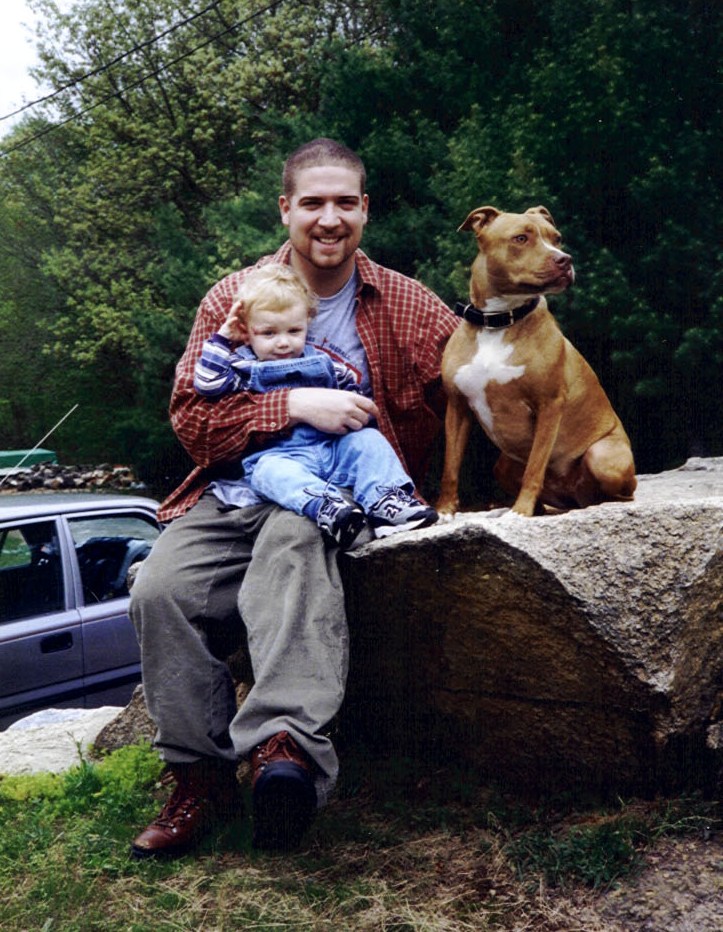
Kevin (Feb 26, 1977- May 14, 2000) with his son, Daniel

xxx

A Reverence for Life

In re-reading a few books on evolution, it occurred to me that there is a common thread running through many of them, which is the reverence that the authors hold for life itself. Unfortunately, there exists an idea out there that to explain something in nature is equivalent to “explaining it away.” The fear is that this may deflate a person’s sense of wonder. But this is far from the truth. For example, the biological anthropologist Helen Fisher commented that her career studying the biology of love (by definition, one of the most romanticized topics possible) has done nothing to diminish her appreciation of it. The same applies for those who study other aspects of science, including evolution.

Eugenie Scott, Director of the National Center for Science Education, has written that for many laypeople the notion that evolution is an unguided, mechanistic process implies that “life has no meaning.” However, contrast that view with how many scientists write about nature. The sense of awe and reverence that they exude is palpable.

Continue reading

Conduct Your Triumph as a Funeral

With the news of Osama bin Laden fresh, I’m reminded of a passage (#31) from the Tao Te Ching on humility and military victory:

Continue reading

Public Outreach: Sharing Anthropology Outside the University

Work Hard. Be Nice.” – motto at the KIPP school in Lynn, Massachusetts

Over the past few months, I’ve done more voluntary outreach teaching than at any point in my past. In sum, I’ve spoken to four separate 4th grade classes in Cranston Rhode Island, three separate 8th grade classes at KIPP Lynn, and given five lectures to 50 year-old+ adults at the Osher Lifelong Learning Institute in Boston. All of these presentations/ discussions were 40 to 90 minutes each, and pertained to primate biology/behavior, human biological variation, or the human fossil record. Why now?

Continue reading