“From the individualistic point of view it matters not at all that a million people perish, what matters is that one person dies a million times.”
—Lidiya Ginzburg (1902-90) siege of Leningrad survivor, “Notes from the Blockade”, p. 85
“I am not a number and I do not consent to my death being passing news. Say, too, that I love life, happiness, freedom, children’s laughter, the sea, coffee, writing, Fairouz, everything that is joyful—though these things will all disappear in the space of a moment.”
—Nour al Din Hajjaj, Palestinian writer (2006 -2023)
~~~~~~~~
Palestinians mourning their relatives, killed in an overnight Israeli strike on the Al-Maghazi refugee camp, during a mass funeral at Al-Aqsa Hospital in Deir Al-Balah, in the central Gaza Strip, on Monday. Source: Mahmud Hams/Agence France-Presse — Getty Images
Numbers can be a double-edged sword.
They can help us perceive the scale of an issue, or the difference between two things. We can use them to detect how patterns may change over time. They can aid us in finding associations between variables. And they can allow us to see a pattern from above and help us gain some emotional distance from it. To quantify, wrote Carl Sagan, was one of our most important “scientific tools” (though he also left room for qualitative approaches). Similarly, in Errol Morris’ outstanding documentary “The Fog of War,” one of Robert McNamara’s eleven lessons was simply “Get the data.” In sum, numbers are essential.
Yet numbers also have some limitations, particularly when it comes to war and human suffering. Sometimes, numbers seem to numb our humanity. As psychologist Paul Slovic has written, we are more apt to empathize with individuals in a way that is difficult when thinking about a multitude, an effect he referred to as “psychic numbing” (Slovic, 2007). For example, people are more likely to donate to charity after being presented with the story of a single affected person than statistics from a humanitarian disaster.
I deleted my Twitter/X account a couple of weeks ago. After being on the site for fourteen years, I admit that it was difficult to let go. Mine wasn’t a huge account, with only a few thousand followers, but Twitter had been good to me. It helped me forge professional contacts, share some writing, even get invited to conferences and be interviewed by journalists. And of course there was some time to follow news, goof off, and just interact with people around the world.
However, after the change of ownership to Elon Musk, the site seemed to change for the worse, with an increase in ethnic slurs and hate speech, and a decrease in oversight. There appears to be an exodus of academics from Twitter, as networks gradually deteriorated and the algorithm seemed to sideline old voices in favor of more sensational, even hate-filled tweets. The journal Nature mentioned one analysiswhich found that a handful of controversial, previously obscure, accounts that Musk personally recommended or interacted with had exploded in popularity after only a year.
I know there are many more important issues than this. Some friends suggested I stay there and “take up space,” make your voice known, etc. Knowing the old maxim about the Internet, “If you are not paying for it, you’re not the customer; you’re the product being sold,” ultimately I felt ethically torn by remaining there and being a product for a site that was going in a direction I disagreed with. So, I guess that’s that.
Current events leave me searching for reasons for optimism, so I turn to one of my favorite videos. It’s raw energy, the editing is spot-on, and the sentiment behind it (the love can leave open better possibilities) is needed.
“Many that live deserve death. And some that die deserve life. Can you give it to them? Then do not be too eager to deal out death in judgement. For even the very wise cannot see all ends.”
(JRR Tolkien, The Shadow of the Past, The Fellowship of the Ring)
Most violence is morally motivated.
That was the conclusion of anthropologist Alan Fiske and psychologist Tage Rai in their 2014 book Virtuous Violence. This isn’t to say that such violence actually is morally justified. Rather, what it means is that the people wielding it often believe that it is. In their view, someone deserved physical harm. As Fiske and Rai put it, “When people hurt or kill someone, they usually do so because they feel they ought to: they feel that it is morally right or even obligatory to be violent” (p. xxii, emphasis added).
This is not the typical view of violence. Fiske and Rai noted that many people in Western societies believe that “only evil actors do violence, and that good people do not hurt others on purpose.” Similarly, psychologist Paul Bloom pushed back against the idea that people commit violence only after dehumanizing others. Certainly, there have been many instances where dehumanization has played a role, but there are other paths. Bloom argued that we may feel violent inclinations against others not necessarily because they are sub-human, but because they were bad humans, that they failed morally in some way. And because values and morals are pliable across cultures, there are so many ways to see others as failed moral agents deserving of punishment.
If we pause and think, we may come up with examples where we may feel that violence is arguably justifiable (a bully receiving comeuppance, a victim resisting a kidnapper, etc.). Even if we agree that violence is not the ideal option, there are times when we may encounter a gray, murky zone where we feel violence was regrettable yet somewhat understandable. That ambiguity is one reason why violence can be so challenging for humanity.
I’ve cited this example before, but even Gandhi – one of the best known proponents of nonviolence – once wrote that “taking life may be a duty.” In his hypothetical example, violence was an acceptable means of stopping a man who was in the act of committing mass murder with a sword, adding that “anyone who dispatches this lunatic will earn the gratitude of the community and be regarded as a benevolent man.” Here we see elements of ostensible “virtuous violence,” with Gandhi describing the intercessor in heroic terms. However, Gandhi added that violence should be used “only when it is unavoidable, and after full and mature deliberation and having exhausted all remedies to avoid it.”
Violence and John Brown
On separate road trips the past two summers I visited two places associated with the abolitionist John Brown: Harper’s Ferry, West Virginia and his family’s historic farm in upstate New York. These were side trips during family vacations, but I was inspired by Yale historian David Blight’s wonderful lecture series on the Civil War, including a compelling short summary of Brown.[1] As is widely known, in 1859 Brown led an unsuccessful raid at Harper’s Ferry in an attempt to seize the U.S. arsenal there as part of a plan to help free people from slavery. Brown was captured, tried, and hanged, while most of the men with him were also killed or captured.
John Brown’s farm, in upstate New York.
I’ve been thinking about Brown a lot recently, as an exemplar of moral violence, particularly as violent rhetoric, death threats against members of Congress, and political violence have increased in the U.S. the past few years. Though I’ve forgotten a lot from my school days, I remember being taught about him, getting snippets of his story in history classes and how he was portrayed as a madman with crazy hair. I don’t recall learning much about his motives, though that might be memory failure. Now I think of Brown in the context of Fiske and Rai’s “virtuous violence” and I wonder how he might have made the psychological journey in deciding violence was justified in his righteous cause. More relevant to today, I wonder how people around the world, including here in the US, make similar mental journeys in their own idiosyncratic causes, convinced of their own righteousness.
With few exceptions, the vast majority of Americans today would agree that slavery is morally repugnant. While I do my best to maintain my commitment to nonviolence, I admit to times when it is challenged. I can feel great empathy toward people like Brown and others in the cause to free human beings from bondage. That empathy is probably magnified by my own personal history, having attended school and grown up with Black friends throughout my youth.
Yet, I have to stop and contemplate the gray zone of violence. As Professor Blight asked: “When is a cause so just that the means justify the ends? When is violence in a moral cause justified? Is it ever justified?” We probably all have our own unique, nuanced answers to such complex questions. Perhaps we have different answers on different days, depending on the cause in question, the specific details in a given scenario, our life experiences, and maybe even our mood.
As imperfect people, we use imperfect minds to make imperfect decisions using imperfect information. Yet those messy decisions—which we can perceive as having morally clear answers—can have messy, permanent effects. In their certainty that their cause was just, the first person that Brown and his men killed was a free Black man, a baggage handler named Hayward Shepherd, likely out of fear he might alert the authorities. I’ve wondered whether Brown felt that Shepherd’s death was justifiable, or whether he was merely collateral damage. I wonder how Mr. Shepherd’s family felt. Apparently, Shepherd was portrayed by local pro-slavery whites as a martyr, another example of how pliable our moralizing can be.
A Few Wrinkles
To return to Gandhi’s example of the man with the sword, many (most?) people would agree that using violence as a last resort to prevent innocent people from being killed imminently is morally permissible, perhaps even obligatory. Yet, human behavior and human minds being what they are, we can add a few wrinkles to imagine other scenarios that are less straightforward.
What if the intercessor had other non-lethal or nonviolent means at their disposal to stop the killer? What if the man with the sword was merely threatening violence, but had not actually done so? What if he had made such threats regularly but never followed through on them (i.e., he was all bluster)? What if he promised to harm others, but at some point in the distant future? Suppose the people he threatened to kill had just killed or harmed his friends or family. Or, what if the intercessor had accused him of a heinous crime, of which he was innocent? And so on and so on. There are so many possible iterations when it comes to human interactions. Yet, somehow we have to deduce how to navigate such scenarios through a combination of lessons from our culture or familial upbringing, as well as what psychologist Jonathan Haidt calls “intuitive ethics.”
Haidt proposed that preventing harm (such as stopping a mass murderer) is among a handful of intuitive “moral foundations” that are widespread across human cultures, perhaps totaling five or six values in all, roughly speaking. Haidt has referred to these as “the equivalent of taste buds that make us notice social patterns that it was adaptive to notice.” The six foundations are: (1) Care/harm, (2) Fairness/cheating, (3) Loyalty/betrayal, (4) Authority/subversion, (5) Sanctity/degradation, (6) Liberty/oppression (this was a later addition, and is sometimes not included).
I find it interesting that the motives behind many recent examples of violence can be mapped fairly well onto these moral foundations. Haidt’s system isn’t perfect, and has been critiqued on multiple grounds, including omitting other important values. That’s fine. No explanation of human behavior is perfect. Still, I think there is utility in it. Or, to be clear, it doesn’t take too much effort after the fact to imagine how people might have employed some of these foundations to be spurred enough to anger to justify violence to themselves. As Abraham Lincoln wrote, “Blood grows hot, and blood is spilled.”
None of the following examples are meant to excuse violence, only to think about how moral outrage might make blood “hot,” nudging people in that direction. Nor are they meant to downplay the genuine pain and suffering involved. These cases are more than theoretical; actual human beings were harmed, and some had their lives ended. Consider….
Last year, a 26-year-old man was arrested near the home of Supreme Court Justice Brett Kavanaugh with a gun and a knife in his possession. He previously had made threats against Kavanaugh and was reportedly suicidal and upset by the prospect of Roe vs Wade being overturned as well as by the recent mass shooting in Uvalde, Texas. He stated that killing Kavanaugh (and himself) would give his life a “purpose” and could (paradoxically) lead to gun restrictions. Ultimately, he turned himself in after getting some last-minute advice from his sister. While the man was clearly not well, unwell minds are still influenced by their environments. And they still make moral choices. It could be argued that he was motivated by the liberty/oppression foundation (the removal of a woman’s ability to choose an abortion), as well as care/harm (concern over mass shootings, concern over women being harmed by unsafe abortions).
Also last year, two brothers in Texas fired multiple rounds at a group of migrants near the US/Mexico border, killing one 22–year-old man and wounding another 31–year-old woman. The brothers claimed they were hunting wild animals and didn’t realize they were firing at people, though the woman and other migrants said they had taunted them in Spanish and fired after the group emerged from hiding. Possible motives for this heinous act might fall under the fairness/cheating foundation (ex., the legality of crossing a border) or loyalty/betrayal (the element of favoring one’s own group—in this case based on ethnicity—and bias against others’). Consistent with this possibility, one of the brothers worked at a private detention center where he had been accused of abusing prisoners and making racial taunts.
Anti-migrant sentiments might also apply to the authority/subversion foundation, due to fears of shifting demographics/ hierarchies, and loss of power. In a 2020 poll conducted in several European countries, people were asked whether immigrants from outside the EU presented more of a problem or an opportunity for their country. Anti-immigrant sentiments were highest in Hungary, Greece, and Malta, with about 63% of respondents saying immigrants were more of a problem. By contrast Finland, Sweden, and Luxembourg were the most tolerant places, with 17 to 22% holding this view. Anti-immigrant sentiments were explained as people perceiving them as threats to jobs, crime rates, resources/welfare, or values and culture. It’s interesting—at least to me—that as cultural beings people can perceive threats not just to our physical bodies and resources, but also to extrasomatic, intangible things like ideas and traditions. Of course, anti-immigration sentiments are not perfectly synonymous with violence, but they have often led in that direction. A few years ago in South Africa, looters targeted businesses owned by foreigners, leading to riots and the deaths of five people. In 2021, a far-right extremist in Frankfurt, Germany was sentenced to life in prison for the assassination of politician Walter Luebcke over his pro-immigration stance. Last month in Pittsburgh, a man was convictedof killing 11 people in a synagogue in 2018. The shooter had espoused anti-Semitic views regularly on social media and expressed disdain toward the synagogue’s support for resettling refugees, whom he referred to as “invaders.” Similar, horrible racist and/or anti-immigrant incidents have occurred elsewhere of course, including Quebec City, El Paso, Buffalo, Charleston, and Christchurch, New Zealand.
In Dublin, Ireland, a young man was sentenced to 2.5 years in prison after viciously beating an 86–year-old woman with dementia because he falsely believed that she was transgender and a “predatory pedophile.” The man’s lawyers argued their client was intoxicated (a terrible excuse). Nor does it negate the fact that, intoxicated or not, the man harbored obvious prejudices. The case also highlights the spreading moral panic against LGBTQ people. Despite the complete lack of evidence involved for his suspicions, the deluded man possibly believed he was punishing or preventing someone who might harm children (care/harm). Like slavery, the vast majority of people would agree that harming children is morally repulsive. The harm done by child abuse is real and has sometimes led to imprisonment, and large-scale lawsuits, including against Catholic and Mormon Church officials. It has also led to calls for vigilante “justice,” whether based on real or unfounded fears. Last month, anti-LGBTQ fliers were placed on multiple cars at a Target parking lot in Redding, California, calling for “groomers” to be hanged. As is widely known, Target stores carried pro-LGBTQ merchandise during Pride Month, leading to a backlash from conservatives who claimed this would influence or harm children. The flier accused Target of being “Satanist pedophiles” who supported “transitioning and mutilating children.” Whether sincerely held beliefs or cynically wielded cudgels, these are obvious moral triggers that can stir passionate responses. Such rhetoric can take a toll. By one estimate, transgender people are over four times more likely than cisgender people to be victims of violent crime.
The authority/subversion foundation could arguably apply to a case from last year, when an armed 42-year-old man was shot and killed after trying to attack an FBI office in Cincinnati. This incident occurred shortly after Donald Trump’s Florida home was searched for classified documents by FBI agents, indicating the man felt a need to defend someone he believed had legitimate authority. His social media account also mentioned a desire for “war” against “active enemies of the people” and fighting back against “tyranny” (liberty/oppression), likely believing that the investigation of Trump was politically motivated.
A year ago, a 24-year-old manstabbed author Salman Rushdiemultiple times before a lecture he was about to give in Chautauqua, New York. Rushdie, famous for his novel The Satanic Verses, has been a target of some Islamic leaders for decades. He survived and his attacker was arrested and interviewed while in jail. Of Rushie, he said “I don’t like him very much,” adding that “He’s someone who attacked Islam, he attacked their beliefs, the belief systems.” This could fall under the sanctity/degradation foundation, with the man believing he was defending/ avenging sacred beliefs.
In May of this year, a 30-year-old homeless Black man, Jordan Neely, was killed on an NYC subway. Neely had a history of mental illness and was reportedly “screaming and behaving erratically.” He was confronted by Daniel Penny, a white, 24-year-old, former marine who placed Neely in a chokehold for several minutes, asphyxiating him and causing his death. Reactions to Neely’s death fell along partisan lines. Many conservatives described Penny in heroic terms, arguing he was protecting others (care/harm) because Neely had threatened people (although Neely had not actually harmed anyone). By contrast, liberals emphasized that Neely had not actually harmed anyone, was likely having an episode of mental illness, and that his life was considered expendable in part because he was Black and homeless (care/harm; fairness/cheating; authority/subversion).
Conclusion
This essay is already too long. Sadly it could be much longer. I have had this topic in the back of my mind for a couple of years, and I’ve been collecting examples that could fit as “moral violence,” or people wishing for death on others (it hasn’t been uplifting work). For better or worse, many of us are quick to moralize, policing others’ behavior and passing judgment over who deserves to be harmed or killed for an almost endless array of supposed violations:
I suppose I wrote this hoping it would help increase our awareness of how easily we can slip into this mode of thinking. The combination of human fallibility and our pliable ability to galvanize moral outrage can create an almost endless range of scenarios when we feel violence is justified. We often paint ourselves as reluctant warriors (I really didn’t want to fight, but they forced my hand because they did… something). As General Norman Schwarzkopf once said, “Any soldier worth his salt should be antiwar. And still there are things worth fighting for.” That’s probably true. There are things worth fighting for, but deciding what those things are is highly subjective. And when we are fighting for something of value, moral certainty is just around the corner. An elderly neighbor of mine, frustrated with a certain politician, told me that she wished someone would kill them. She just… blurted it out.
Some people even blurt it out on national television, convinced of their own righteousness. Former pitcher Curt Schilling, who I once admired as a Red Sox fan, said on television that “somebody’s gonna have to pull a trigger, because everything we hold dear – everything this country was founded on – is being just dragged through the mud and mocked and made fun of.” He listed multiple grievances, mostly imaginary, that pertained to fairness, liberty, and sanctity. Schilling has a history of controversial remarks, including a “joke” that journalists should be hanged.
Similar “jokes” can be found elsewhere. For example, the satirical website The Onion posted an article about providing locations of weapons and oil executives as a last-ditch effort to curtail climate change. One academic paper asked whether fossil fuel companies could be charged with “homicide” for climate related deaths. Others have openly wondered, pertaining to the care/harm foundation, whether violence against fossil fuel executives is justifiable, given the damage done to life and property, the damage yet to come, and the lack of any meaningful shift away from fossil fuels.
On the bright side, most of us do not engage in nor condone violence. In a 2021 poll, Americans were asked whether they think it is ever justified for citizens to take violent action against the government. The majority, at 62%, said it was never justified; however this was down from 90% in May of 1995. For those who said it could be justified, their most common causes pertained to government abuse of power (oppression, loss of democracy, shifting to a dictatorship, tyranny, violating the Constitution). Another common reply is if the government harmed citizens or was not working in the citizens’ best interests (a difficult thing to measure). As a country, our collective blood has gotten hotter. But what can be done can be undone.
I think it helps to remember that Tolkien’s admonition to “not be too eager to deal out death in judgement. For even the very wise cannot see all ends.” Wisdom is a noble pursuit, but I think if we reflect we might agree that it seems to be a fairly rare achievement. This could also spur us to try a bit harder to increase our creativity to solve problems nonviolently. Finally, if we are feeling moral certainty about the use of violence, we might also remember something Martin Luther King wrote in 1956:
“As you press on for justice, be sure to move with dignity and discipline, using only the weapon of love. Let no man pull you so low as to hate him. Always avoid violence. If you succumb to the temptation of using violence in your struggle, unborn generations will be the recipients of a long and desolate night of bitterness, and your chief legacy to the future will be an endless reign of meaningless chaos.”
[1] Professor Blight’s entire lecture series is excellent and can be found here.
Some choices or moments have disproportionate effects on our lives. We tend to return to something like baseline, eventually, but those effects reverberate. Some people advise living in the present, putting the past behind us. I choose to remember.
Delaney Glass, a graduate student in biological anthropology at the University of Washington, kindly invited me to be part of a project on the effects of the Vietnam War (or Second Indochina War or the American war, depending on your perspective) on the health of older Vietnamese adults. The article is now in press in the Journal of Psychosomatic Research and titled: “Weathering within war: Somatic health complaints among Vietnamese older adults exposed to bombing and violence as adolescents in the American war.”
There’s a lot in here, but to me the main takeaway is that proximity to intense US bombing in adolescence, particularly early adolescence, was associated with health complaints decades later in older Vietnamese adults. I think it speaks to the long reach of war, and it adds to what we know about the many ways war can become embodied, lasting for a very long time in the health of survivors. It also provides another example of how the Second Indochina War disrupted health, as was the case in Laos and Cambodia.
“They suffer because they have lost all hope. They walk like the blind, and they fall wherever death strikes them. No one pays attention to the corpses lying on the streets. People either step over or sidestep them and keep on walking. From time to time they are collected and buried in common pits. Seventy and more people are buried together.”
-Ukrainian woman, describing the Holodomor in 1933 (source)
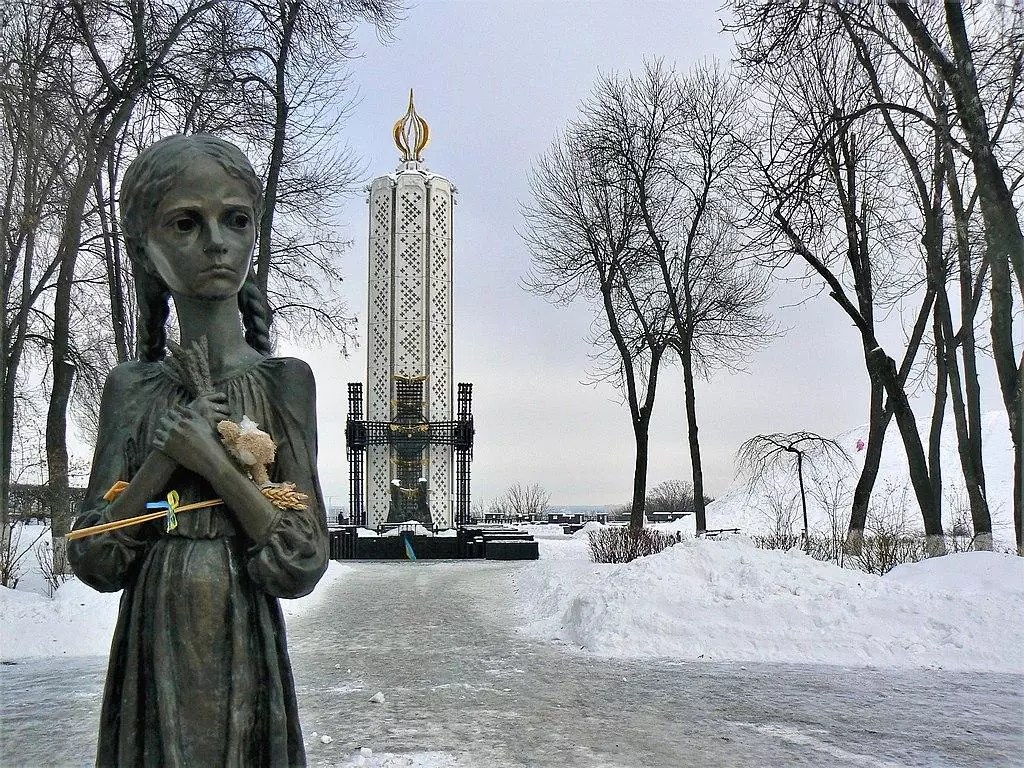
In 2008, the European Parliament formally recognized that the 1932-33 famine in Ukraine was “artificial,” and “an appalling crime against the Ukrainian people, and against humanity.” While the real number will never be known, estimates are that between 3.5 to 7 million Ukrainians died from starvation during this period, known as “the Holodomor” (“death inflicted by starvation”).
The famine resulted from a combination of factors, among these being the Soviet policy of collective farming imposed on the population. Resistance to collectivization was brutally repressed, quotas of grain and other foods demanded from farms were increased and ultimately exported, Ukrainians were prohibited from leaving the republic in search of food or even to travel from the countryside to cities in Ukraine, and police were tasked with confiscating hidden food from homes. Altogether, these decisions to weaponize food led to massive amounts of human suffering and death, the echoes of which reverberate to today.
In 2015, Columbia epidemiologist L.H. Lumey and colleagues tested whether there was a correlation between prenatal exposure to the Holdomor and subsequent development of type 2 diabetes in adulthood (Lumey et al. 2015). Per a robust body of research known as the DOHaD hypothesis (developmental origins of health and disease), various stressors early in life can increase the risk for a compromised physiology, predisposing people to an array of health conditions. Perhaps the best-known example of this is the Dutch “Hunger winter” during the Second World War. Adults who were exposed prenatally to a Nazi-imposed famine in the Netherlands consistently show elevated risk for diabetes and schizophrenia, as well as other conditions and effects on body size. To be clear, the extreme levels of hunger during famine are not required to see the effects of prenatal deprivation on later health. Rather, such a relationship appears to exist along a continuum in a “dose response” fashion. Yet the pattern becomes more predictable at the extreme end, such as during wars and famine.
To determine whether a similar pattern existed in Ukraine, Lumey et al. obtained government data from nine oblasts (regions), with a sample of 1.4 million adults born between 1930-38, including 43,150 cases of diabetes diagnosed after age 40 years. The study design allowed the researchers to look at temporal and geographic effects, as these birth cohorts straddled the famine years, and were exposed to extreme famine (Luhansk, Kharkiv, Cerkasy, and Kherson oblasts), severe famine (Chernihiv, Khmelnytskyi, and Vinnytsia oblasts), or no famine at all (Volyn and Rivne oblasts, which were under Polish control at the time).
Famine exposure in Ukraine 1932-33 (map from Lumey et al)
After adjusting for confounding variables including seasonality, the researchers found that people born in early 1934 in oblasts with extreme famine had a 1.5 times increase in the odds of having type 2 diabetes, while those born in severe famine areas had a 1.3 times increase. People born in non-famine oblasts showed no increase. Lumey et al. added that the study suggested that early gestation was “a critical timing window for determining risk of type 2 diabetes.”
The Holodomor and the Dutch famine are far from isolated cases. Though there are methodological differences and some inconsistencies in results, for the most part prenatal exposure to conflict and famine has been linked with compromised adult health throughout the world. Examples include the siege of Leningrad, the Spanish Civil War, the Biafran famine in its war for independence, France during WW2, the European Holocaust, the wars in the DRC, the Korean War, and the civil wars in Laos (for a review, see Clarkin 2019).
Could History Repeat Itself?
Could something similar happen today? Russia’s current invasion of Ukraine has been widely condemned as an unprovoked “act of aggression and human rights catastrophe” (Amnesty International) and “a clear violation of international law” and “a violation of the United Nations Charter” (UN Secretary-General António Guterres). It is telling that the oblasts exposed to extreme famine in the early 1930s are some of the same places in the news today, with massive destruction, forcibly displaced civilians, and/or likely war crimes committed by Russian troops in Luhansk, Kharkiv, Cerkasy, and Kherson oblasts. To a certain degree, history may be repeating itself.
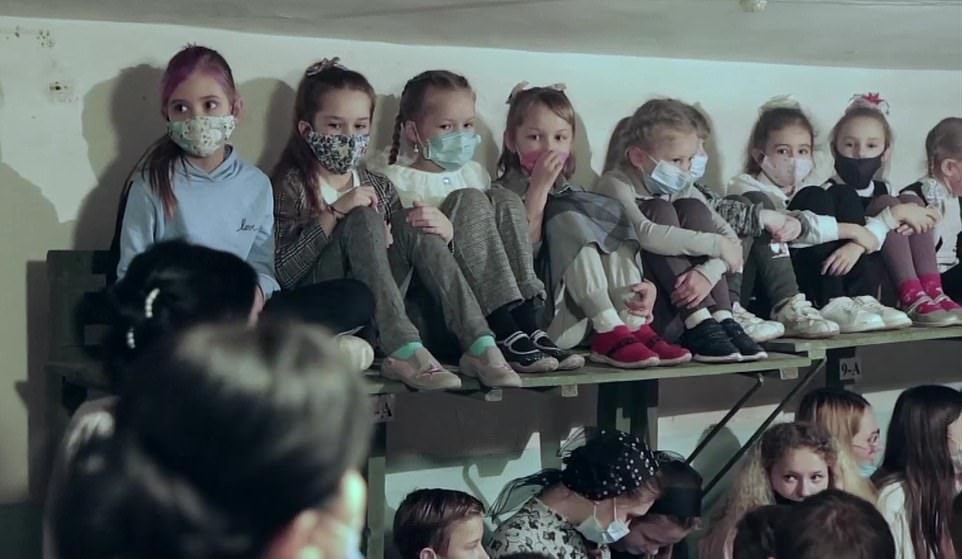
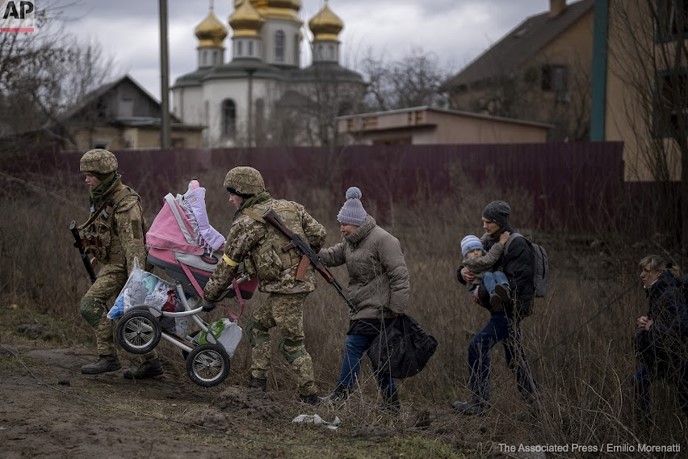
Ukrainian children wait in a bunker in Donetsk (source)Ukrainian soldiers help a fleeing family crossing the Irpin river in the outskirts of Kyiv, Ukraine, Saturday, March 5, 2022. (Emilio Morenatti/AP)Saltivka, Kharkiv. A man holds the hand of his 13-year-old son, who was killed by Russian shelling, which killed three civilians and wounded two others (source).Damage to Irpin, April 2022 (source)
At present, there are no reports of widespread famine within Ukraine. Most of the concern about the effects of Russia’s invasion on food has focused on the regional or global supply, as the conflict exacerbates fuel prices and hinders Ukraine’s ability to export agricultural products such as wheat, corn, and sunflower oil.
However, it is exceedingly obvious that it is Ukrainians themselves who bear the brunt of the war, with 7.1 million people displaced, millions forcibly deported to Russia, at least thousands killed, with those who remained behind facing food insecurity. A May 2022 survey of 4,700 Ukrainians conducted by the World Food Programme found that one-third of households were food insecure and had to forgo meals, decrease portion sizes, and eat lesser quality foods. In the highly affected eastern and southern oblasts, with about half of households being food insecure (see map below). Worst of all were internally displaced people in the east, with a rate of 62% (including 14% being severely insecure).
From World Food Programme: Ukraine Food Security Report 12 May 2022 (source)
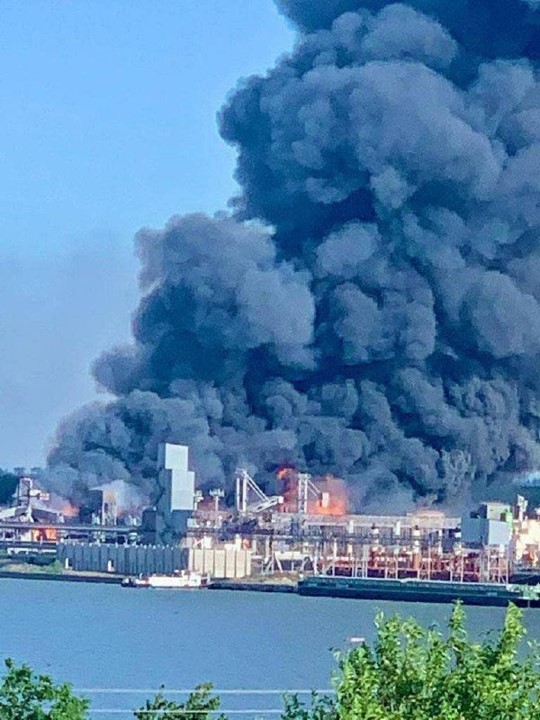
The food situation has likely deteriorated since then. There are signs that Russia has deliberately targeted the food and water supply in Ukraine, blockading ports, burning wheat fields, exporting grain from occupied Kherson’s farms to Russia, bombing fields outside of Sloviansk, stealing farming equipment, shutting off water in Mariupol, destroying hundreds of small farms and slaughtering livestock, targeting food storage sites (including grain silos, railways, and warehouses), even killing the grain tycoon Oleksiy Vadaturskyi and his wife Raisa in their home in Mykolaiv. Much like the original Holodomor, the current food shortage is an “artificial” one and an appalling crime against humanity.
Wheat fields allegedly set on fire by Russian troops in Zaporizhzhya region (source)Grain Terminal destroyed in Mykolaiv (source)Skeletons of cows, killed by Russian soldiers. At one farm at least 20 cows were shot. Alessio Mamo/The GuardianA satellite image shows fields peppered with artillery craters, north west of Sloviansk, Ukraine, June 6. Maxar/via REUTERS
Yale historian Timothy Snyder has written that such actions indicate that Russian troops are implementing a “hunger plan” concocted by Putin. According to Snyder, such a plan has three main objectives: cutting off Ukraine’s exports in an attempt to destroy its statehood, creating instability in Europe by producing refugees from areas that rely on Ukraine’s food exports sch as North Africa and the Middle East, and to be able to blame Ukraine in a propaganda war should starvation spread abroad and food riots begin.
Accusations of alleged Russian war crimes in Ukraine are extensive and heinous. The weaponization of starvation should not be overlooked among these. Article 54(1) of the Geneva Conventions succinctly states that “Starvation of civilians as a method of warfare is prohibited.” Likewise, Article 8(2)(b)(xxv) of the 1998 ICC Statute notes that “intentionally using starvation of civilians as a method of warfare by depriving them of objects indispensable to their survival, including willfully impeding relief supplies as provided for under the Geneva Conventions” constitutes a war crime in international armed conflicts.
Throughout history, war and hunger have been paired together with regularity and Ukraine is no exception. Yet it seems apparent that there is a deliberate strategy on the part of Russian leadership to exacerbate the situation and punish civilians within and outside of Ukraine by targeting the food supply. As mentioned above, there are multiple examples of such war-related food shortages having costs to health not only in the immediate term, but reverberating decades later. When tallying up all of the costs of the war in Ukraine, the main focus should be on the loss of life, the physical and mental scars, the broken relationships and families, the damaged homes and property. Yet it shouldn’t be forgotten that there will likely be other costs, including to a generation of Ukrainians who have yet to be born.
References
Clarkin PF. 2019. The embodiment of war: growth, development, and armed conflict. Annual Review of Anthropology 48(1): 423-442. Link
Lumey LH, Khalangot MD, Vaiserman AM. 2015. Association between type 2 diabetes and prenatal exposure to the Ukraine famine of 1932–33: a retrospective cohort study. Lancet Diabetes Endocrinol. 3(10):787–94 Link
“I know what I’m talking about when I talk about war, and it’s the most disgusting thing that you could ever think of. And I’ve also noticed with every single war, it’s been declared by men who were too old to go, and it’s made me suspicious.”
Sunisa Lee. Photo by Danielle Parhizkaran/USA TODAY Sports
After Sunisa Lee won the Olympic gold medal in gymnastics, a reporter (Perry Russom) from NBC10 in Boston found me online and emailed to ask if I would give a little background about Hmong people, given her importance to Hmong-Americans in Massachusetts and around the country. It was a pleasant conversation and he asked good questions about Hmong history. We spoke for maybe 15 minutes. The video below was the result [update Aug 1 2024: unfortunately, the video has been taken down].
The clip is fine. Obviously, not everything we talked about would make it into the final edited version. That’s not how television works. And the focus was where it should be — on Suni Lee’s remarkable achievement and what she means to Hmong people, who have long been overlooked in this country.
“There never was a good war or a bad peace.” – Ben Franklin
It is a blessing and a curse of being a social animal that we are often aware of what the other social animals around us are thinking. If online activity is any indication of what people are thinking, then things are not great. Every day for the past year, I have found that the most viewed essay on this site, by far, has been something I wrote in 2019 aboutwho would win a second civil war in the United States.
Perhaps I am giving this too much attention. But maybe not. A significant percentage of Americans have been deeply worried and/or angry for a while. In anOctober 2020 poll,61% of people agreed with the statement: “I’m concerned that the U.S. could be on the verge of another Civil War.” Another Yougov poll from the same time found that 56% felt that the country would see “an increase in violence as a result of the election.” A smallerpollfrom December reported that 71% of Trump voters and 40% of Biden voters believed “we are headed into a civil war or significant upheaval.” (Upheaval and civil war were not defined, however).
When I play the scenario out in my head, I think the possibility of another civil war is remote, at least not in the sense of replicating the original one. Although there has been chatter about secession in a few states(Texas, Wyoming), this has little momentum. And while there are certainly regional political differences, they do not fall along neat boundaries akin to northern and southern states. There is no Mason-Dixon line. Rather, the main divide seems to be urban-rural, within states rather than between them.
Yet even within states and within counties, there is plenty of political variation. While many counties voted overwhelmingly for either Biden or Trump in 2020, most were not very lopsided. According toone analysis, fewer than 600 out of roughly 3,000 counties (excluding Alaska, for some reason) voted over 80% for either candidate.
Alternative ways of looking at the 2020 political divide in the US. On the left, the percentage of the vote for Biden and Trump by county. On the right, results by population size. While there are regional differences, they do not break down into simple “red and blue” states. Source.