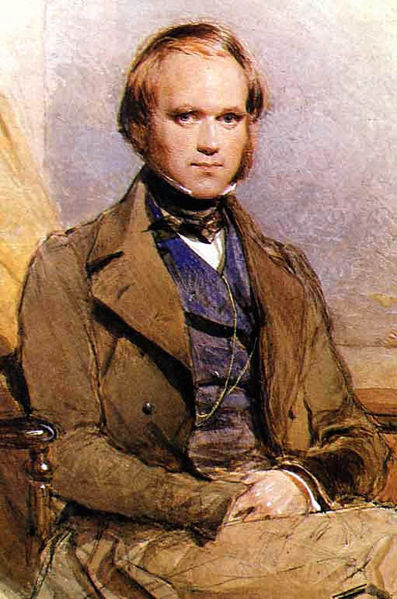
It is quite curious, when thrown into contact with any set of men, how much they continue improving in ones good opinion, as one gets ackquainted (sic) with them. This was an argument used, in a religious point of view, by a very clever Clergyman in Shrews. to encourage sociability (he himself being very fond of society), for he said that the good always preponderates over the bad in every persons character, & he thought, the most social men were generally the most benevolent, & had the best opinion of human nature. I have heard my father mention this as a remarkably good observation, & I quite agree with him.”
Of all the things I’ve written on this site, this remains one of the most meaningful to me. (May 29, 2017)
“The weak can never forgive. Forgiveness is the attribute of the strong.” …………………………………………………………………………– Mohandas K. Gandhi
On my desk sits a spoon I bought in a restaurant in northern Laos. It’s lightweight, bigger than a tablespoon, and full of tiny dents that some unknown metalsmith hammered into it. The owner was bemused that in addition to the bowl of pho noodle soup, I also wanted to buy one of her utensils. But I had my reasons.
Earlier on my trip, my guide1 informed me that people in the town of Phonsavanh half-jokingly called these ‘B-52 spoons,’ as they were made of metal recovered from bombs dropped decades ago by U.S. planes during ‘the Secret War.’ To me, the spoon was more than a quirky souvenir. Instead, it represented an attempt by Laotians to take the physical remnants of a tragic period in history and forge them into something more positive, in effect turning swords into plowshares (or bombs into spoons).Continue reading →
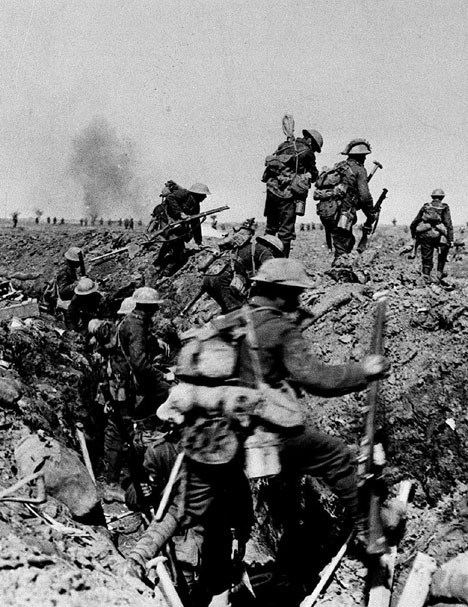
As Christmas approaches, it seems like the perfect time to reflect on an unlikely event from military history. During the First World War, a spontaneous, temporary truce was brokered between German, French, and Scottish officers on Christmas Eve, 1914. On that night and on Christmas Day along the trenches in Flanders, soldiers who recently had been shooting at each other used the ceasefire to bury their dead, then shared food and drink with their ‘enemies,’ played soccer, and even exchanged gifts and addresses in order to write each other after the war ended.
…
The details leading up to the ceasefire are a bit murky, but eyewitnesses reported that German and Scottish troops took turns festively singing carols in their own trenches. A few brave officers then seized the spirit of the moment to risk their safety, leave their trenches, and negotiate a respite from the brutality. The remaining soldiers then followed, leading to the amazing scene.
Today marks the beginning of the First Meeting of States Parties to the Convention on Cluster Munitions, held in Vientiane, Laos. The meeting’s purpose is to determine how to effectively implement the objectives laid out by the original Convention, which took place in Dublin in May 2008 and became binding to ratifying states in August this year. Those objectives are as follows:
…
The Convention on Cluster Munitions, CCM, prohibits all use, stockpiling, production and transfer of Cluster Munitions. Separate articles in the Convention concern assistance to victims, clearance of contaminated areas and destruction of stockpiles.
…
Thus far, 36 countries have been affected by cluster munitions (ex. Lebanon, Angola, Serbia). However, it is appropriate that Laos is hosting this meeting, as it is one of the most heavily bombed countries in history – a legacy of American bombing during the Second Indochina War. The lingering effects of cluster munitions have been particularly pernicious. Even today, almost four decades after the bombing of Laos ended, there are roughly 250 casualties annually from unexploded ordnance (UXO) leftover from the war. Many of these casualties are children.
..
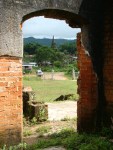
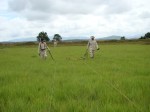
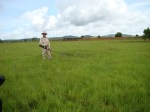
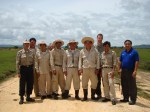
Last year, I saw some of the effects of the war in Laos first-hand in Xieng Khouang province, where craters and injured people are both abundant. My interpreter and guide, Manophet, introduced me to a bomb clearance team outside of the town of Phonsavan. They explained how the process of UXO detection and removal is painstakingly slow, given how widespread an area a single cluster bomb unit can cover and how many tons of ordnance were released over Laos (click here to see what a cluster bomb can do to your neighborhood).
…
The day I visited, the team had located ten ‘bombies,’ and they were kind enough to let me remotely detonate one, an experience far removed from my usual job. It was exciting, but also a chilling reminder of how long such munitions can last, with the potential to indiscriminately maim or kill even decades after a war has officially concluded.
…
As an American, it also struck me how we are obligated to clean up the mess we left behind. After all, the war in Laos is over. Therefore, UXO is not a military problem or a political one. Rather, it is a public health problem – killing family members, causing disability, and disrupting lives. Regardless of where one falls on the political spectrum, it should be uncontroversial to say that children should not be maimed or killed by bombs leftover from a war that ended decades before they were born. Removing the bombs in Laos is simply the right thing to do.
I love baseball, having played from Little League through high school. The game taught me many lessons about athletics, but also about life. As a New Englander, I grew up a Red Sox fan, which was sometimes painful (the infamous Bill Buckner game of the 1986 World Series fell on my 12th birthday). However, the 2004 championship was pure elation, and made up for everything. After the Red Sox came back from a 0-3 deficit to beat the Yankees in the ALCS (the semi-finals, for you non-baseball fans), my father, brother, uncles, cousins, and I took photos in front of the television, as if we were documenting history. I even made sure my infant son was in the photos, to prove to him when he got older that he was there. Ridiculous, right?
“The past is never dead. It is not even past.” –William Faulkner
…
Bosnian Muslims in Trnopolje camp, 1992
The dividing line between past and present is almost never clear cut. We constantly carry our pasts around with us: personal, cultural, historical, and evolutionary. Often, those pasts are burdened with regrettable or undesirable incidents and other phenomena, be they tragedies, atrocities, accidents, bad memories, poor decisions, crimes, natural disasters, or even as part of our evolutionary baggage (e.g., oncogenes, a ruptured appendix, or impacted wisdom teeth). At different times we may find ourselves as the aggrieved or the aggrieving party. To the extent that we can, we make extraordinary efforts to get past our pasts via redemption, reparation, and reconciliation.



























 Patrick F. Clarkin, Ph.D.