Another Trip to KIPP

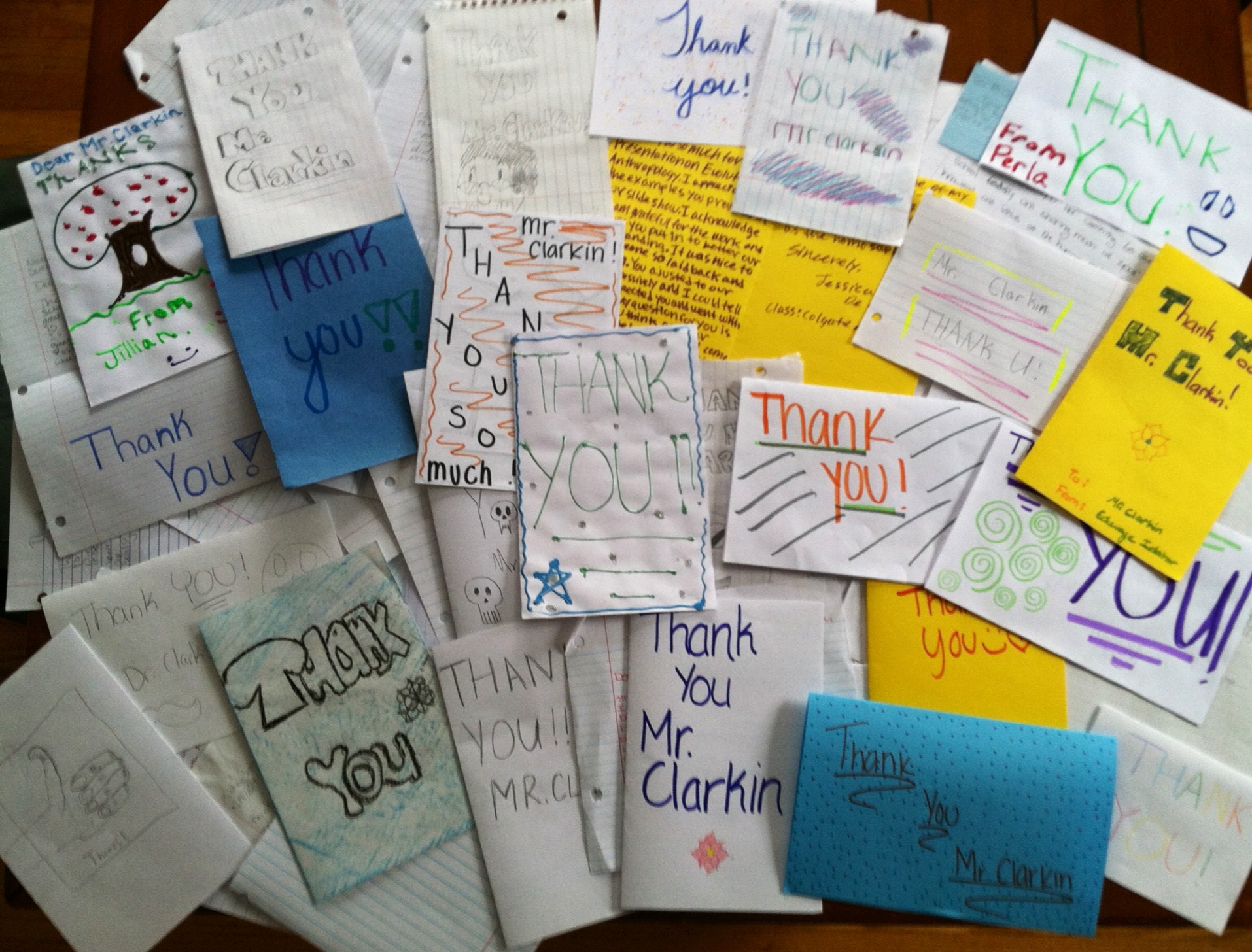
This is the fourth year I’ve visited the 8th graders at the KIPP school in Lynn, Massachusetts to talk about anthropology and evolution for a few hours. Every year, their teacher has them write me thank you notes, about 90 in all over three classes. That alone makes the visit worth it.

KIPP 2014

Related

Public Outreach: Sharing Anthropology Outside the University
Public Outreach 2: KIPP Lynn
More Public Outreach
KIPP Students Rock


Part 15: Humans Are (Blank)-ogamous: Lessons from Models of Sex and Love

Part 15: Humans Are (Blank)-ogamous: Lessons from Models of Sex and Love

The introduction to this series can be found here.

Summary: There are many ways to put a human life together, including for sex and love. Each path has tradeoffs.

____________________________________________________________________

I thought I knew what love was. What did I know?Don Henley, “Boys of Summer”

There are all kinds of love in this world, but never the same love twice. – F. Scott Fitzgerald


“Mom, love is love, whatever you are.” These words of wisdom came from Jackson, the 12 year-old son of actress Maria Bello, after she revealed to him that she had fallen in love with a woman. Bello’s essay, Coming Out as a Modern Family, appeared in last November’s New York Times, where she bravely reflected on her handful of past romantic relationships (mostly with men), her trepidation in revealing her evolving feelings on love, and the variety of meaningful relationships – platonic, familial, romantic – she had in her life.

In the most important sense, which is of course the sense that Jackson meant, love is love, irrespective of one’s sexuality, gender, or ethnicity. Studies from neurobiology reveal that people in the early stages of romantic love show consistent activation in specific brain regions (the ventral tegmental area and caudate) when viewing a photo of one’s partner. This was true for (1) men and women, (2) hetero- and homo-sexuals, and (3) American, British, and Chinese adults (Zeki and Romaya 2010; Xu et al. 2011). Not that Jackson needed it, because a person’s choices in love should be respected regardless of what neurobiology tells us, but he has science on his side.

Continue reading

Two Million Tons of Bombs over Laos in One Minute

This is a simple, yet powerful, video cataloging the 600,000 bombing missions and 2 million tons of bombs the U.S. dropped over Laos from 1964-73. I’ve never been able to comprehend the scale of the bombing in Laos because it’s hard to get a handle on such large numbers. This short video helps put it into perspective.

The person who made the video, Jerry Redfern, also has a new book out Eternal Harvest: The Legacy of American Bombs in Laos (co-authored with his wife, Karen Coates). 

Continue reading

What War Does to Children

This is a powerful message from Save the Children, meant to raise awareness of recent events in Syria:

I think the power of the video comes from the fact that it follows a single child over time, as we watch the vibrancy of her personality gradually fade away as the conditions around her deteriorate. We see her become more anxious, and even her physical health falters as her hair starts falling out. By extension, all we have to do is make a short mental leap from this fictional British girl to that of any child, anywhere, who is currently living under war conditions, knowing that they have probably undergone a similar transition. 

The reality is that the impacts of war on child health are consistently negative, not only for Syria, but virtually everywhere. On one hand, it’s important to remember that children living in such harsh conditions can be resilient, and that they are not lost causes, broken beyond repair. On the other hand, they shouldn’t have to be put in that position in the first place. 

Our Essential, Fragile Bonds

Today would have been my brother’s birthday, and I’ve been saving this passage from Boris Pasternik’s Doctor Zhivago to mark it. Here the title character, Yura Zhivago, is speaking to Anna Ivanovna who feared she was terminally ill. He offers what he thinks happens to us when we die, and the primacy of our social connections:

“So what will happen to your consciousness? Your consciousness, yours, not anyone else’s. Well, what are you? There’s the point. Let’s try to find out. What is it about you that you have always known as yourself? What are you conscious of in yourself? Your kidneys? Your liver? Your blood vessels? No. However far back you go in your memory, it is always in some external, active manifestation of yourself that you come across your identity–in the work of your hands, in your family, in other people. And now listen carefully. You in others–this is your soul. This is what you are. This is what your consciousness has breathed and lived on and enjoyed throughout your life–your soul, your immortality, your life in others. And what now? You have always been in others and you will remain in others. And what does it matter to you if later on that is called your memory? This will be you–the you that enters the future and becomes part of it.” (Boris Pasternak, Doctor Zhivago, p. 68)

.

I still haven’t mastered the ability to completely separate the academic and the personal, and I’m not sure I completely want to. Instead of an impenetrable wall between them, perhaps, for me, there is a wrought-iron fence with an open gate. What I mean is that I often go between the two, allowing them to inform each other. The passage from Zhivago is from literature, and is not a scientific statement. But it runs parallel to some aspects of science, which seems poetic to me, particularly on a day I’m thinking of my brother. 

Continue reading

Did Pairbonds Evolve to Be Asymmetrical?

“I know you belong to somebody new, but tonight you belong to me.” Rose and David 

“I wanted love, I needed love. Most of all, most of all.” Auerbach and Carney (1)

.

Several researchers have attempted to reconstruct the very difficult problem of why pairbonding may have evolved in humans (I wrote about this here, but a decent guess is that this began around 2 million years ago. Maybe). Those reconstructions often come with an addendum, which predict that pair-bonds would not be completely symmetrical. Instead, either males or females would have more of an incentive to initiate or maintain a long-term bond, and this would depend on the reasons that pairbonding evolved in the first place.

For example, here is David Buss, explaining why males are more likely to fall in love first:

“Because love is an emotion tethered to long-term mating; because fecundity and reproductive value is so critical to men in selecting a long-term mate; and because physical appearance provides an abundance of cues to a woman’s fecundity and reproductive value, we can predict that men will experience “love at first sight” more often than women. The empirical evidence supports this prediction.” (Buss, 2006: 69)

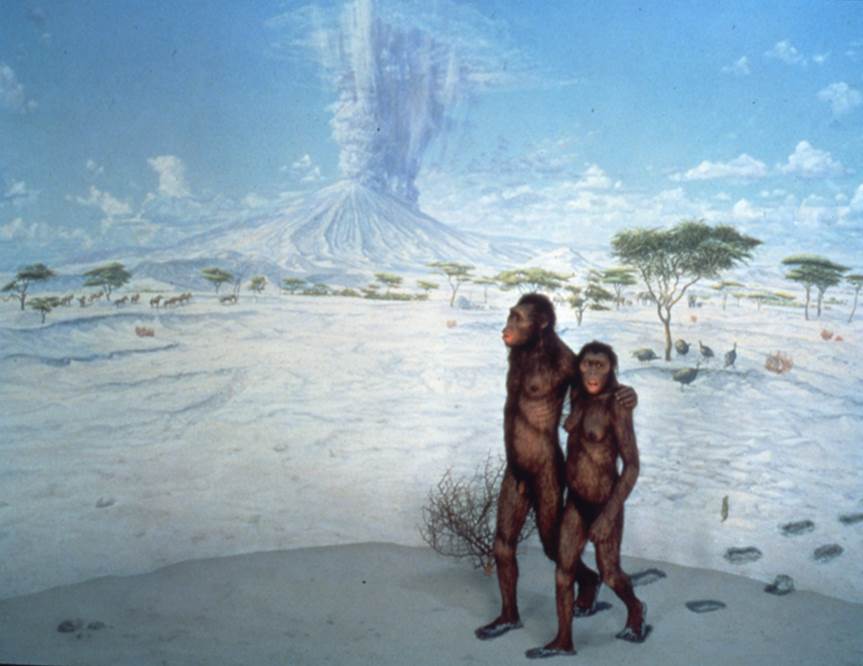
Australopithecus afarensis ("Lucy"), out with her date. Source.

Australopithecus afarensis (“Lucy”), out with her date around 3.6 mya. This portrayal of an early pairbond is speculative, but it ‘s probably not accurate. Source: AMNH.

Continue reading

Part 14: Humans Are (Blank)-ogamous: Paleo Hookups & Archaic Lovers

The introduction to this series can be found here.

Summary: Genetic evidence shows that various Pleistocene populations interbred, including humans, Neanderthals and Denisovans. Is it possible to know whether these could have occurred in pair-bonded relationships? What were the evolutionary origins of pair-bonds in hominins, or are single explanations too simple? 

____________________________________________________________________

.

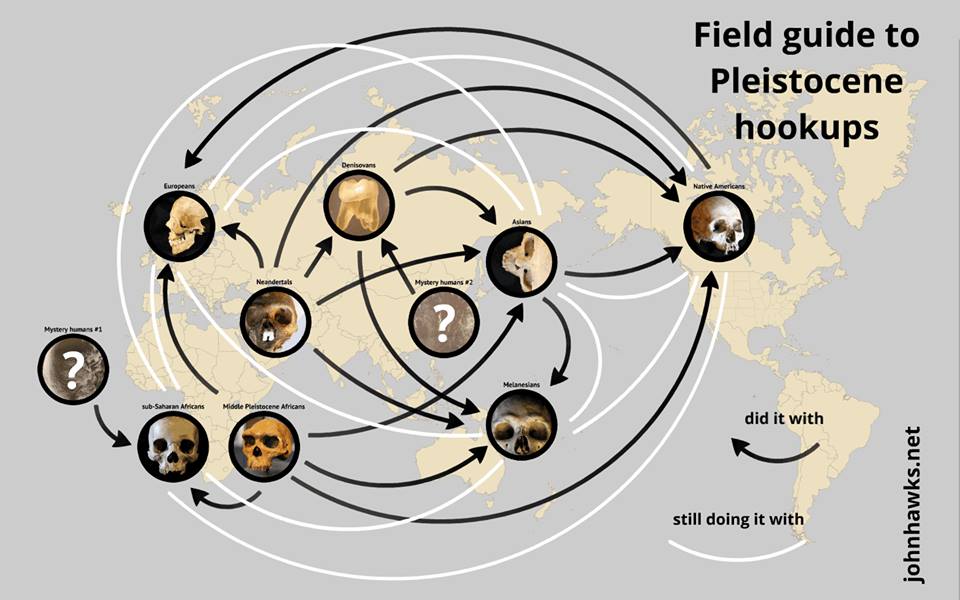
Paleoanthropologist John Hawks created this great infographic that summarizes what we know about ancient human interbreeding, based on recent genetic discoveries (this link to his site has a larger version). The graphic shows that several archaic populations mated with each other, although likely at low rates, including modern humans with Neanderthals and Denisovans. There are also a couple of mystery populations in the mix, whose existence is known solely based on the DNA they left behind. Very cool stuff.

Who Interbred with Whom in the Pleistocene. (Figure by John Hawks).

Who Interbred with Whom in the Pleistocene. (Figure by John Hawks).

Continue reading

Ancient Ethnic Hatreds

This photo from a BBC report on the ongoing fighting in South Sudan made its rounds on the internet today, showing refugees being segregated by ethnicity at a UN compound. As of last month, an estimated 93,000 people had been displaced by the conflict, indicating the scale of the crisis (source: reliefweb).  

Signposts in Bentiu camp

Sign at a camp in Bentiu, South Sudan, segregating refugees by ethnicity. (Source: BBC)

Continue reading

Human Evolution, an Ongoing Story

Over at Scientific American, Kate Wong compiled a list of some of the most compelling discoveries in human evolution from 2013. I won’t rehash her entire list here, but the ones that will stick with me for a while include the variation found among the Dmanisi hominins, probably all within the same species. The other is the genetic evidence for interbreeding between Neanderthals, Denisovans, and other extinct humans. Fascinating.

Continue reading