Year in Review: Top Posts of 2017

Looking through the 5 most frequently read essays of 2017, I see few themes. They are mostly attempts to find reasons to be hopeful (even though that has been hard at times). Humans are adaptable and flexible, and we aren’t fated to any single behavioral way of being. That means we can always make a better world. Light up the darkness.


1. The Conditions of the Game: It’s Not a “World of Eternal Struggle” (Sept 2)

This was by far the most read post on this site, which I wrote after the violent clashes in Charlottesville, Virginia. This was upon seeing a photo of a man with a t-shirt that quoted Hitler in which he wrote that ours is “a world of eternal struggle.” I found it disturbing, but also just wrong. In evolution, adaptations are context specific, and they depend on the conditions of the game. This is also true for cooperation and conflict.

“How we view the world matters. If we see it as zero-sum, as an eternal struggle against other people where only one party can win, then we will act accordingly. Norton and Sommers (2011) found that many white people see racial relations as a zero-sum game: that if other groups are making progress toward equality, that this progress comes at their expense. But remember that non-zero-sum relationships are widespread. With cooperation so prolific in nature (genes, cells, organisms, groups, human societies), it just seems odd to declare that life is solely a contest of struggle. Nor does it make sense to say that cooperation is impossible between groups. Or we can see it as a chance for coalitions, that the success and well-being of others around us does not require us to lose. We make a niche for the others around us, as they do for us, and we all decide whether the costs that come with building up our armor are worth it. They may be, depending on how we perceive the conditions of the game.

I don’t know about you, but I think my life would be better if I was surrounded by healthy, fulfilled, cooperative people over those who feel distrustful, held back, and resentful. Of course, some people may feel differently. There are many strategies one can use. But don’t argue that nature gave us only one hand to play.”

  Continue reading

A Small Protest…

President Trump just gave the CDC a list of forbidden words that it cannot use in official documents.  So, in solidarity, here they are:

  • “vulnerable”
  • “entitlement”
  • “diversity”
  • “transgender”
  • “fetus”
  • “evidence-based”
  • “science-based”

Also, evolution is real. Climate change is real. The earth is older than 10,000 years. Transgender people exist, as do fetuses, and vulnerable people. Among 7.5 billion human beings, there is diversity, as is true of all species (though we are also more alike than unalike). Some things just are, and manipulating language in the quest to impose one’s will on reality won’t make them go away. 

(A) man in his arrogance…

From Carl Sagan:

“We’re Johnny-come-latelies. We live in the cosmic boondocks. We emerged from microbes and muck. Apes are our cousins. Our thoughts and feelings are not fully under our own control. There may be much smarter and very different beings elsewhere. And on top of all this, we’re making a mess of our planet and becoming a danger to ourselves. The trap door beneath our swings open. We find ourselves in bottomless free-fall. We are lost in a great darkness and there’s no one to send out a search party. Given so harsh a reality, of course we’re tempted to shut our eyes and pretend that we’re safe and snug at home, that the fall is only a bad dream. If it takes a little myth and ritual to get us through a night that seems endless, who among us cannot sympathize and understand?

We long to be here for a purpose, even though despite much self-deception, none is evident. The significance of our lives and our fragile planet is then determined only by our own wisdom and courage. We are the custodians of life’s meaning. We long for a Parent to care for us, to forgive us our errors, to save us from our childish mistakes. But knowledge is preferable to ignorance. Better by far to embrace the hard truth than a reassuring fable.

Modern science has been a voyage into the unknown, with a lesson in humility waiting at every stop. Our common sense intuitions can be mistaken. Our preferences don’t count. We do not live in a privileged reference frame. If we crave some cosmic purpose, then let us find ourselves a worthy goal.”  

The Future Health of Puerto Rico after Hurricane Maria

Darieliz Michelle Lopez, her 20-month-old son and three-year-old daughter sit on a sofa where her apartment stood in San Isidro on Sept. 28. (Andres Kudacki for TIME) 


In 2013, Orlando Sotomayor, a professor of economics at the University of Puerto Rico-Mayagüez, looked into whether two hurricanes in 1928 and 1932 impacted the long-term health of the people of the island. He specifically explored whether people exposed to the hurricanes prenatally had higher rates of various chronic diseases and lower education levels decades later.

He framed this within what used to be referred to as the fetal origins of disease hypothesis, but is now usually called the DOHaD (developmental origins of health and disease), acknowledging the importance of development beyond the fetal period. In a nutshell, the DOHaD is based on decades of evidence that various biological insults (malnutrition, maternal psychological stress, pollution) in the prenatal and early postnatal stages of life may predispose individuals to chronic diseases later in life. This has been linked to type 2 diabetes, coronary heart disease, and hypertension (Barker 1994), schizophrenia (Wahlbeck et al 2001), osteoporosis (Cooper et al 2009), and possibly cancer (Walker and Ho, 2012).

In one of the best-known examples, women who were pregnant during the Dutch “hunger winter” in World War 2 had offspring who had a higher risk of various conditions by the time they reached middle age, including a doubled rate of coronary heart disease, obesity, and diabetes in adulthood (Rooseboom et al 2011). They also had an increased chance of having schizophrenia and depression, and did worse on cognitive tasks. While famine conditions are not necessary to have such impacts (poverty and deprivation operate in a dose-like fashion), the well-defined period of the “hunger winter” provided a way to compare exposed and unexposed persons. 


The 1928 and 1932 Hurricanes

Professor Sotomayor viewed the decades-old hurricanes in Puerto Rico as akin to something like the Nazi-imposed famine in the Netherlands. There are differences, obviously. Disasters resulting from intentional, anthropogenic (human-generated) disasters like war usually end up leading to protracted humanitarian crises (Schultz et al 2014). While natural disasters are often devastating, they are usually short-lived and can be ameliorated by humanitarian aid, whereas unsafe conditions during war often makes such assistance logistically difficult. Of course, aid following natural disasters depends on the scale of destruction, a country’s pre-disaster wealth and access to resources, and the political willingness of neighboring countries to assist.

Hurricane San Felipe (1928) and hurricane San Ciprian (1932) both had devastating effects on the agrarian economy of Puerto Rico, with damages estimated to be about one-third and 20% of national income, respectively (Sotomayor, 2013: 282-3). Coffee, citrus, and sugar cane crops were particularly affected. Using data from the CDC Behavioral Risk Factor Surveillance System surveys, Sotomayor looked at people born between 1920 and 1940, and defined those individuals born in the years immediately following the hurricanes (1929 and 1933) as having been exposed to difficult early life conditions. Unfortunately, month of birth was not available in the dataset, so year of birth had to suffice.
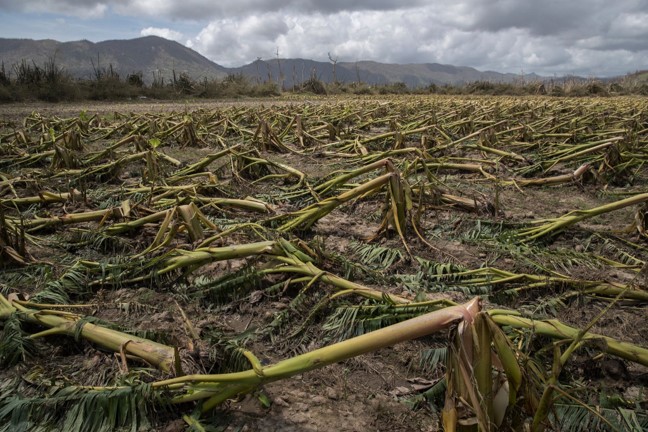
Plantain trees flattened by Hurricane Maria in Yabucoa, P.R. In a matter of hours, the storm destroyed about 80 percent of the crop value in Puerto Rico, the territory’s agriculture secretary said. Credit Victor J. Blue for The New York Times


In all, the sample comprised 11,990 individuals, with 1,197 defined as being exposed to the effects of the hurricanes in early life. Overall, he found that exposed individuals were more likely to be diagnosed with hypertension, high cholesterol, and diabetes, as well as be more likely to have no formal schooling. This latter outcome variable was interpreted as possibly being a “cognition shock,” suggesting that exposed individuals may have had some decline in mental faculties resulting from poor early neurological development.

Incidence (and 95% confidence intervals) of chronic diseases and lack of schooling in Puerto Rico by year of birth. People born in 1929 and 1933 were viewed as being exposed to the effects of a hurricane in early life (Sotomayor 2013).


After Hurricane Maria

We can speculate whether something similar might result from hurricane Maria, which made landfall on Puerto Rico on September 20 of this year. As a Category 5 hurricane, it was among the most powerful ever recorded and its devastating effects likely won’t be resolved anytime soon. It has been estimated that more than 1,000 people died as a result of Maria, while a substantial proportion of the population still remains without electricity, months later.

Similarly to Hurricanes San Felipe and San Ciprian, Maria destroyed up to 80% of Puerto Rico’s agriculture, and rates of food insecurity have increased (rates were already high before the hurricane). Reports indicated that following the hurricane, many people on the island had to skip meals and waited in lines for hours waiting for emergency food supplies, as relief supplies were below standards that were available in other recent hurricanes that hit Texas and Florida (even though all are American citizens). According to CBS News, more than 215,000 people left Puerto Rico for Florida between October 3 and December 5, and it’s been projected that perhaps more than 470,000 people will leave in the next two years (and up to 750,000 people over the next four). Proportionally, this is a staggering loss of population on an island that had 3.4 million people in 2016.
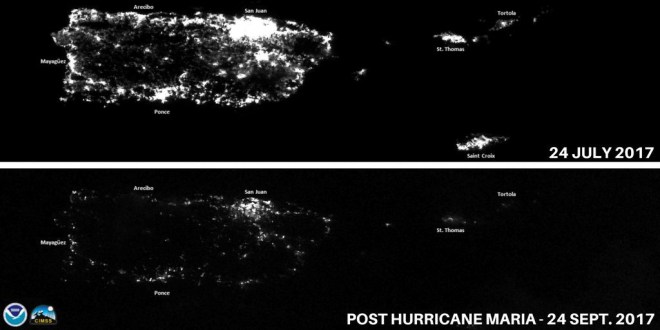
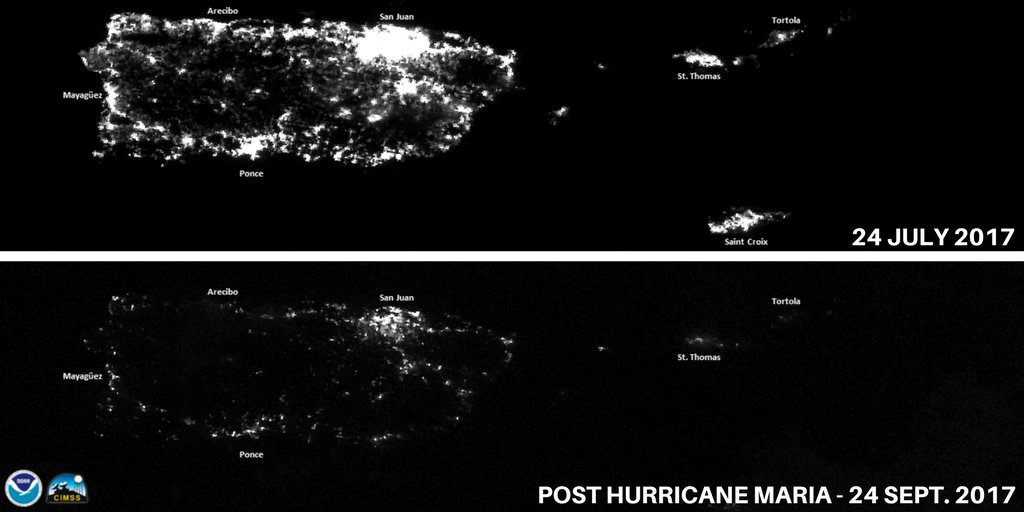
A combination of NOAA satellite images taken at night shows Puerto Rico in July, top, and on Sept. 24, 2017, after Hurricane Maria knocked out the island’s power grid. NASA/NOAA/Handout/Reuters


All of this suggests that there is the potential that Maria could have long-term effects on health, growth, and development similar to San Felipe and San Ciprian. Early life is a particularly vulnerable period, and there are an estimated 175,000 children under the age of  to 4 years old on the island. Growth rates are fastest in this stage, and the potential for long-term effects on health should factored into Maria’s costs beyond the effects on mortality, damaged infrastructure, destroyed crops, economic losses, and displaced population. It also hints at the urgent need to summon the political will to respond rapidly and sufficiently to minimize the effects of natural disasters like this. Otherwise, the costs will have to be paid later in terms of loss of health, premature death, and possibly diminished cognitive capacity (and all of its concomitant costs to education and economic potential). As Professor Sotomayor wrote (2013: 291):

“Evidence therefore suggests that in absence of preventive measure, effects of events like Bay of Bengal cyclones, Caribbean Sea storms like hurricane Mitch, or the great Haitian earthquake may not be over for a long time.”


References

Barker DJP. Mothers, Babies, and Disease in Later Life. BMJ Publishing; 1994.

Caruso GD. The legacy of natural disasters: The intergenerational impact of 100 years of disasters in Latin America. Journal of Development Economics. 2017 Jul 31;127:209-33. Link

Cooper C, Harvey N, Cole Z, Hanson M, Dennison E. 2009. Developmental origins of osteoporosis: the role of maternal nutrition. Early Nutrition Programming and Health Outcomes in Later Life. 2009:31-9. Link

Shultz JM, Ceballos ÁM, Espinel Z, Oliveros SR, Fonseca MF, Florez LJ. 2014. Internal displacement in Colombia: fifteen distinguishing features. Disaster Health. 2(1):13-24. Link

Sotomayor O. Fetal and infant origins of diabetes and ill health: Evidence from Puerto Rico’s 1928 and 1932 hurricanes. Economics & Human Biology. 2013 Jul 31;11(3):281-93. Link

Wahlbeck K, Forsen T, Osmond C, Barker DJ, Eriksson JG. 2001. Association of schizophrenia with low maternal body mass index, small size at birth, and thinness during childhood. Arch Gen Psychiatry 58: 48-52. Link

Walker CL, Ho SM. Developmental reprogramming of cancer susceptibility. Nature Reviews Cancer. 2012 Jul 1;12(7):479-86. Link
Roy Moore on the Evils of Evolution

I just saw this video (below) yesterday. It shows Roy Moore, who is currently running for Senator for Alabama, commenting on evolution. Apparently, it dates to 1997, and in it Moore criticized evolutionary biology for the things it allegedly could not explain, such as why mammals, reptiles, and bird all had males and females (it can, in fact, explain this), and that there was no evidence that our ancestors evolved from animals that once lived in the water (there is). 

Moore is not an evolutionary biologist, so I suppose he could be forgiven for having gaps in his understanding of the subject (though we are probably obligated to make an effort to shore up our knowledge before commenting publicly).  However, even though this was twenty years ago, there was another part of his comments that doesn’t sit well with me. Moore also said:

“That’s the kind of logic (biologists have) used in our society today when we have kids driving by shooting each other that they don’t even know each other. They’re acting like animals because we’ve taught them they come from animals.”

https://twitter.com/chrismassie/status/938833735893561350

The idea that learning about evolution is responsible for society’s ills has a history. As I’ve written before, I think this view is profoundly misguided for a couple of reasons. For one, it is obvious that the human capacity for violence and callousness existed long before evolutionary thinking. The world before Darwin was not a paradise that was ruined by the idea that our species has changed over time or that we are connected to the rest of the natural world.

Continue reading

No More Trouble

Killing the brother

Destroying the country

For nothing

For nothing

The Suffering of the Rohingya

Smoke and flames in Myanmar are seen from the Bangladeshi side of the border near Cox’s Bazar, Sept. 3, 2017. (AP Photo/Bernat Armangue)

Two recent videos caught my eye, one from Al Jazeera, the other via the New York Times. They both pertain to the massive number of Rohingya refugees forcibly displaced from Myanmar into Bangladesh, in what the United Nations is calling “ethnic cleansing.” There are many reports of deliberate targeting of Rohingya Muslims by the largely Buddhist Myanmar military, police, and militias.


However, only a few voices have been willing to call this a “genocide,” in part because the charge is so serious and the burden of proof is onerous. According to Dr. Azeem Ibrahim, a senior fellow at the Center for Global Policy, this reluctance may stem in part from a mental image that a genocide requires “one huge act of frenzied violence,” rather than a steady, slow drip of purging. Another factor may be because of legal obligations required to counteract such atrocities once genocide is declared. For example, the U.S. was hesitant to declare the events in Rwanda and Darfur a genocide partly because a finding of genocide might have required the Clinton and Bush administrations “to actually ‘do something.'”

Images from satellites and on the ground confirm that hundreds of Rohingya villages have been burned to the ground in a scorched earth campaign, as a deliberate strategy to deny the Rohingya a home to return to after they are expelled. Refugees have reported that soldiers have killed villagers, gang-raped women, even thrown babies into fires, burning them alive. Despite denials from the Myanmar government, the refugees’ reports seem consistent, corroborating each other. In the video below from the New York Times, the reporter says that “It seems like everyone in the camp has a horror story to tell.


Among the survivors, the suffering is not likely to go away any time soon. The distribution of food seems inadequate, overwhelmed by the numbers of refugees. As a form of therapy, children in camps are drawing some of their traumatic experiences in order to cope with them. Several depict soldiers killing civilians and burning houses. 

In a 2009 study of 1,500+ elderly Germans, Philip Kuwert and colleagues found that even after 60 years had passed, people who were forcibly displaced as children during WWII were significantly more likely to suffer from current anxiety, lower life satisfaction, and lower resilience (Kuwert et al 2009). Whether this pattern will recur in the Rohingya is to be seen. There is also a possibility for post-traumatic growth, where individuals can experience positive changes “as a result of the struggle with a major life crisis or a traumatic event.”

But it seems clear that the Rohingya at least face the potential for a multi-generational trauma. If a high-income nation like Germany, with all of its resources, can be still be affected six decades later, then how much higher are the odds for that same effect in the Rohingya now living in Bangladesh, as well as those who stayed behind in Myanmar. This suggests the need for the world to pay more attention to the plight of the Rohingya to prevent more suffering from occurring.


Reference

Kuwert P, Brähler E, Glaesmer H, Freyberger HJ, Decker O. (2009) Impact of forced displacement during World War II on the present-day mental health of the elderly: a population-based study. Int Psychogeriatr. 2009 21(4):748-53. Link

Time to Move On

I’ll get back to writing fuller essays soon. In the meantime, go in peace.

It’s time to move on, time to get going
What lies ahead, I have no way of knowing
But under my feet, baby, grass is growing
It’s time to move on, it’s time to get going
Broken skyline, movin’ through the airport
She’s an honest defector
Conscientious objector
Now her own protector
Broken skyline, which way to love land
Which way to something better
Which way to forgiveness
Which way do I go
It’s time to move on, time to get going
What lies ahead, I have no way of knowing
But under my feet, baby, grass is growing
It’s time to move on, it’s time to get going
Sometime later, getting the words wrong
Wasting the meaning and losing the rhyme
Nauseous adrenalin
Like breakin’ up a dogfight
Like a deer in the headlights
Frozen in real time
I’m losing my mind
It’s time to move on, time to get going
What lies ahead, I have no way of knowing
But under my feet, baby, grass is growing
It’s time to move on, it’s time to get going

If God’s on our side

This is an atypically short post. I don’t have anything to add. Please just listen.

So now as I’m leavin’
I’m weary as Hell.
The confusion I’m feelin’
Ain’t no tongue can tell.
The words fill my head
And they fall to the floor.
That if God’s on our side
He’ll stop the next war.”

https://vimeo.com/187217862


PBS Series on the Secret War in Laos

Minnesota PBS has an upcoming documentary on the Secret War in Laos to complement the one on Vietnam by Ken Burns and Lynn Novick. I’ve been told it will be available on October 3rd

Prenatal “Shocks” and Birth Outcomes

Birth weight is often used as a rough gauge for the quality of the prenatal environment. A newborn who weighs 2500g or less (about 5.5 pounds) is considered to be “low birth weight” (LBW). At the individual level, weight alone is an imperfect measure because of confounders such as gestational length (it’s axiomatic that the less time spent in the womb, the less time there is to grow). However, at the population level, if average birth weight fluctuates, then it is an indication that something in the environment probably has changed.

Sometimes, stressful changes can be low-intensity and chronic; at other times, they can be abrupt and dramatic. Biologists, psychologists, and bioanthropologists might call these changes “stressors” or “insults.” Economists might use the term “shocks.” They’re both getting at the same idea: to what extent can harmful environmental factors affect growth and health outcomes? 

In the case of a natural disaster, the harm done can be substantial. Florencia Torche (2011) found that rates of LBW increased following the 2005 Tarapaca earthquake in northern Chile. Despite the magnitude of the earthquake (7.9 on the Richter scale), the amount of destruction was relatively limited: eleven people died, and 0.035% of the population had to temporarily relocate to shelters. This was attributed to the low population density of the region as well as Chilean preparedness and building codes to withstand earthquakes. Although the damage was not as severe as it could have been, Torche reasoned that the earthquake likely caused acute maternal stress, which in turn could affect prenatal development. 

Looking at over half a million births, Torche used maternal county of residence as an estimate of the earthquake’s intensity across different trimesters of exposure. She found that mothers who were lived in the most intensely affected regions during the first trimester were the most affected. The probability of LBW increased from 4.7% to 6.5%, while rates of pre-term births also increased from 5.2% to 8.0%. Later periods of gestation were not substantially affected, and for infants who were conceived after the earthquake, the probability of LBW returned to baseline.

Again, these outcomes seemed to result primarily from acute psychological stress stemming from the earthquake. Torche reasoned that – given the relatively low amount of damage to infrastructure – the increases in LBW and pre-term births were unlikely to have resulted from other factors such as malnutrition, infection, stress resulting from deprivation, strenuous workloads, or exposure to environmental toxins. In reality, it’s not possible to control for all of these variables entirely, but overall it seems plausible that maternal psychological stress played a substantial role in birth outcomes.

Continue reading