War as a Public Health Problem

The surgeon Gino Strada, who has worked in war zones around the world, once referred to war as “the biggest tragedy in public health.” It is debatable whether this empirical claim is true, but by re-framing the issue in this way we can see war with fresh eyes and as more than a conflict between political entities. Rarely, if ever, is war a matter that affects solely competing militaries. Recent images from Syria, Gaza, and Israel are the latest reminders of the impact of war on civilians. See these compelling photo essays here and here.

Aside from the obvious culprits of death, injury, and post-traumatic stress disorder, there are many ways that war can affect public health. As early as February of this year, food shortages were reported in Syria. One displaced woman told a reporter: “I can guarantee you this, people will starve to death.”

Food shortages in Syria. From CNN (Feb 21, 2012).

Continue reading

Hillary Clinton in Laos

For at least a few days, one of the most emailed article on the New York Times website was a story on Hillary Clinton’s recent visit to Laos, the first there by a U.S. Secretary of State since 1955. As the title of the article suggests (“Vietnam War’s Legacy Is Vivid as Clinton Visits Laos“), much of Clinton’s brief visit pertained to the legacy of the Second Indochina War in Laos.

..

Hillary Clinton in Laos (Washington Post)

..

My interests in the war in Laos stem from my research on how physical growth and health of Hmong and Lao refugees were affected by living under such conditions as children, and younger. When one confronts the history, it quickly becomes apparent how disproportionate the damage was compared to any strategic or military importance of the country.  In an Op-Ed in the Washington Times,  a number of former U.S. Ambassadors to Laos, including Douglas Hartwick, summarized the history and the fact that civilians were – and continue to be – highly affected:

..

Between 1964 and 1973, the U.S. dropped the equivalent of one planeload of bombs every eight minutes, for 24 hours a day – one ton of bombs for each of the 2 million people in Laos at the time, making it the most heavily bombed country per capita in history. These bombings were part of a campaign – kept secret from the American people, not formally authorized by Congress, and in violation of international accords – whose purpose was to deter communist proliferation. But the people who suffered most were ordinary Lao villagers.

Continue reading

HBA/AAPA Portland, OR 2012

Next week is the annual joint conference for the Human Biology Association and the American Association of Physical Anthropologists, which I’ve attended fairly regularly since graduate school. This year the conference will be held in Portland, Oregon. My talk is scheduled for the afternoon of Apr 12th, though I’ll be around from the 10th to 13th. Looking forward to seeing old friends, meeting new colleagues, learning, and sightseeing. My abstract:

“Toward a human biology of war.” Clarkin PF. Department of Anthropology,University of Massachusetts, Boston, Massachusetts.

 …

Over a decade ago, Leatherman and Goodman (1998) proposed that biological anthropologists and human biologists increase research efforts toward better understanding what they termed the ‘biology of poverty.’ Similarly, we now may be poised toward studying the human biology of war. Historical records demonstrate that war consistently creates an array of physiologically taxing stressors that extend beyond competing military forces into nearby civilian populations. Exposure to such stressors (infection, malnutrition, psychological stress, etc.) may vary in duration, but they result in predictable, though variable, biological outcomes contingent on local circumstances.

This paper reviews some of the epidemiological and biology literature related to the various ways that war-related experiences become embedded within human bodies. Additionally, it suggests future potential areas of research, and delineates possible approaches and pitfalls. Epidemiologists and humanitarian organizations have led the way in studying health outcomes in refugees and other groups affected by war. However, human biologists and biological anthropologists – with their intellectual traditions rooted in evolution, variation, and plasticity – may add substantively to the understanding of such patterns that extend beyond physical trauma and mortality into more subtle aspects of biology.

Furthermore, such a research agenda seems relevant in applying human biology toward understanding ‘real life’ problems. Rather than viewing examples such as the Dutch Hunger Winter or the Biafra famine as ‘natural experiments’ and opportunities for testing given hypotheses, it seems necessary to maintain a complex perspective which views war as an interaction of human agency and shifting ecological conditions that impact health.

Roundup (Jan 10, 2012)

I generally don’t do roundups, but below are a few things I thought worth sharing. If “a scholar is just a library’s way of making another library,” as Daniel Dennett put it, then this is what I’ve checked out lately.

#1.

Greg Downey at Neuroanthropology has begun a new series on anthropology and the evolution of human sexuality, titled: “The Long, Slow Sexual Revolution.” I’ve been looking forward to it for a few weeks since Greg first told me he was working on this, and I can say that the wait was worth it (and not just because he kindly cites some of my stuff from the Blank-ogamous series). He takes a *very* big picture approach, and what I liked most about it was that it stressed the need to confront the evidence while also keeping an eye on context and complexity, and avoiding overly simplistic narratives. As he wrote:

Continue reading

War and Opportunity Costs

In doing research on the opportunity costs of military spending for “Growing up in the Two Koreas,” I was reminded of the quote below by Dwight Eisenhower. Though I linked to it in that post, I thought it deserved more than that, so I’m highlighting it here. The back story to the speech is that it was written soon after the death of Stalin. Eisenhower thought that presented an opportunity to shift away from wasteful military spending, which could then be applied to other avenues more conducive to peace, better economic conditions, and a healthier population.

Continue reading

Growing Up in the Two Koreas

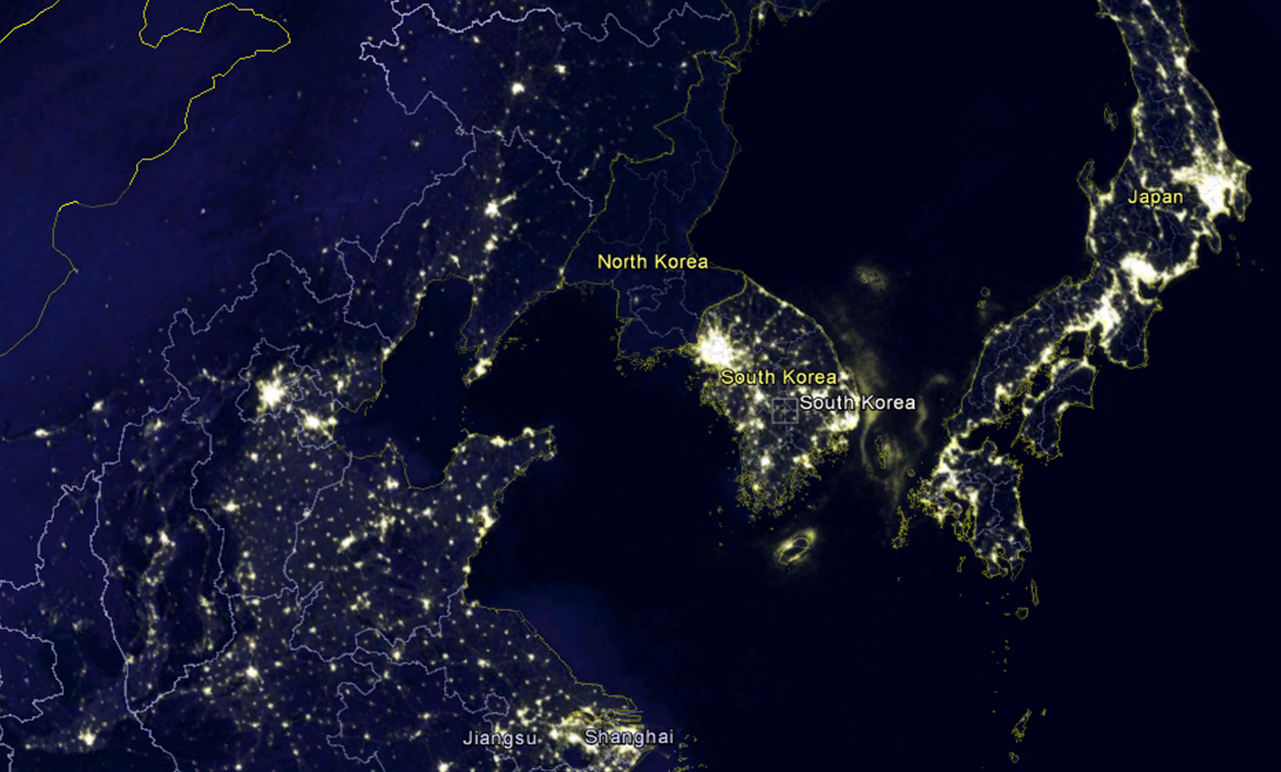
The Korean peninsula at night (google earth)

The above image of east Asia at night is worth more than a thousand words. Below the 38th parallel is the birthplace of my mother-in-law in South Korea, which is luminescent at night as the result of its highly developed economy. My father-in-law was born above that line in North Korea, which today appears to be little more than a shadow of its southern neighbor. Even if one knew nothing about history or geography, they could infer from that single satellite image that there must be a chasm in living standards on either side of the border.

A full history of the two Koreas and the war of 1950-53 is beyond the scope of this post. What is relevant is that the forces of history and politics took a once cohesive nation and cleaved it in two, having disparate effects not only on the ideologies on either side, but also on the physical bodies of the respective inhabitants. It’s almost as if someone collected a population of dandelions from a single field and then placed them in two different greenhouses for six decades, replete with different soil quality, sunlight, and temperatures, and then observed how they fared. By now, many people have heard something about how North Koreans are significantly shorter than their southern cousins, implying that, like our dandelion example, the conditions for physical growth are quite different in the two greenhouses. John McCain even mentioned this during the 2008 presidential debates to illustrate North Korea’s brutality toward its citizens. How true is this claim?

Continue reading

Anthropology & the Art of War

When the elephants fight, it’s the grass that suffers.” 

Last week, the American Anthropological Association held its annual meeting, this year in the beautiful city of Montreal (for a couple of summaries of the conference, see here and here). Rahul Oka, from the University of Notre Dame, asked if I would like to be one of two discussants for his session (co-chaired with Nerina Weiss) “Traces of Violence and Legacies of Conflict,” and I agreed. The session was full of very erudite presenters who spoke on a range of topics related to the anthropology of conflict and violence.

But in preparation for the session, I have to admit to some trepidation because nearly all of the presenters were  ethnographers or archaeologists. And as a biological anthropologist, I felt out of my element.  The presentations were also quite diverse in geography, time period, theoretical perspective, and outcome variable, ranging from structural violence and undocumented border crossings from Mexico into the United States, to skeletal trauma in Neolithic Europe, to Kurdish survivors of torture. I found it hard to discuss the various papers with much sophistication and detail while also finding commonalities among them (and all in fifteen minutes, no less). I tried, but finally concluded that it probably wasn’t going to happen. Therefore, I decided to do a rather broad analysis of the papers, which I read ahead of time. But there was always the risk of zooming out too far, thereby making any analysis overly simplistic and virtually meaningless.

Continue reading

The Logic of War: Iraq, Afghanistan, & Pakistan

A team of researchers, co-directed by Brown University anthropologist Catherine Lutz, released a report this summer which sought to estimate the full scale of the direct and indirect costs of ten years of war in Iraq, Afghanistan, and Pakistan. The report concluded that the financial and human costs of the war have been vastly underestimated (the Executive Summary of the report can be found here).


Among the study’s findings:

Continue reading

Student Research on War, Health, and Biology

With grades submitted earlier this week, the Spring 2011 semester is officially in the books. In my ANTH 324 class, “A Biocultural Approach to War,” students were required to write a literature review paper on the ways that war impacts human biology and health.

In my opinion, research papers are valuable in upper level undergraduate classes because they give students the freedom to pick a topic of their choice, within the boundaries of class goals. While it seems self-evident that war’s effects on biology are negative, this relationship is not always straightforward for every possible outcome variable. Thus, it is necessary to explore the evidence thoroughly.   

Continue reading

The Sex Ratio at Birth Following Periods of Conflict

Note: this paper was written by UMass Boston undergraduate student Johnny Xu for my Spring 2011 class ANTH 324: “A Biocultural Approach to War.” I asked his permission to post it here. 

..

Birth Sex Ratio and Infant Mortality: Adaptations or By-products?

..

1. Introduction

            The purpose of this paper is to provide manifold reasons attempting to explain why the birth sex ratio following war periods tend to rise in favor of males and what this implies in correlation with infant mortality; and, most of all, to answer the following question: is the combination of these findings proposing that this is an adaptive response of the parent to produce the sex with higher survival prospects in the given environment, or is this simply the by-product of environmental forces?


Continue reading