How War Gets Under Our Skin

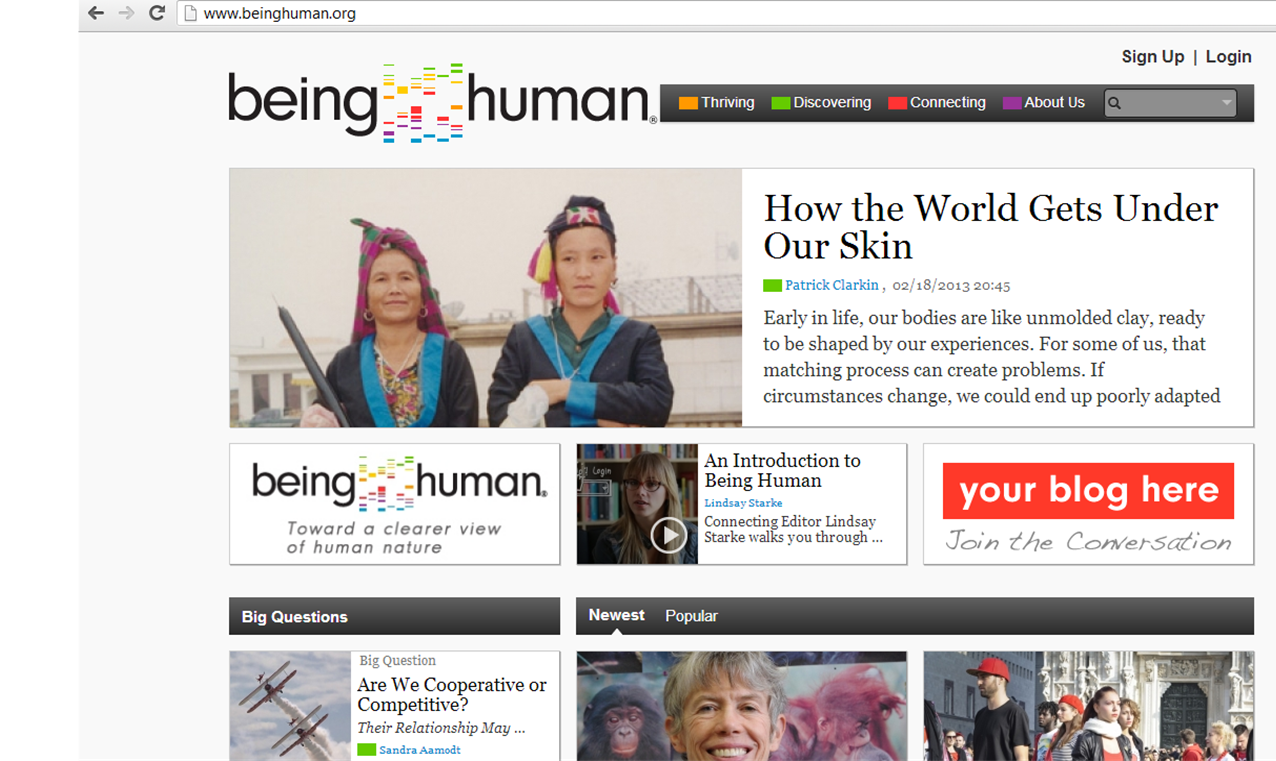
beinghuman.org front page

I wrote this piece on BeingHuman.org about how war (and the world in general) gets under our skin. It looks at the Hmong example, as well as examples from a few other wars around the world (the Dutch Hunger Winter, the Biafran famine, and the Khmer Rouge period), and how these experiences get into our bodies. 


http://www.beinghuman.org/article/how-world-gets-under-our-skin

.

Unbending rigor is the mate of death,
And wielding softness the company of life:
Unbending soldiers get no victories;
The stiffest tree is readiest for the axe.

Tao Te Ching: 76


Early in life, our bodies are like unmolded clay, ready to be shaped by our experiences. For some of us, that matching process can create problems. If circumstances change, we could end up poorly adapted to our adult environment. A child born into harsh conditions, though, may have to take that risk in order to make it to adulthood at all.

Reconciliation & the Second Indochina War, II

Our prime purpose in this life is to help others. And if you can’t help them, at least don’t hurt them.” – Dalai Lama

..

I wrote this post, titled Reconciliation, Biology, & the 2nd Indochina War, about a year ago, and I consider it one of the more meaningful things on this site. It addresses:

(1) Examples of profound case studies in reconciliation and making peace with the past (Kim Phuc and John Plummer; the My Lai massacre, Pham Thanh Cong, and William Calley; various national-level apologies for past injustices).

(2) The significance, evolution, and neurobiology of guilt and forgiveness.

(3) Lingering injustices and problems caused by the war, as well as a few reasons for optimism. 

Admittedly, it is a bit long, and if you don’t make it to the end, it concludes on a hopeful note:

Continue reading

Peace with the ‘Enemy’

NBC News has been running a compelling series on the return of American Col. Jack Jacobs to Vietnam, where he was wounded forty years ago. I recommend this insightful essay by Col. Jacobs, a Medal of Honor recipient and former West Point faculty. It describes his meeting with the former commander that ambushed his battalion, as well as his general reflections on the ‘enemy.’

But the enemy is an amoebic mass, a single-minded monolithic inhuman force. Killed in action, they are only a logistical problem, and you get a feeling of them as individuals only when you capture them, scared, wounded and shivering. They are no longer part of the enemy organism, and it is only then they come to life as people.”

Continue reading

Reconciliation, Biology, and the Second Indochina War

Of all the things I’ve written on this site, this remains one of the most meaningful to me. (May 29, 2017)

The weak can never forgive. Forgiveness is the attribute of the strong.” …………………………………………………………………………– Mohandas K. Gandhi

On my desk sits a spoon I bought in a restaurant in northern Laos. It’s lightweight, bigger than a tablespoon, and full of tiny dents that some unknown metalsmith hammered into it. The owner was bemused that in addition to the bowl of pho noodle soup, I also wanted to buy one of her utensils. But I had my reasons.

Earlier on my trip, my guide1 informed me that people in the town of Phonsavanh half-jokingly called these ‘B-52 spoons,’ as they were made of metal recovered from bombs dropped decades ago by U.S. planes during  ‘the Secret War. To me, the spoon was more than a quirky souvenir. Instead, it represented an attempt by Laotians to take the physical remnants of a tragic period in history and forge them into something more positive, in effect turning swords into plowshares (or bombs into spoons). Continue reading