Further Strides toward Reconciliation

One of the major themes of this blog has been reconciliation and cooperation under difficult circumstances. Below are three pertinent, hopeful stories on reconciliation that I’ve collected over the last few months.

1. Colombia to Spend $30 B to Compensate War Victims (AlertNet; Jan 24, 2012)

Reparations to victims of Colombia’s long, bloody armed conflict will reach as much as $30 billion in the next 10 years, the government said on Tuesday… The reparation program will benefit more than 3 million victims of the war, which has dragged on for nearly five decades.”
Continue reading

Peace with the ‘Enemy’

NBC News has been running a compelling series on the return of American Col. Jack Jacobs to Vietnam, where he was wounded forty years ago. I recommend this insightful essay by Col. Jacobs, a Medal of Honor recipient and former West Point faculty. It describes his meeting with the former commander that ambushed his battalion, as well as his general reflections on the ‘enemy.’

But the enemy is an amoebic mass, a single-minded monolithic inhuman force. Killed in action, they are only a logistical problem, and you get a feeling of them as individuals only when you capture them, scared, wounded and shivering. They are no longer part of the enemy organism, and it is only then they come to life as people.”

Continue reading

Reconciliation, Biology, and the Second Indochina War

Of all the things I’ve written on this site, this remains one of the most meaningful to me. (May 29, 2017)

The weak can never forgive. Forgiveness is the attribute of the strong.” …………………………………………………………………………– Mohandas K. Gandhi

On my desk sits a spoon I bought in a restaurant in northern Laos. It’s lightweight, bigger than a tablespoon, and full of tiny dents that some unknown metalsmith hammered into it. The owner was bemused that in addition to the bowl of pho noodle soup, I also wanted to buy one of her utensils. But I had my reasons.

Earlier on my trip, my guide1 informed me that people in the town of Phonsavanh half-jokingly called these ‘B-52 spoons,’ as they were made of metal recovered from bombs dropped decades ago by U.S. planes during  ‘the Secret War. To me, the spoon was more than a quirky souvenir. Instead, it represented an attempt by Laotians to take the physical remnants of a tragic period in history and forge them into something more positive, in effect turning swords into plowshares (or bombs into spoons). Continue reading

Lessons from the Christmas Truce of 1914

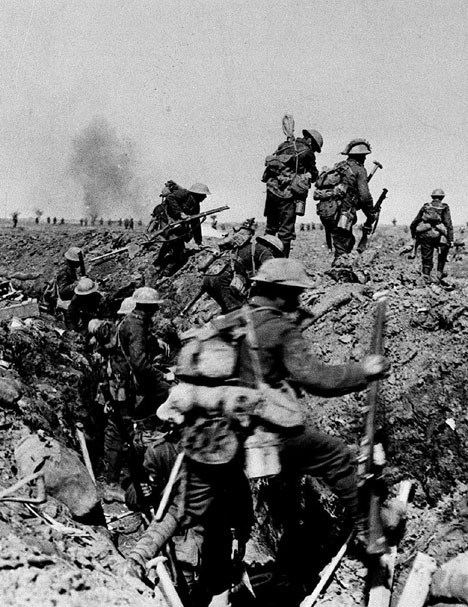
Trench warfare, WWI (dailymail.co.uk)

As Christmas approaches, it seems like the perfect time to reflect on an unlikely event from military history. During the First World War, a spontaneous, temporary truce was brokered between German, French, and Scottish officers on Christmas Eve, 1914. On that night and on Christmas Day along the trenches in Flanders, soldiers who recently had been shooting at each other used the ceasefire to bury their dead, then shared food and drink with their ‘enemies,’ played soccer, and even exchanged gifts and addresses in order to write each other after the war ended.

The details leading up to the ceasefire are a bit murky, but eyewitnesses reported that German and Scottish troops took turns festively singing carols in their own trenches. A few brave officers then seized the spirit of the moment to risk their safety, leave their trenches, and negotiate a respite from the brutality. The remaining soldiers then followed, leading to the amazing scene.

Continue reading

In the Final Analysis

A couple of reminders from John F. Kennedy and Carl Sagan that we are, all of us, in this together. We are all connected, share commonalities, and come from one big family, after all.

XXX

“For in the final analysis, our most basic common link is that we all inhabit this small planet. We all breathe the same air. We all cherish our children’s future. And we are all mortal.”         – John F. Kennedy (June 10, 1963)

Continue reading

Us, Them, & Non-zero Sumness

I love baseball, having played from Little League through high school. The game taught me many lessons about athletics, but also about life. As a New Englander, I grew up a Red Sox fan, which was sometimes painful (the infamous Bill Buckner game of the 1986 World Series fell on my 12th birthday). However, the 2004 championship was pure elation, and made up for everything. After the Red Sox came back from a 0-3 deficit to beat the Yankees in the ALCS (the semi-finals, for you non-baseball fans), my father, brother, uncles, cousins, and I took photos in front of the television, as if we were documenting history. I even made sure my infant son was in the photos, to prove to him when he got older that he was there. Ridiculous, right?

Game 5, 2004 ALCS (gothamist.com)

Continue reading

American – Laotian Relations

Yesterday marked the first visit of a Laotian government official to the United States since 1975. According to the Department of State website, Foreign Minister Thongloun Sisoulith and Secretary Hillary Clinton discussed many issues:

.. Continue reading

Hope from Northern Ireland

Bono in the NY Times on British Prime Minister David Cameron’s apology for Bloody Sunday:

If there are any lessons for the world from this piece of Irish history … for Baghdad … for Kandahar … it’s this: things are quick to change for the worse and slow to change for the better, but they can. They really can. It takes years of false starts, heartbreaks and backslides and, most tragically, more killings. But visionaries and risk-takers and, let’s just say it, heroes on all sides can bring us back to the point where change becomes not only possible again, but inevitable.


Let’s hope that visionaries and risk-takers can help defuse tensions in the many other ongoing conflicts in the world.


Funding the removal of UXO in Laos


War leftovers, decorating a hotel lobby in Phonsavan, northern Laos (July, 2009)


I was impressed by the conviction shown by Congressman Mike Honda (D-CA), when he wrote in today’s Washington Times that “we have a moral obligation to fix this problem” (leftover unexploded ordnance in Laos).  He also called for an increase in funds and a sustained commitment to removing leftover cluster bombs dropped by U.S. planes in the 1960s and 70s.

Incidentally,  the organization Legacies of War testified before Congress last week, including Rep.  Honda, about the extent of the problem of UXO in Laos, and the need for greater funding. As I wrote previously, the scope of the problem is massive and deserves much more attention than it has gotten thus far.

Making Peace with the Past

“The past is never dead. It is not even past.”  –William Faulkner

Bosnian Muslims in Trnopolje camp, 1992

The dividing line between past and present is almost never clear cut. We constantly carry our pasts around with us: personal, cultural, historical, and evolutionary. Often, those pasts are burdened with regrettable or undesirable incidents and other phenomena, be they tragedies, atrocities, accidents, bad memories, poor decisions, crimes, natural disasters, or even as part of our evolutionary baggage (e.g., oncogenes, a ruptured appendix, or impacted wisdom teeth). At different times we may find ourselves as the aggrieved or the aggrieving party. To the extent that we can, we make extraordinary efforts to get past our pasts via redemption, reparation, and reconciliation.

Continue reading