
I’ve been watching the news on current events around the world, including the massive wildfires in California that so far have killed at least thirty people and displaced hundreds of thousands. I know a number of people in the area, and even though they are not in the direct path of the fires they’ve been on my mind for the past several days. We’re still due to arrive in San Jose in just a few days for an anthropology conference, but it seems surreal to travel so far to talk about anthropology while there are many people suffering not too far away. From what I understand the smoke has traveled far and wide across the state. In fact, we just got an email from the American Anthropological Association reaffirming that the conference will proceed as planned, but also warning us that the air quality may not be suitable for older adults, young children, and people with health problems. Maybe that’s what we’re supposed to do—try to live life as normally as possible in times of stress. I’m not sure that it feels totally right, but I also donated to help some of the people affected (some suggestions here ).
Personal
R.I.P. Dolores O’Riordan
“You’ll always be special to me.”
Yesterday, it was reported that singer Dolores O’Riordan passed away unexpectedly at age 46. This one was a gut punch to me. I must have played The Cranberries‘ CD’s hundreds of times in college and graduate school, and I often had their songs on my playlist while traveling, including on a long, memorable bus ride through the mountains of Laos. Her voice and lyrics will be with me for a long time.
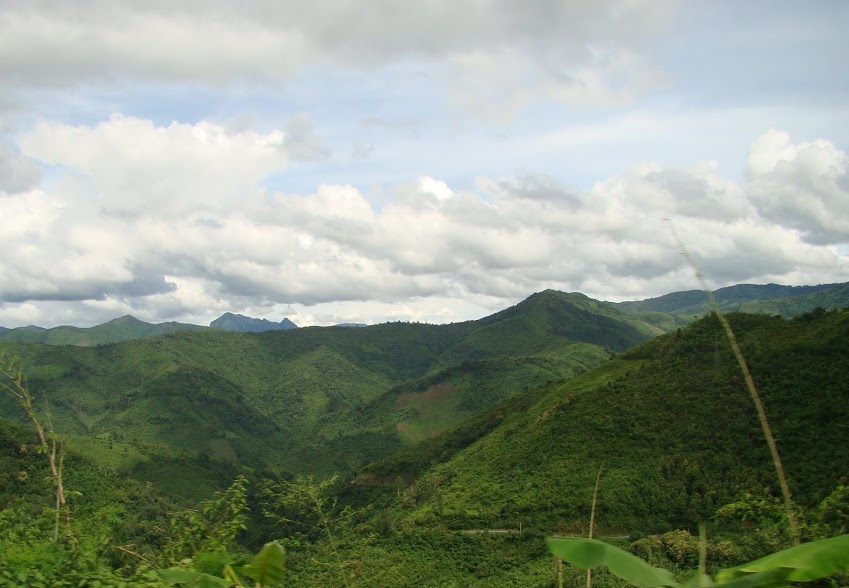
Somewhere between Phonsavan and Luang Prabang in northern Laos, 2009. I’ll long remember the breathtaking scenery, paired with the Cranberries’ music.
8th Anniversary at a Crossroads
“The purpose of anthropology is to make the world safe for human differences.” – Ruth Benedict
“Imagine what seven billion people could accomplish if we all loved and respected each other.” – Anthony Douglas Williams
I just received notice from WordPress that it is the 8th anniversary for this site. To be honest, I have not been feeling too great about this site lately. Readership is down noticeably, and it has been harder to get the attention of my targeted audiences. I’ve even contemplated folding the tent.
Surely, part of that is me, as I’ve found it hard to maintain the volume of essays compared to prior years. Perhaps it’s merely the nature of today’s Internet. Eight years ago, there were fewer personal blogs and sites to compete for readers’ attention, and people seem to prefer shorter, more digestible, essays before moving on to the next item on their list. I understand. Time is finite, and we have things to do.

Time to Move On
I’ll get back to writing fuller essays soon. In the meantime, go in peace.
It’s time to move on, time to get going
What lies ahead, I have no way of knowing
But under my feet, baby, grass is growing
It’s time to move on, it’s time to get going
What lies ahead, I have no way of knowing
But under my feet, baby, grass is growing
It’s time to move on, it’s time to get going
Broken skyline, movin’ through the airport
She’s an honest defector
Conscientious objector
Now her own protector
She’s an honest defector
Conscientious objector
Now her own protector
Broken skyline, which way to love land
Which way to something better
Which way to forgiveness
Which way do I go
Which way to something better
Which way to forgiveness
Which way do I go
It’s time to move on, time to get going
What lies ahead, I have no way of knowing
But under my feet, baby, grass is growing
It’s time to move on, it’s time to get going
What lies ahead, I have no way of knowing
But under my feet, baby, grass is growing
It’s time to move on, it’s time to get going
Sometime later, getting the words wrong
Wasting the meaning and losing the rhyme
Nauseous adrenalin
Like breakin’ up a dogfight
Like a deer in the headlights
Frozen in real time
I’m losing my mind
Wasting the meaning and losing the rhyme
Nauseous adrenalin
Like breakin’ up a dogfight
Like a deer in the headlights
Frozen in real time
I’m losing my mind
It’s time to move on, time to get going
What lies ahead, I have no way of knowing
But under my feet, baby, grass is growing
It’s time to move on, it’s time to get going
What lies ahead, I have no way of knowing
But under my feet, baby, grass is growing
It’s time to move on, it’s time to get going
AAA Meetings in D.C. & San Jose
I’m planning for the American Anthropological Association annual meeting in Washington, D.C. later this year, and it struck me as unusual to hold it in that city again since the meeting was last there only three years ago. Next year, it will be held in San Jose, which was the host in 2006. I then got curious when the last time the meeting was held in Boston or New York, since I can’t remember the meeting ever being held in the northeast. Just for fun, I wondered if the AAA has preferred particular cities over its long history, since its first meeting in Pittsburgh in 1902. So, I made a heat map.
According to the AAA website, the city to host the meeting most frequently has been Washington D.C. (22 times, including this year), followed by Philadelphia (13 times), Chicago (11 times), New York City (10 times), then San Francisco/ San Jose/ Berkeley (9 times).
However, things have shifted recently, with some cities not hosting for decades. The original host, Pittsburgh, has not been home to the meeting since 1966, while New York last held the meeting in 1971. Boston lasted hosted in 1955, and Los Angeles in 1981 (coinciding with Fernandomania). Several cities hosted only once, including my hometown of Providence, R.I. in 1910.
By comparison, since 1990 New Orleans has hosted three times and San Francisco/ San Jose six times.
The midwest, aside from Chicago, and the southeast have been largely overlooked. Saint Louis is due to host in 2020. I’m curious why Florida has never been the host. I thought they grew convention centers there, not to mention the warm weather, since the meeting is usually in late November.
The meeting has also been held outside of the U.S. five times — Mexico City and Toronto twice each, and Montreal once. Vancouver, B.C. will host in 2019 for the first time.
Anyway, this was all just out of curiosity.
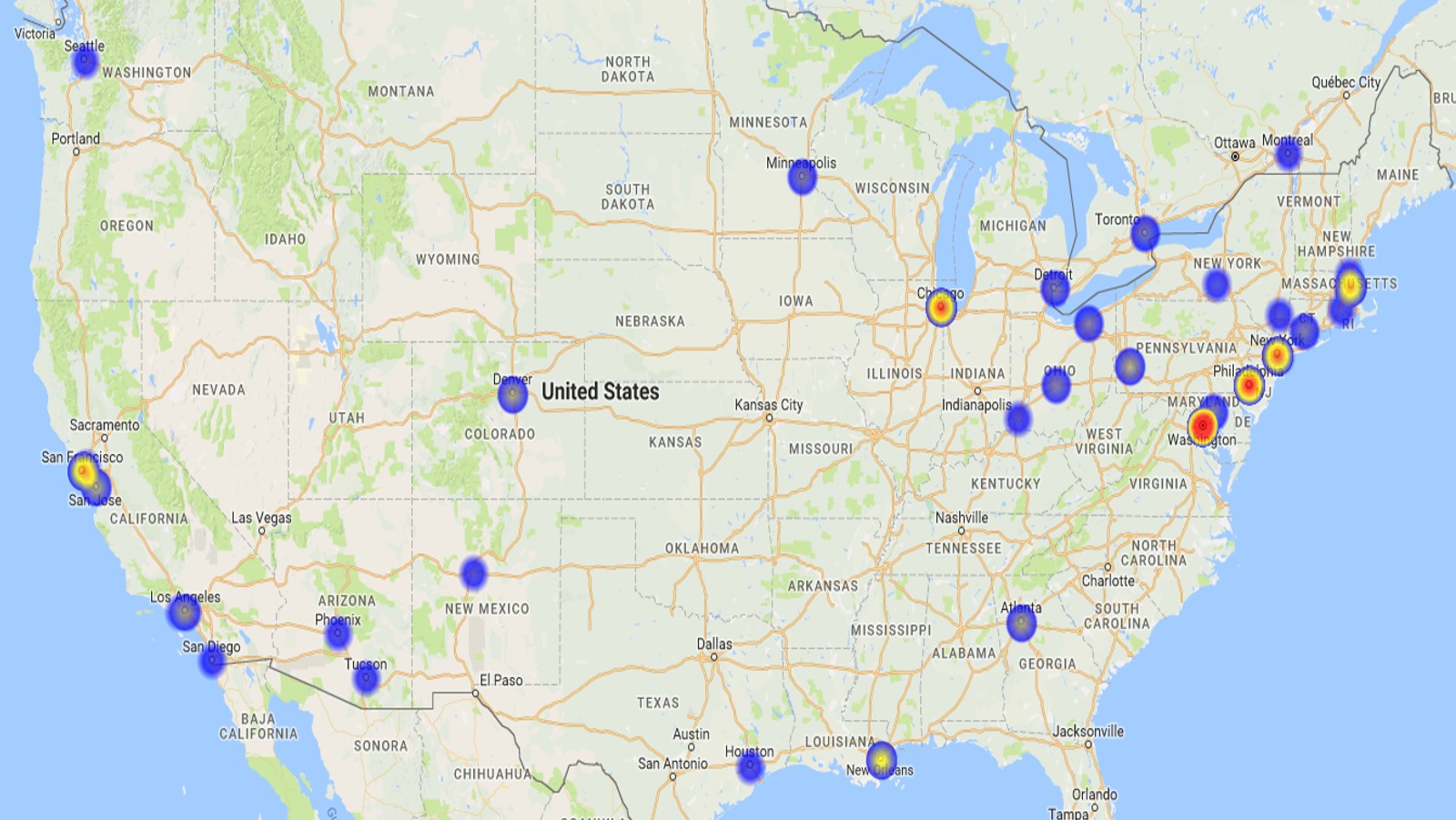
Heat Map of AAA Meetings (the map is zoomed in too close to see Mexico City, which has hosted twice).
Three Bases to Go
(This one is for me, but you might enjoy the link to the song.)
This storm it came up strong
It shook the trees
And blew away our fear
I couldn’t even hear

Jackie, rounding the bases. Three more bases to go.
Kata’s Story
We’ve gotten a lot of snow over the past week in our area, so after I got home from work this afternoon, I shoveled snow for my older neighbor down the street. As soon as I started, I heard someone yelling, trying to get my attention. It was yet another neighbor, an older woman I’d never met before, and she was unable to get her car up the steep, icy incline in her driveway.
She asked for my help, and detecting an accent, I asked where she was born. “Budapest,” she smiled. “If I had four-wheel drive, I could make it, but all I have is this shitty Kia. This driveway is terrible. When I bought this house, it was in September; if I had known how terrible it would be in the winter, I wouldn’t buy it. And I can’t leave the car here. It will slide back into the street. I also have a bad hip so it is hard for me to walk on the snow.” I chuckled at her forwardness and colorful language, especially for an older woman I just met.
I did my best to clear the driveway, chipping at the ice with a garden spade, and scattering some salt, but it didn’t work. She would attempt the climb, and then slide back down again. After several tries, she asked me to drive her car. I backed up into another neighbor’s driveway across the street to build as much momentum as possible, and it worked.
Early Romantic Love & Selecting Mates

Explorer, mess-maker
A few weeks ago, my infant daughter found a stash of old letters I’d written to my wife (longhand!) when we first started dating in college many years ago. With a big grin on her face, she pulled several of them out and scattered them all over the floor. As I began to clean up the mess, I pulled one out at random and started to read it. [Long story short: early romantic love is gross.]
The handwriting was instantly recognizable, but it had been so long since I wrote the letter that it almost seemed like I was reading someone else’s words. That would probably be true about anything I wrote that long ago, but given the tone of the letter, I assumed that it would all come back to me instantly. Some of it did, but with the passage of time, much has been forgotten. A quote from Joan Didion seems appropriate here: “I have already lost touch with a couple of people I used to be.” (But there is always room to become re-acquainted).
Our Essential, Fragile Bonds
Today would have been my brother’s birthday, and I’ve been saving this passage from Boris Pasternik’s Doctor Zhivago to mark it. Here the title character, Yura Zhivago, is speaking to Anna Ivanovna who feared she was terminally ill. He offers what he thinks happens to us when we die, and the primacy of our social connections:
“So what will happen to your consciousness? Your consciousness, yours, not anyone else’s. Well, what are you? There’s the point. Let’s try to find out. What is it about you that you have always known as yourself? What are you conscious of in yourself? Your kidneys? Your liver? Your blood vessels? No. However far back you go in your memory, it is always in some external, active manifestation of yourself that you come across your identity–in the work of your hands, in your family, in other people. And now listen carefully. You in others–this is your soul. This is what you are. This is what your consciousness has breathed and lived on and enjoyed throughout your life–your soul, your immortality, your life in others. And what now? You have always been in others and you will remain in others. And what does it matter to you if later on that is called your memory? This will be you–the you that enters the future and becomes part of it.” (Boris Pasternak, Doctor Zhivago, p. 68)
.
I still haven’t mastered the ability to completely separate the academic and the personal, and I’m not sure I completely want to. Instead of an impenetrable wall between them, perhaps, for me, there is a wrought-iron fence with an open gate. What I mean is that I often go between the two, allowing them to inform each other. The passage from Zhivago is from literature, and is not a scientific statement. But it runs parallel to some aspects of science, which seems poetic to me, particularly on a day I’m thinking of my brother.
For My Daughter
Every so often, some occurrence comes along that throws life into a new orbit. My trajectory was recently shifted by such an event – I fell in love with a girl. She’s much younger than me: not even a week old, in fact. And she happens to have half of my chromosomes, as daughters tend to do. She is healthy, and both she and her mother are doing well. I find myself carrying her around the house, just staring at her face. When she’s awake and looks back at me, which is mostly late at night unfortunately, it’s magical.
Obviously, we knew this day was coming. We’re not ready to plan her entire life out for her just yet (not until she’s at least a month old). But for a while now I’ve been thinking about what it will be like to be a father to a baby girl, and all the possibilities and challenges life has before her. She has two older brothers, who are crazy about her, but there are things that I worry about for their sister that I didn’t have to think about for them, at least not as much. Forgive me for how naïve this is about to sound because I know I’m behind the curve, but I’m trying…
 Patrick F. Clarkin, Ph.D.