In Spite of Everything

This seems relevant.

“It’s a wonder I haven’t abandoned all my ideals, they seem so absurd and impractical. Yet I cling to them because I still believe, in spite of everything, that people are really good at heart.

It’s utterly impossible for me to build my life on a foundation of chaos, suffering and death. I see the world being slowly transformed into a wilderness, I hear the approaching thunder that, one day, will destroy us too, I feel the sufferings of millions. And yet, when I look up at the sky, I somehow feel that everything will change for the better, that this cruelty too will end, and that peace and tranquility will return once more.”

Anne Frank

Friday, July 21, 1944

Related Posts

On Finding Optimism (July 2013)

Nature, Not Always Red in Tooth and Claw (January 2013)

On Optimism and Human Nature (April 2011)

Love is Wise. Hatred is Foolish.

“The moral thing I should wish to say to them is very simple. I should say love is wise; hatred is foolish. In this world, which is getting more closely and closely interconnected, we have to learn to tolerate each other. We have to learn to put up with the fact that some people say things that we don’t like. We can only live together in that way; if we are to live together and not die together, we must learn a kind of charity and a kind of tolerance which is absolutely vital to the continuation of human life on this planet.”

Peace is Rational

“I speak of peace, therefore, as the necessary, rational end of rational men.”

“What kind of peace do I mean and what kind of a peace do we seek? Not a Pax Americana enforced on the world by American weapons of war. Not the peace of the grave or the security of the slave. I am talking about genuine peace, the kind of peace that makes life on earth worth living, and the kind that enables men and nations to grow, and to hope, and build a better life for their children — not merely peace for Americans but peace for all men and women, not merely peace in our time but peace in all time…I speak of peace, therefore, as the necessary, rational end of rational men. I realize the pursuit of peace is not as dramatic as the pursuit of war, and frequently the words of the pursuers fall on deaf ears. But we have no more urgent task…Our problems are manmade; therefore, they can be solved by man. And man can be as big as he wants. No problem of human destiny is beyond human beings. Man’s reason and spirit have often solved the seemingly unsolvable, and we believe they can do it again…And if we cannot end now our differences, at least we can help make the world safe for diversity. For in the final analysis, our most basic common link is that we all inhabit this small planet. We all breathe the same air. We all cherish our children’s futures. And we are all mortal.”

Our Trivial, Different Ways of Being Human

From Carl Sagan’s “Cosmos” (p. 283):

“We have held the peculiar notion that a person or society that is a little different from us, whoever we are, is somehow strange or bizarre, to be distrusted or loathed. Think of the negative connotations of words like ‘alien’ or ‘outlandish.’ And yet the monuments and cultures of each of our civilizations merely represent different ways of being human. An extraterrestrial visitor, looking at the differences among human beings and their societies, would find those differences trivial compared to the similarities. The Cosmos may be densely populated with intelligent beings. But the Darwinian lesson is clear: There will be no humans elsewhere. Only here. Only on this small planet. We are a rare as well as endangered species. Every one of us is, in the cosmic perspective, precious. If a human disagrees with you, let him live. In a hundred billion galaxies, you will not find another.”

Astronomers using the Hubble Space Telescope have captured the most comprehensive picture ever assembled of the evolving Universe — and one of the most colourful. The study is called the Ultraviolet Coverage of the Hubble Ultra Deep Field (UVUDF) project.

The Hubble Ultra Deep Field. (Source)

“To Tame the Savageness of Man”

Let us dedicate ourselves to what the Greeks wrote so many years ago: to tame the savageness of man and make gentle the life of this world.”

–Robert F. Kennedy, on the night of Martin Luther King’s assassination (1968)

“Have I sinned?”

— Anwar Congo, The Act of Killing  (2012)

“They are souls, like us.”

— Greek fisherman Babis Manias, after saving a refugee child from the ocean (2015)
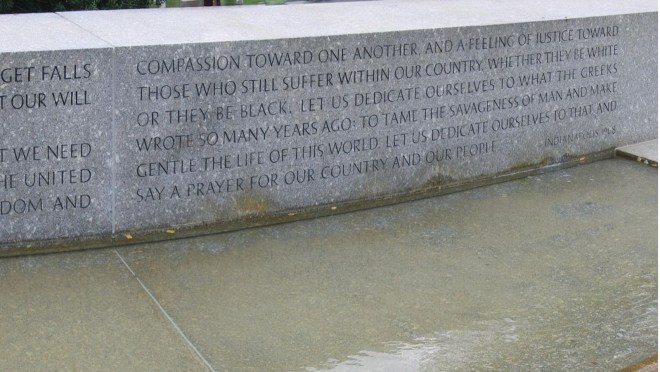
Robert Kennedy Memorial (Source)

Robert Kennedy Memorial (Source)

The inherent dilemma of all social animals is the tension between balancing two obligations — the ones we we have to ourselves, and those we have to others. One cannot be completely selfless, sacrificing everything for others. Nor can we be totally self-absorbed, ignoring the rights of others. Somewhere in that tangled mess of sometimes overlapping, sometimes competing, interests we get a sloshing mixture of cooperation and conflict.

Sloshing fluid, here representing the shifting dynamics of cooperation and conflict (Source).

As primates, humans have a deep history as social beings, probably going back tens of millions of years. According to Shultz et al. (2011), primates began their path as intensely social animals around 52 million years ago, probably as a means of protection from predators as our ancestors made the shift from nocturnal to diurnal living. One benefit of living in groups was strength in numbers, but a reliance on the group also had drawbacks, such as the need for at least some modicum of self-restraint to maintain group cohesion. After all, one cannot just do whatever they feel like whenever they want, particularly if those wants conflict with the wants of others. 

Continue reading

“The Fundamental Connection That We All Share”

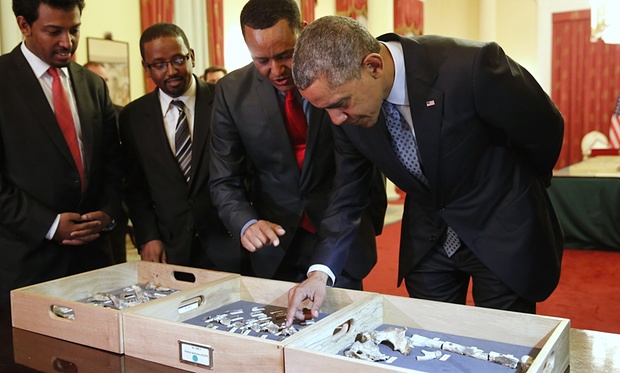
On his visit to Ethiopia, U.S. President Barack Obama viewed the fossil remains of three famous human ancestors. These included two belonging to the 3 to 3.8 million-year old hominin species Australopithecus afarensis, “Lucy” and “Selam”), as well as “Ardi” from an older species Ardipithecus ramidus. (Click here for a nice overview of our hominin family tree). Later, he said this

“When you see our ancestor, 3.5 million years old, we are reminded that Ethiopians, Americans, all the people of the world are part of the same human family, the same chain… And as one of the professors (Zeresenay Alemseged) who was describing the artifacts correctly pointed out, so much of the hardship and conflict and sadness and violence that occurs around the world is because we forget that fact.  We look at superficial differences as opposed to seeing the fundamental connection that we all share.

I think Obama got it right, which isn’t surprising, since his mother was an anthropologist. Humans everywhere belong to the same species and share common ancestry. We have our differences — some trivial, some significant to us — but our bedrock should be that shared connection. That may be an ideological approach, but the nice thing is that it’s also scientifically accurate. 

Pesident Obama touches the fossilized vertebra of Lucy, an early human ancestor in Ethiopia on Monday. Photograph: Jonathan Ernst/Reuters

President Obama touches the fossilized vertebra of Lucy, an early human ancestor in Ethiopia on Monday. Photograph: Jonathan Ernst/Reuters

Apologies Are in the Air

Hopeful news comes in threes (I think that’s how the saying goes). I just happened to come across three stories today related to apology and forgiveness.

1. In Bolivia, Pope Francis apologized for the role of the Catholic Church in the harm done to Native Americans:

“Some may rightly say, ‘When the pope speaks of colonialism, he overlooks certain actions of the church. I say this to you with regret: Many grave sins were committed against the native people of America in the name of God.”

He added: “I humbly ask forgiveness, not only for the offense of the church herself, but also for crimes committed against the native peoples during the so-called conquest of America.”

Continue reading

You Are My Cousin

There’s so many different worlds
So many different suns
And we have just one world
But we live in different ones

         — Mark Knopfler, Brothers in Arms

I had the above T-shirt custom-made a couple of weeks ago, which reads “you are my cousin” in several languages. I can’t say for certain whether all of the translations are 100% accurate, but I tried to include a diverse range of languages, including the most commonly spoken ones (and Hmong; I just had to include Hmong). I’ve yet to wear it in public, but I am curious whether people will ask me about it. My hope is that it will get people to think a little about human diversity, similarity, difference, and how we are all related.

Of course, I’m playing fast and loose with terminology here, using ‘cousin’ in a very broad evolutionary sense. From an evolutionary perspective, genetic ties (or ‘blood’) are considered important since they indicate degree of shared genetic material. However, not every society sees family relations in the same way, which is a testament to the power of culture.

Continue reading

More Reconciliation: Multiplying the Exceptions

Is it impossible to multiply the exceptions so as to make them the rule? Must man always be brute first, and man after, if at all?” – MK Gandhi (1926)


I have a soft spot for stories that showcase the better parts of humanity. This isn’t to ignore all of the horrible things that people often do to one another. In fact, I think I’ve done a decent job at describing the ways that humans can alternate between being completely horrible or wonderful to each other (ex., see “Genocidal Altruists”). Overall, I think that focusing exclusively on either the good or the bad cannot accurately do justice to describing our complexity.

With that said, here are three stories of forgiveness or reconciliation that fall on the courageous and hopeful end of human behavior. As amazing as they are, perhaps consolidating them in one place will help make them seem not so unattainable for the rest of us.

Continue reading