Biology: The Science of Exceptions

[Edit:  Every year, I get a large number of visitors from Nepal and Bhutan on this post. Welcome, everyone. I’m just curious why this seems to happen every year at the same time. Could someone please let me know? It would help me understand how this site is being used, particularly if it’s for educational purposes. Thank you.]

Biology is sometimes referred to as “the science of exceptions.” A few recently reported examples from the study of animal behavior (i.e., ethology) help to bolster that reputation.

The first instance has probably received the most attention simply because it’s just so cool. It’s a video from Russia of some type of wild corvid (others have said it is most likely a hooded crow) that appears to snowboard down a roof. It does this multiple times by sliding on a small unidentified object under its feet, picking it up with its beak when it gets to the bottom of the roof, then flying back to the top to do it again. See for yourself.

Continue reading

Empathy in Flux

All is flux.” – Heraclitus

Before criticizing someone, you should walk a mile in their shoes. That way, when you do criticize them, you are a mile away… and you have their shoes.”      –Jack Handey

Stop motion photo of a girl jumping rope. A few moments of an individual life. (Photo by Harold Edgerton).

My advisor in graduate school, Mike Little, once shared with the class that he fantasized about a machine that would provide instantaneous biological data just by having a person walk through it. As he described it, the machine would work something like an airport metal detector, only instead of revealing any concealed objects, it would assess the types of variables that biological anthropologists salivate over – anthropometrics, body composition, blood pressure, hormonal profiles, presence of infections, etc. If only…

Continue reading

Roundup (Jan 10, 2012)

I generally don’t do roundups, but below are a few things I thought worth sharing. If “a scholar is just a library’s way of making another library,” as Daniel Dennett put it, then this is what I’ve checked out lately.

#1.

Greg Downey at Neuroanthropology has begun a new series on anthropology and the evolution of human sexuality, titled: “The Long, Slow Sexual Revolution.” I’ve been looking forward to it for a few weeks since Greg first told me he was working on this, and I can say that the wait was worth it (and not just because he kindly cites some of my stuff from the Blank-ogamous series). He takes a *very* big picture approach, and what I liked most about it was that it stressed the need to confront the evidence while also keeping an eye on context and complexity, and avoiding overly simplistic narratives. As he wrote:

Continue reading

War and Opportunity Costs

In doing research on the opportunity costs of military spending for “Growing up in the Two Koreas,” I was reminded of the quote below by Dwight Eisenhower. Though I linked to it in that post, I thought it deserved more than that, so I’m highlighting it here. The back story to the speech is that it was written soon after the death of Stalin. Eisenhower thought that presented an opportunity to shift away from wasteful military spending, which could then be applied to other avenues more conducive to peace, better economic conditions, and a healthier population.

Continue reading

Growing Up in the Two Koreas

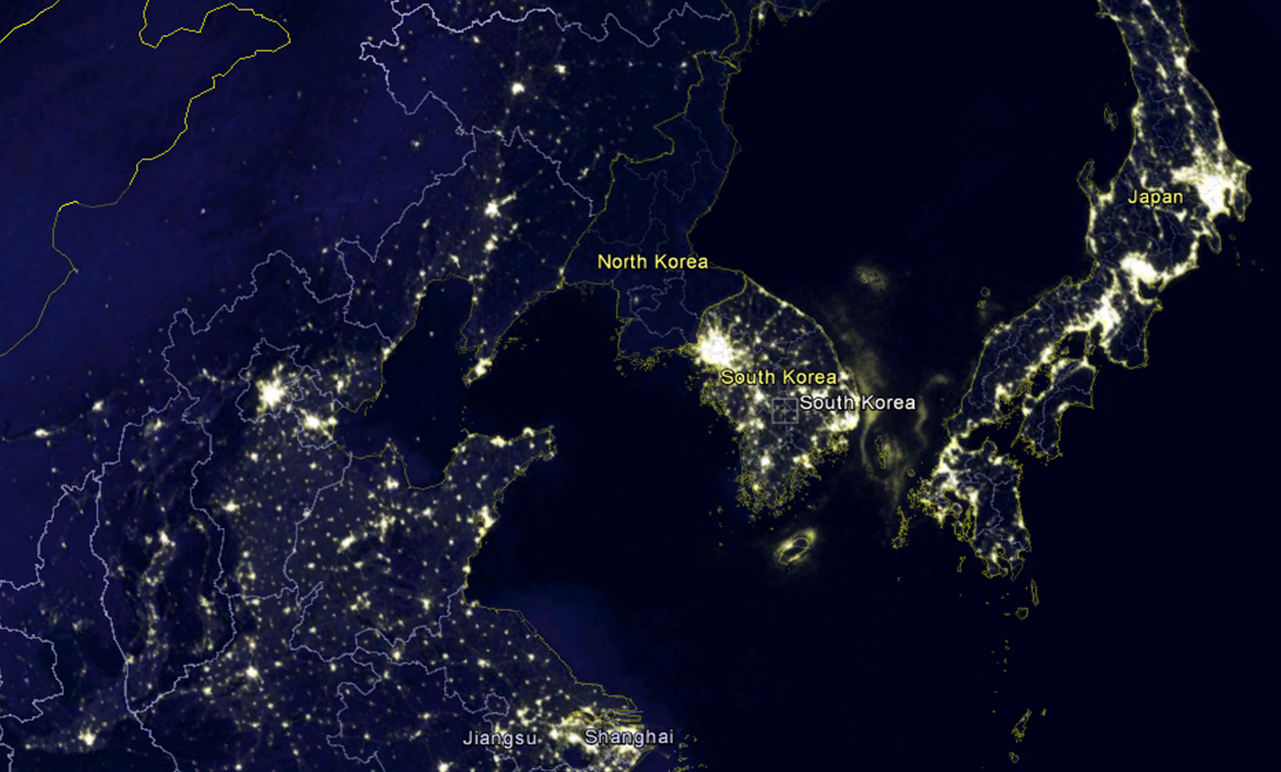
The Korean peninsula at night (google earth)

The above image of east Asia at night is worth more than a thousand words. Below the 38th parallel is the birthplace of my mother-in-law in South Korea, which is luminescent at night as the result of its highly developed economy. My father-in-law was born above that line in North Korea, which today appears to be little more than a shadow of its southern neighbor. Even if one knew nothing about history or geography, they could infer from that single satellite image that there must be a chasm in living standards on either side of the border.

A full history of the two Koreas and the war of 1950-53 is beyond the scope of this post. What is relevant is that the forces of history and politics took a once cohesive nation and cleaved it in two, having disparate effects not only on the ideologies on either side, but also on the physical bodies of the respective inhabitants. It’s almost as if someone collected a population of dandelions from a single field and then placed them in two different greenhouses for six decades, replete with different soil quality, sunlight, and temperatures, and then observed how they fared. By now, many people have heard something about how North Koreans are significantly shorter than their southern cousins, implying that, like our dandelion example, the conditions for physical growth are quite different in the two greenhouses. John McCain even mentioned this during the 2008 presidential debates to illustrate North Korea’s brutality toward its citizens. How true is this claim?

Continue reading

Awe and Wonder

I think these videos help put things into perspective. Sometimes when you’ve got your head buried in your work and/or in life in general, it’s important to step back and forget about the minutia or strife in order to remember that we find ourselves in a physically beautiful world. Two of these videos view earth from space. The third is a time lapse of various landscapes in the state of Oregon. I’ve not yet been to Oregon (though I will visit there in a few months), but the larger point is that we are surrounded by pieces of nature that elicit awe and wonder.

..

It really is a beautiful world. 

… 

Continue reading

2011 Review

Below is a quick look at the most-read posts in 2011. I’m listing some of the top ones with a brief summary, in case you’re interested. Thanks very much to everyone for visiting, and to the kind people who have shared these writings and commented on them.

Lessons from the Christmas Truce of 1914. This is easily the most widely read thing on this site, with nothing else coming close. It looks at the truce negotiated by German, French, and Scottish officers on Christmas Eve of 1914 during WWI, and the lessons we can draw upon from this and similar events to facilitate cooperation. I’m grateful to John Rennie for linking to it on his site.

Continue reading

Wonderful World

There’s not much that I need to add here. It’s just a beautiful video that Ed Yong kindly shared with his readers: 

Continue reading

The Christmas Truce, Revisited

I wrote this piece on the Christmas Truce during WWI about a year ago now, and it is far and away the most visited post on this site. Some of that comes from people looking for information on trench warfare, but the post is really about some basic tools we have as a species that facilitate cooperation, even in times that are enormously challenging and emphasize aggression.

The latest example of this comes from the Bronx and the uplifting NPR story of Julio Diaz, who confronted his mugger with compassion, and had inspirational results. Highly recommended.

….

Something similar to the story of Mr. Diaz actually happened to me when I was a teenager. Each summer from the ages of 16 to 21, I worked six days a week on a ferry boat in order to save enough money for college. It was a great job at that age, but the 12-hour days were long and monotonous, and left little time for much else.

Continue reading

Anthropology & the Art of War

When the elephants fight, it’s the grass that suffers.” 

Last week, the American Anthropological Association held its annual meeting, this year in the beautiful city of Montreal (for a couple of summaries of the conference, see here and here). Rahul Oka, from the University of Notre Dame, asked if I would like to be one of two discussants for his session (co-chaired with Nerina Weiss) “Traces of Violence and Legacies of Conflict,” and I agreed. The session was full of very erudite presenters who spoke on a range of topics related to the anthropology of conflict and violence.

But in preparation for the session, I have to admit to some trepidation because nearly all of the presenters were  ethnographers or archaeologists. And as a biological anthropologist, I felt out of my element.  The presentations were also quite diverse in geography, time period, theoretical perspective, and outcome variable, ranging from structural violence and undocumented border crossings from Mexico into the United States, to skeletal trauma in Neolithic Europe, to Kurdish survivors of torture. I found it hard to discuss the various papers with much sophistication and detail while also finding commonalities among them (and all in fifteen minutes, no less). I tried, but finally concluded that it probably wasn’t going to happen. Therefore, I decided to do a rather broad analysis of the papers, which I read ahead of time. But there was always the risk of zooming out too far, thereby making any analysis overly simplistic and virtually meaningless.

Continue reading