Early Romantic Love & Selecting Mates

Explorer, mess-maker

Explorer, mess-maker

A few weeks ago, my infant daughter found a stash of old letters I’d written to my wife (longhand!) when we first started dating in college many years ago. With a big grin on her face, she pulled several of them out and scattered them all over the floor. As I began to clean up the mess, I pulled one out at random and started to read it. [Long story short: early romantic love is gross.] 

The handwriting was instantly recognizable, but it had been so long since I wrote the letter that it almost seemed like I was reading someone else’s words. That would probably be true about anything I wrote that long ago, but given the tone of the letter, I assumed that it would all come back to me instantly. Some of it did, but with the passage of time, much has been forgotten. A quote from Joan Didion seems appropriate here: “I have already lost touch with a couple of people I used to be.” (But there is always room to become re-acquainted).
Continue reading

Finding Commonality

“Blood just looks the same/ when you open the veins.” – Karl Wallinger

From where I sit right now, it feels like a lot of social divisions are widening, many of which are intertwined: rich-poor, Black-White, Republican-Democrat, police-civilians, etc. I just want to step back a little bit to help me remember to maintain perspective. Below is a copy-and-paste from something I wrote before about my daughter (I don’t have much time to reinvent the wheel). The general sentiment is about trying to see commonality first.

[begin paste]

I’ve liked this passage from Matt Ridley’s bookThe Agile Genefor a while:

Continue reading

Strained Bonds of Affection

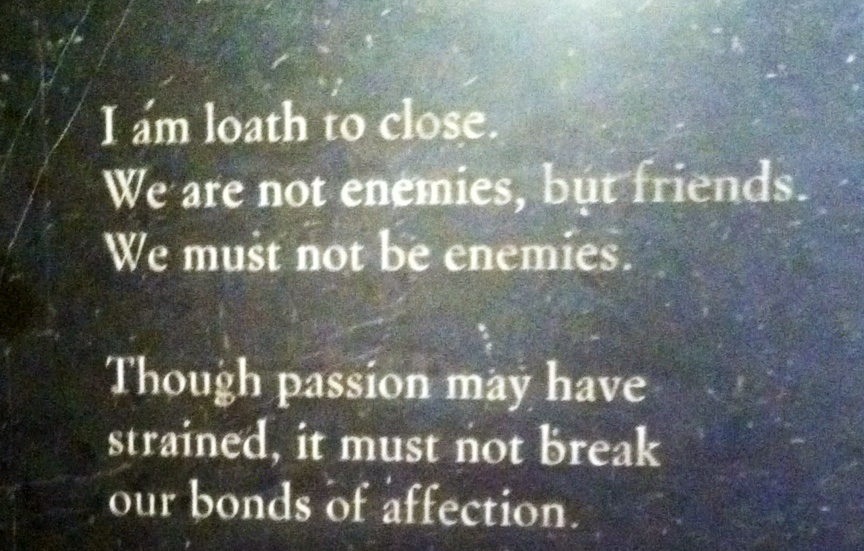
image

I took this (blurry) photo inside the Lincoln Memorial, on a recent trip to Washington, D.C. The quote comes from Lincoln’s first inaugural address, and it struck me as particularly relevant today since it seems that bonds are strained in so many places. Hopefully, we can remember that those bonds are essential, even if they don’t always come easily.  After all, we are cosmically connected primates


Bonobos

Apropos of nothing. Just felt like sharing two related images.

Bonobos, by Tim Flach. (Source)

The Kiss, by Gwenn Seemel.

The Kiss, by Gwenn Seemel. (Source)

The Kindness of Strangers

In one of my classes, we play a game known as the Prisoner’s Dilemma. It’s a fun exercise, where students earn ‘points’ by choosing either to cooperate with, or defect on, a partner. We do a few different versions of the game, sometimes with randomly assigned partners for a single round, sometimes with the same partner for multiple rounds, and with different point structures. We also use a deck of playing cards, where students choose a red card to signify defection or a black card for cooperation. All interactions are face-to-face, in real time, and as an incentive there is a prize for the two people who receive the most points.

The main rule of the game is that the number of points one earns depends not only on their own choices, but also the choice their partner makes. The game was originally named after the dilemma that two partners in crime face should they be caught. Here is Eric Johnson’s succinct explanation:

In the game, two people who committed a crime are arrested and each is placed in solitary confinement for interrogation. If one betrays the other, the first goes free while the second is sentenced to three years in prison. If they both betray one another, they each receive two years. But if they both keep silent, they receive the minimum penalty of one year each. Under this scenario, the best individual strategy would be to betray the other. 

In our classroom exercise, we invert the scenario and give positive rewards for cooperating (points), since I’m not authorized to give out negative penalties for defecting like years in prison (not that I’d want to do that, anyway). 

Scenario

You get

Partner gets

You both cooperate w/each other 

3 pts

3 pts

You cooperate, but partner defects 

0 pts

5 pts

You defect, partner cooperates

5 pts

0 pts

Both defect 

1 pt

1 pt

.

.

Continue reading

Nicholas Winton & “The Only Way Out”

“And you think it’s easier
To know your own tricks
Well, it’s the hardest thing you’ll ever do.”


On my drive into work this morning, I caught the latter half of an interview with Nicholas Winton, the “British Oskar Schindler,” who helped rescue over six hundred Jewish children from Nazi-occupied Czechoslovakia just before World War 2. Recognizing the impending danger, Winton helped coordinate a number of trains to get the children to Britain, where families had volunteered to take them in. He was later reunited with some of those children – since grown – in 1988, recorded by the BBC. It is a very moving scene, particularly considering that the last train carrying children did not make it, and all of its evacuees were believed to have died in concentration camps. 


Winton is now 105 years old, and the interviewer asked him a range of questions about his role in the evacuations, his view of himself as a hero (he wanted no part of this), and his thoughts on the changes in the world that he had seen over his very long life. Overall, he said, he was pessimistic about the way the world has changed. We’ve grown more efficient at killing each other, and seem mired in conflict and unable to get out of our own way. 

The key, or “the only way out,” as he put it, is finding commonality with each other through ‘ethics.’ As a child, he embraced his own Jewish heritage, but then converted to Christianity. Later, he grew disillusioned with religion altogether when he learned that religious figures on both sides of World War 2 were praying for their own countries to win. I wanted to quote his exact words, so I found this print version of the interview. 

Continue reading

A Chain of Ancestors

One of the better examples I’ve yet found that conveys the concept of evolution comes from the 2002 NOVA documentary “Search for the First Human.” The main focus of the video is the species Orrorin tugenensis and it’s possible place in our family tree six million years ago. However, two particular segments stand out to me, and I think do a pretty good job of conveying the idea of evolution to students.

Continue reading

For My Daughter

For my daughter, who is just about a year old…

“Stifling human potential for women, or anyone, through oppression, intimidation, or harassment is a way of creating suffering, which begets more suffering. This isn’t rocket science, but I think my life would be better if it were surrounded by as many happy, fulfilled people as people as possible, not people who feel held back.”

Patrick Clarkin's avatarPatrick F. Clarkin, Ph.D.

Every so often, some occurrence comes along that throws life into a new orbit. My trajectory was recently shifted by such an event – I fell in love with a girl. She’s much younger than me: not even a week old, in fact. And she happens to have half of my chromosomes, as daughters tend to do. She is healthy, and both she and her mother are doing well. I find myself carrying her around the house, just staring at her face. When she’s awake and looks back at me, which is mostly late at night unfortunately, it’s magical.

Obviously, we knew this day was coming. We’re not ready to plan her entire life out for her just yet (not until she’s at least a month old). But for a while now I’ve been thinking about what it will be like to be a father to a baby girl…

View original post 1,294 more words

Feeding the Voices Within Us

From a David Barash piece in the New York Times (Are We Hard-Wired for War?):

“There is a story, believed to be of Cherokee origin, in which a girl is troubled by a recurring dream in which two wolves fight viciously. Seeking an explanation, she goes to her grandfather, highly regarded for his wisdom, who explains that there are two forces within each of us, struggling for supremacy, one embodying peace and the other, war. At this, the girl is even more distressed, and asks her grandfather who wins. His answer: “The one you feed.”

I like the story and the premise, that we may have multiple internal forces or ‘voices,’ but that there is also some executive decision maker within us that can choose which ones to nurture and cultivate. However, circumstances also play a large role — socialization, perceptions of injustice, fear of insecurity, relationships with our neighbors — in which voices we listen to. The rational executive is not always in complete control; instead, it’s a complex dialogue. As Jaak Panskepp once wrote:

Despite the appeal of (the) rational fallacy, our higher brain areas are not immune to the subcortical influences we share with other creatures. Of course, the interchange between cognitive and emotional processes is one of reciprocal control, but the flow of traffic remains balanced only in nonstressful circumstances. In emotional turmoil, the upward influences of subcortical emotional circuits on the higher reaches of the brain are stronger than top-down controls. Although humans can strengthen and empower the downward controls through emotional education and self-mastery, few can ride the whirlwind of unbridled emotions with great skill.” (Panksepp, 2004: 301)


Who’s in charge here?


Reference

Panksepp J. 2004. Affective Neuroscience: the Foundations of Human and Animal Emotions. Oxford Univ Press.


Related: Tradeoffs, Happiness, & the Biology of Our Cacophonous Selves

Ehrlich on Plural Human Natures

I’ve been thinking about human behavioral complexity a bit more lately, and the persistent use of the term ‘human nature.’ That brought me to this passage from the biologist Paul R. Ehrlich in his book Human Natures (2000: 330).


“In my view, it is highly unlikely that human beings will ever create a utopia, but I think it a counsel of despair to assume that we can’t collectively do a lot better than we’re doing today. Cultural evolution led many past civilizations to extinction. Our global civilization had better move rapidly to modify its cultural evolution and deal with its deteriorating environmental circumstances before it runs out of time. Whether the natures of most of us can be changed to establish better connections among diverse groups and to take more systematic control of our cultural evolution remains to be seen. One good starting point would be to drop the term human nature in the singular form from most of our discourse and learn to think automatically of the built-in genetic and cultural plurality of human beings. Our challenge is to learn to deal sensibly with both nature and our natures — for all of us to learn to be both environmentalists and “people people.” Utopian? Perhaps. I tend to be optimistic in thinking that we can do it but pessimistic that we will do it.” 


Anthropologists might cringe at the use of ‘cultural evolution,’ which has its baggage, but Ehrlich was not promoting the idea of linear progression. As is apparent in the quote, his concern was with people taking charge of some of our larger challenges, particularly overpopulation, war, and environmental degradation. As for the matter of being optimistic or pessimistic, I suppose that’s an open question.


(Related) I’d also recommend this essay by Jason Antrosio on human nature.